Summary
- The Wall Street Journal’s reporting points to a candidate-selection and recognition-deficit explanation for Graham’s vulnerability: Donald Trump recruited her late, Graham entered without a primary-built constituency, and Annie Andrews used a $4.5 million advantage to air opposition advertising.
- Donald Trump’s falling approval could widen Annie Andrews’s issue appeal, but The Wall Street Journal’s undated and methodologically unspecified polls leave the relative effects of candidate weakness, presidential drag and straight-ticket voting uncalibrated.
- Graham can use Donald Trump’s rallies, Republican events and straight-ticket mobilization to concentrate turnout, although the reported evidence does not establish a durable personal majority.
- Annie Andrews’s spending, Donald Trump’s approval and straight-ticket behavior will shape the final margin through conversion into votes and turnout.
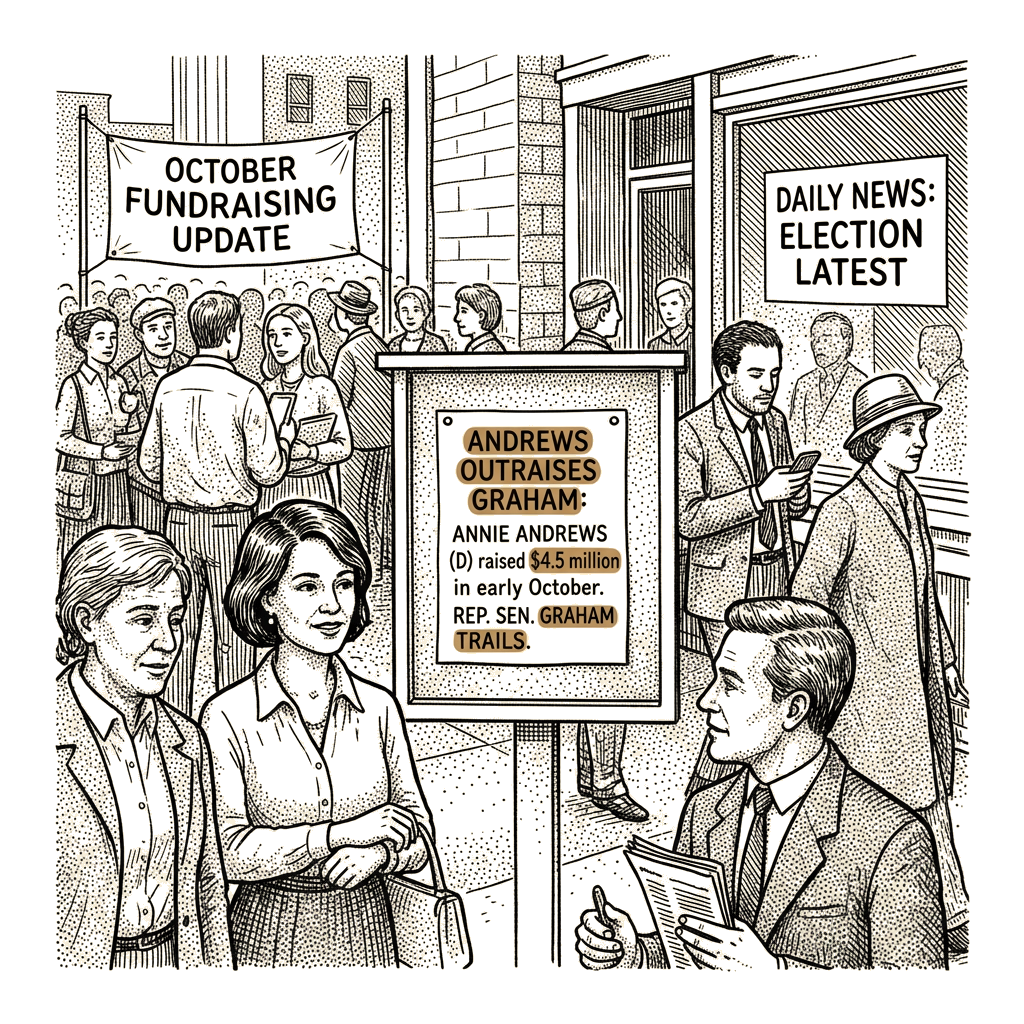
The Wall Street Journal’s account gives Darline Graham a narrower route to office than South Carolina’s partisan history ordinarily suggests. Democratic candidate Annie Andrews raised $4.5 million in the first two weeks of October, while Graham raised less than $600,000, and public and internal polls reportedly showed Graham tied with or trailing. The Journal also reported that Graham’s political fate had become tied to Trump’s, describing a progression from Trump helping Graham win the Republican primary to intervening as her campaign struggles in the general election. That reporting is consistent with a candidate who entered the general election without a constituency built around her own name. The decisive contest is not whether straight-ticket voting can preserve a narrow Graham victory—some consultants expect that outcome—but whether Graham can convert the state’s Republican baseline into personal support before Andrews’s spending and issue appeal become a statewide alternative. The account does not settle which mechanism will dominate because it provides no poll dates, sponsors, samples or margins and cannot independently distinguish candidate recognition from presidential drag, Republican turnout or crossover behavior.
Candidate selection created Graham’s recognition problem
According to Graham, her candidacy followed an Oval Office conversation during the summer, shortly after she was sworn in to finish her late brother Lindsey Graham’s Senate term. Graham said she pressed Trump to support Lindsey Graham’s Russia sanctions bill and told Trump he could blame a grieving sister for any fallout. Trump was reluctant, Graham recounted, but chuckled and told her, “You’re tough.” Trump then asked Graham to run for the full six-year term, an option she had not previously considered. Trump later halted most of the sanctions, leaving Graham privately disappointed.
The sequence provides one basis for inferring that Graham entered the general election without the donor base and name recognition usually produced by a contested primary. The record does not establish how much either asset affected her general-election prospects. Rep. Ralph Norman’s account that Trump’s Myrtle Beach appearance pushed Graham over the finish line in the primary supports the possibility that Republican voters were mobilized by the president rather than by Graham, allowing primary votes to transfer without establishing durable personal loyalty. Norman’s report that his entire family refused to vote for Graham demonstrates the possibility of candidate resistance, but it does not measure resistance across the electorate.
Recognition was also limited before the general election. People who knew Graham said she never wanted to be a public figure and usually remained behind the scenes. South Carolina political veterans said they barely knew Graham and that voters did not either. Graham said much of her time in Washington was spent serving as a senator, leaving little time to introduce herself. People close to the campaign said the loss of her brother, a primary, a runoff and the general election had left her exhausted; she described the sequence as “absolutely brutal” and said the campaigns and concurrent strain together had made the period “bad, times 10.”
Graham’s first significant debate misstep reinforced questions about candidate preparation. When asked about Taiwan, she said that “national security is not my thing,” leaving her dejected for days, according to people who spoke to her. Graham subsequently said, “I do support the military.” After winning the primary, she took debate advice from Sens. Tim Scott and Republican gubernatorial nominee Alan Wilson, increased voter contact and began studying Andrews’s record while traveling across South Carolina. Advisers said she had become more active on the campaign trail.
That go-negative response could reassure committed Republican voters more readily than expand Graham’s acceptability among voters who did not yet know her. Continued emphasis on Andrews, national Democrats and cultural contrasts without a substantive introduction of Graham’s biography and record would be an early sign of that sequence. The reporting does not establish that Graham remained in the earlier stage, but it supplies the mechanism by which the reported recognition gap could persist even as her campaign organization improved.
Fundraising problems added another constraint. Donors attributed Graham’s difficulty partly to her inexperience and partly to contributors being exhausted by consecutive races. Graham said, “Even though we’re a solid red state, it’s almost like she had an advantage.” Andrews used her funding advantage to blanket the airwaves with advertising portraying Graham as a Washington insider and as “Data Center Darline.”
The reported fundraising gap gave Graham less paid-communication capacity than Andrews. Money, however, is an input to persuasion rather than evidence of its effect: the account does not establish that Andrews’s additional spending increased visibility or converted voters. The combination of low familiarity, fundraising difficulty and reported reluctance among some conservatives provides more support for a candidate-specific weakness than the fundraising comparison alone.
Trump’s intervention supplies turnout capacity while his approval constrains it
The Wall Street Journal reported that Trump’s approval in South Carolina had fallen amid growing frustration over gasoline prices and the Iran war. That decline provides a plausible mechanism for reduced enthusiasm or increased Democratic issue appeal, but it does not establish that Trump supporters were defecting from Graham. Andrews’s campaign had so far insulated itself from the president’s name. She criticized his policies on tariffs, the Iran war and corruption while saying, “We don’t talk about him really.” Whether other candidates distance themselves from Trump would depend on how his approval moves.
Trump’s Thursday rally in Rock Hill demonstrated Graham’s access to concentrated Republican mobilization. Several thousand people attended, although part of the large arena was blocked off. Many speakers barely mentioned Graham and instead attacked Andrews and national Democrats. Trump repeatedly referred to Andrews as “Trannie Annie.” Rep. Russell Fry said, “I think highlighting her past associations has been eye-opening to voters.” Graham also sought to portray Andrews in similar terms, saying, “She’s just plain old batshit crazy.”
The rally is consistent with Trump’s personal pull drawing the crowd, but attendance alone cannot distinguish candidate preference from venue capacity, scheduling, promotion or the effect of having the president appear. The account supplies no comparable attendance baseline for candidate-only events. The event therefore demonstrates access to a concentrated mobilization opportunity, not proof of its effectiveness or of broad statewide familiarity with Graham.
The political concern around Graham was more explicit among insiders. Some Senate Republican campaign strategists and Trump advisers had privately become alarmed about her race. Several said they believed they could have found a better candidate, although Trump wanted Graham. Their accounts indicate uncertainty within Graham’s coalition but do not establish that Republican voters share their assessment.
Rep. Ralph Norman provided the clearest direct evidence for interpreting the campaign’s final posture as presidential intervention rather than consolidation. Norman said, “The reason he’s here is she’s lagging in the polls. He’s doing it because she is in trouble.” He also said, “You have to earn the vote. She hasn’t done that,” and, “The campaign has been about trying to prop up a candidate.” Norman declined to say whether he would vote for Graham after saying his family would not.
The reporting also documents presidential dissatisfaction among people considering Andrews. Paul Vining, a retired veteran who had voted for Trump three times, attended an Andrews rally after becoming disillusioned with the second Trump term. His appearance shows that at least some voters will publicly support a Democratic candidate despite previous presidential votes; it does not establish split-ticket voting or an intended Senate vote. Jennifer Lyons described repeatedly calling Lindsey Graham’s Senate office to complain about Trump and being ignored. Vining’s and Lyons’s accounts provide a trace of dissatisfaction with Trump, not direct evidence of Graham defections.
Trump’s approval can decline without producing Graham defections. Down-ballot candidates in a president’s home state can also inherit local political costs from that president’s policies even when the president’s own race is not in play. Graham’s personal standing and the Trump-centered political environment can move independently: Trump could recover while Graham remained little known, or Graham could gain credibility while Trump remained weak. Trump could also lift the Republican ticket without changing personal views of Graham, while Andrews might build support around issues that remain relevant after Trump leaves the campaign spotlight.
South Carolina’s Republican baseline supplies Graham with a floor
The Journal’s account says South Carolina has not voted for a Democrat in a statewide election in two decades and that Trump carried the state by double digits in 2024. Those facts supply a structural prior favoring Graham. They do not establish the size of her personal advantage within that Republican electorate, because a statewide partisan baseline can coexist with substantial candidate or ticket-splitting weakness.
Some consultants say Graham is likely to eke out a tight victory buoyed by straight-ticket voters. That is a reported expectation rather than an observed mechanism. The account provides no precinct results or validated voter-file evidence showing how straight-ticket and split-ticket behavior will translate into Graham’s vote, and it does not quantify how much of her prospective support depends on straight-ticket voting.
The split-ticket question applies symmetrically to both sides. Some Andrews supporters declined to display bumper stickers because they feared heckling or vandalism, largely avoided telling neighbors they were Democrats and delayed displaying a sign until the race’s final days. Their willingness to support Andrews therefore differed from their willingness to build an overt partisan identity. Republican concern about Graham could likewise affect willingness to vote for her without extending to opposition to Trump or every other Republican candidate.
Democratic persuasion also encountered resistance. Vining said, “A lot of Democrats haven’t done themselves any favors.” Prosecutor Jenny Desch said she had some luck making the case for Andrews during door knocks but that some listeners remained opposed regardless of the argument presented. Andrews’s effort to recruit Republican voters therefore operated within both a presidential-drag opportunity and a limit on Democratic mobilization.
Democratic crossover remains potential rather than measured support
Andrews has received an endorsement from former Gov. David Beasley and has circulated lists naming more than 100 South Carolina Republicans who support her. Many of the state’s top Republicans do not appear on those lists. The supporter lists are attributed to Andrews’s campaign and have not been independently verified, so their scale and representativeness remain uncertain.
Andrews’s emphasis on gasoline and diesel prices, groceries, rural hospitals and Medicaid created potential openings for voters dissatisfied with the governing party but reluctant to adopt a full Democratic identity. Her endorsements and economic message could help Republican voters separate their assessment of Trump and state politics from their view of Graham.
The account documents potential crossover support, not crossover voting. It does not establish that Andrews’s endorsements or supporter lists converted voters, and it does not measure the scale or conversion rate of crossover support. The reluctance of some Andrews supporters to identify publicly indicates both an opportunity for soft support and a social limit on turning that support into durable party identification.
Three reinforcing mechanisms remain plausible but unmeasured
One possible sequence begins with Andrews’s advertising increasing her visibility. Greater visibility could make her Republican endorsements appear more credible, and credible validation could encourage additional support. The Journal account establishes the funding, advertising and endorsements, but it does not measure any of those intermediate effects or the conversion of endorsements into votes.
Graham’s fundraising constraints permit the opposite feedback loop: fewer advertisements could produce less recognition, weaker recognition could reduce donor confidence, and reduced donor confidence could further limit campaign resources. The account does not show that this loop is dominant, and the reported increase in voter contact and debate preparation indicates that Graham’s campaign was trying to interrupt it.
Trump approval and turnout could also reinforce each other. A rally can add attention among attendees without establishing broad statewide familiarity with Graham, and the record does not measure whether Trump’s appearance increased turnout, changed preferences or merely reassured voters who were already aligned. Gasoline and grocery prices give household finances a partisan role in the race, while the Iran war is part of the reported source of presidential dissatisfaction. Both campaigns seek to translate those conditions into voting behavior, but the record does not measure the conversion.
A preregistered, pre-voting panel survey measuring Trump approval, Graham’s familiarity and favorability, Andrews’s support and intended ticket behavior could distinguish candidate-specific weakness from Trump-linked drag. A deficit concentrated among voters with low familiarity or low favorability would support the candidate explanation. Trump approval predicting Graham defections after controlling for candidate views would strengthen the Trump-drag explanation. The rally account cannot separate those mechanisms.
Evidence that Graham was closing the recognition deficit would include polling that separates her favorability from Trump’s, Republican support among voters beyond those already aligned with the campaign, and candidate-only event attendance measured under reasonably similar venue and promotion conditions. The account provides no basis for assuming Graham can close that deficit in the final days. One possible inference is that her campaign remains more likely to reassure committed voters than persuade uncommitted voters, but the record does not establish how quickly candidate recognition can change.
Four approval-and-conversion paths frame the final vote
If Trump’s approval falls and Graham fails to convert voters who evaluate her as a candidate, Andrews is positioned to become the first Democrat in two decades to carry a statewide office in South Carolina. Continued weakness in Trump’s state polling, no expansion of the top-tier Republican endorsement list and polls showing Graham’s support narrowing among voters not committed to straight-ticket voting would indicate this path.
If Trump’s approval falls but Graham converts voters based on her own candidacy, Graham can hold the seat without relying on presidential approval and turn South Carolina’s partisan baseline into a campaign asset rather than a personal one. Polling that separates Graham’s favorability from Trump’s, support among Republicans beyond those already aligned with the campaign and candidate-only attendance under comparable conditions would indicate that conversion.
If Trump’s approval stabilizes but Graham fails to convert voters independently, a tight Graham victory remains possible if straight-ticket voters offset her weakness—the outcome some consultants expect. Final fundraising filings showing the resource gap narrowing without closing, continued base-assurance messaging, no meaningful movement in the endorsement list and polling showing Graham’s support remains contingent on the president would indicate this path.
If Trump’s approval stabilizes and Graham converts voters independently, Graham could win more comfortably and establish a late-mobilization template for other Republican tickets. Polling showing independent movement in her favorability, visible campaign organization in counties where the party lacks recent infrastructure and regular opportunities for Graham to introduce her biography and record rather than contrast herself with Andrews would indicate that path.
The same interaction produces four broader combinations. Under low personal standing and a supportive presidential environment, the Republican baseline may preserve a narrow Graham victory while her personal vulnerability remains; Trump approval, straight-ticket intent, Republican turnout, Graham’s name recognition and validated poll spread would show which forces are carrying the result. High personal standing and a supportive presidential environment would give Graham a conventional statewide victory path and more room to separate the campaign from Trump; relevant measures would include high-quality polling, Graham’s favorability, Trump approval, Republican turnout and donor recovery. High personal standing and a hostile presidential environment would give Andrews a plausible path through crossover voting and economic dissatisfaction, although the statewide baseline would remain favorable to Republicans; validated polling, Trump approval, fuel-price sentiment, split-ticket intent, crossover support and Democratic enthusiasm would distinguish the competing effects. Low personal standing and a hostile presidential environment would most strongly favor an Andrews path because Trump-linked opposition and Graham’s personal vulnerability would reinforce each other; a persistent polling deficit, Republican defections, Trump approval, partisan-turnout projections and event attendance measured against a documented baseline would show that combination.
The reporting does not establish which combination is most likely. It reports only that some consultants expect a tight Graham victory carried by straight-ticket voters.
An abrupt development in the Iran war that materially changes fuel prices before voting could reset voters’ priorities and rapidly move Trump’s approval. The Journal identifies the Iran war as a source of dissatisfaction, but it does not establish that a price shock will occur. Such a development would be a low-probability, high-impact possibility that could move the race between scenarios without changing either candidate’s underlying position, making current assignments provisional.
Candidate recognition, credible local messengers, sustained voter contact and issue-based communication are less exposed to a one-day shock than reliance on a single rally or fuel-price development. If Graham gains personal credibility while Trump remains weak, the campaign can move toward candidate-centered persuasion. If Trump rebounds while Graham remains little known, additional rallies offer less protection than local validators and broader issue engagement. If Andrews’s endorsements fail to produce visible crossover support, her campaign has less reason to assume favorable opinions among Republicans have become transferable votes.
Either result would carry consequences beyond the election
During the immediate election period, Andrews has greater paid-advertising capacity, although the account does not establish how much visibility that spending produces. Graham retains rallies, endorsements and party events for concentrated mobilization. Trump’s appearance may reassure Republican voters, but it also places greater attention on the president whose approval The Journal reports has declined.
Over the short term, from months to one year, a narrow Graham victory would provide immediate relief to the state party and Trump while leaving questions about Graham’s personal support and future primary vulnerability. An Andrews victory would constitute a statewide Democratic breakthrough and intensify debate within the Republican party over candidate selection and presidential endorsements. The reluctance of some Democratic supporters to identify publicly would complicate the conversion of crossover support into durable party identification.
Over the medium term, from one to five years, a Graham victory would place a Republican senator in office but, if won chiefly through party and presidential mobilization, could leave her personal support less developed. An Andrews victory would give Democrats an advocate for gun-safety policy, rural health care and Medicaid protection. Either result would elevate the campaign’s positions in national party messaging, although the larger institutional effect would depend on the Senate’s contemporaneous composition.
Over the long term, five years and beyond, a Graham win might validate a model of party and presidential mobilization while exposing the model’s limits if the margin is narrow. An Andrews win could make South Carolina a recurring Democratic target and alter recruitment patterns on both sides. More broadly, the result could affect how the parties understand the durability of Trump-aligned voting outside his strongest constituencies.
The horizons pull in different directions. Trump’s intervention may maximize short-term turnout while leaving Graham less prepared for a future contested nomination. Straight-ticket voting may preserve a Republican senator without producing a durable personal majority, while a Democratic breakthrough could energize the state party but remain vulnerable if crossover supporters remain reluctant to identify publicly.
A Graham result could provide evidence about Trump’s ability to carry Republican candidates in South Carolina, while an Andrews victory could affect national assessments of Democratic geographic and demographic durability. Relevant social conditions include Graham’s low familiarity, crossover supporters’ private reluctance to identify openly and the campaigns’ use of social and cultural issues. Broadcast advertising represents the principal technological condition because it can reach voters statewide. Economic conditions include fuel and grocery prices, rural-hospital and Medicaid concerns, donor exhaustion and the resulting fundraising gap. The article identifies no environmental controversy as a material driver, so the record supports no separate environmental explanation. Political conditions include Trump’s approval, the state’s voting history, candidate endorsements, ballot behavior and the mobilization capacity of the state party.
Several evidence gaps prevent a calibrated forecast
The Journal’s account does not define whether Graham’s political fate being “tied to Trump’s” means electoral dependence, candidate substitution or another political mechanism. Fuller polling, campaign evidence or direct reporting would be required to distinguish among them. The polls have no disclosed dates, sponsors, samples or numerical margins, so the tightness of the race cannot be calibrated independently.
October fundraising totals are supplied without later filings, leaving the size and trajectory of Andrews’s resource advantage unmeasured. Later filings could establish whether the gap persists, but they could not establish whether either campaign converts resources into votes. The account also supplies no comparable attendance baseline, county-level returns, validated split-ticket data or canvass results. Those omissions leave untested whether skeptical Republicans can be persuaded to support Graham and whether crossover voters split their ballots in ways that alter the broader ticket.
The record does not establish that Andrews’s spending increased visibility, that visibility made endorsements more credible or that endorsements converted voters. The scale and conversion rate of crossover support remain unmeasured. The evidence also does not establish how quickly a candidate-recognition deficit can change during a final-week campaign, leaving the strength of forecasts about Graham’s ability to close the deficit indeterminate.
External verification of the supplied article’s fundraising figures, rally attendance, two-decade statewide-office claim and Trump’s double-digit 2024 formulation remains unresolved. The Beasley endorsement has additional supplied support, while the list of more than 100 Republican supporters remains candidate-reported.
The decisive question is which conversion becomes stronger: Annie Andrews’s spending into a governing alternative, Trump’s approval into turnout, or straight-ticket behavior into Graham’s margin. Andrews has the greater paid-communication capacity; Graham has the stronger institutional route to survival in South Carolina. Until those conversions can be measured, the reported evidence identifies a close race shaped by an unusually entangled combination of candidate recognition, presidential approval and ticket behavior.
Analytical techniques used in this piece
This analysis applies the methods below. Each links to a short, plain-English explainer you can read and reuse.
- Consequences & Sequels
- Plays a decision forward to its first- and second-order consequences.
- Process Tracing
- Reconstructs the step-by-step causal pathway of a specific historical event.
- Scenario Planning
- Builds a small set of distinct, plausible futures to plan against.