Summary
- Rahm Emanuel used a Nov. 4, 2026 NPR interview to press Democrats who took control of both chambers of Congress to make lobbying and ethics reform the first-session deliverable, ranking it ahead of a third impeachment of President Trump.
- The interview supplies a specific electoral mechanism for that ordering — three narrowly decided seats Emanuel named — and a stated means-end relation between oversight hearings and legislation, the two strongest items in the record for a coalition-consolidation account of the agenda.
- Emanuel’s 2006 reform precedent is the most explicitly stated rationale in the interview and the least independent, recording what Emanuel believes about sequencing rather than evidence that the sequencing works.
- The interview does not address what happens if the new majority cannot deliver, the condition on which its central forecast depends.
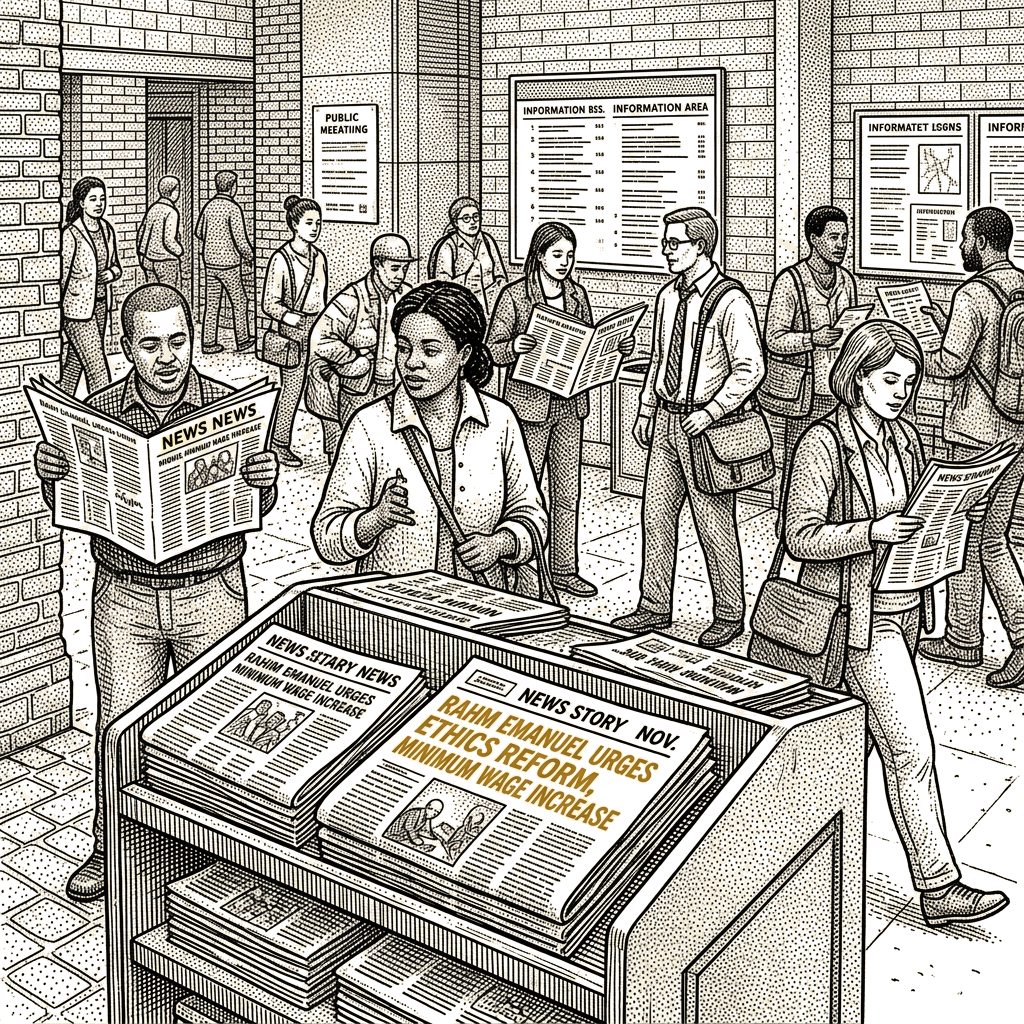
In an NPR interview published Nov. 4, 2026, Rahm Emanuel told host Ailsa Chang that Democrats who took control of both chambers of Congress should spend their first session on lobbying and ethics reform, a minimum-wage increase, restricting and repealing many tariffs, and restoring some of the healthcare cuts made to Medicaid and the ACA exchange — and declined to endorse a third impeachment of President Trump. Chang framed the stakes as the “blue tsunami” that swept Democrats into control of both chambers, which she said would give the party new power to check President Trump for the last two years of his term. Emanuel, who served as Chicago’s mayor, a congressional representative and chief of staff to President Obama, called the result a repudiation of the Republicans rather than a vindication of Democrats, and said the party’s task was to turn an electoral coalition into a governing coalition. The interview’s evidentiary weight is uneven across the outcomes it discusses: the ethics-statute path carries the strongest documented advocacy and the weakest independent corroboration, and the interview contains no base rate for either of the two questions its forecast turns on — how often a first-session unified government enacts an ethics package of this scope, and how voters have treated impeachments pursued by a House majority.
The four outcomes in play
Four outcomes are in play, and the interview’s evidence does not reach them equally: a lobbying-and-ethics statute advances, the outcome Emanuel urges; oversight hearings proceed without converting into legislation; a third impeachment effort against President Trump proceeds; or the majority’s internal arithmetic fails and none of the above is decided.
On the first, Emanuel’s position is documented in the interview itself. He was categorical that “the hearings are not the end in themselves. They’re a means towards lobbying and ethics reform,” and that a majority stopping at hearings would have “fallen short.” Asked directly whether Democrats should try to impeach Trump a third time, he declined to endorse it and returned to lobbying and ethics reform.
On the interview’s own evidence, the ethics-statute outcome carries the strongest documented advocacy and the weakest independent corroboration; the hearings-only outcome is the one Emanuel concedes would have “fallen short”; the impeachment outcome is argued against by Emanuel and assessed by no other voice in the record; and the fourth outcome — the majority failing to act at all — is the condition the interview does not address.
No base rate for either question appears in the interview. The weighting among these outcomes is a judgment, not a measured rate, and the conclusions hold conditionally on it.
The ethics package as described
The ethics package Emanuel described would cover all three branches of government: a ban on stock trading, a ban on participation in prediction markets, mandatory retirement or term limits, a mandatory blind trust, and what he called the Kushner rule, barring officials from taking foreign investments and money while in government and for two years afterward.
The interview does not establish whether that rule would be drafted as a general prohibition or as a named one, and it does not establish that the term-limits and blind-trust provisions would be introduced as described. The same unresolved drafting question attaches to each element of the package, and the interview settles it for none of them.
Oversight as means, not end
“I’m all for the hearings. Follow the money,” Emanuel said, adding that “the hearings are not the end in themselves. They’re a means towards lobbying and ethics reform,” and that a majority that stopped at hearings would have “fallen short.” Chang noted that incoming House oversight chair Robert Garcia posted “lawyer up” on social media the night before, and Emanuel said he was for that — placing hearings among the means rather than as the term of the session.
The seat arithmetic cuts both ways
Hearings-first and impeachment-first carry costs concentrated in seats decided narrowly. Emanuel’s framing that “This was a repudiation of the Republicans, not a vindication of us” narrows the mandate and therefore argues against the maximal use of power.
The list Emanuel told Democrats to think about: “the Kansas senator,” Nancy Lacore “in the Charleston, South Carolina, district that flipped,” and Sean McCann, “who just won by 300 votes in western Michigan.” Three members, selected by the person making the argument. The margin they carry cuts in both directions: a caucus this narrow needs a deliverable that reads as economic change rather than a partisan fight, and a caucus this narrow may also lack the votes to pass an ethics package of the scope Emanuel described — the same arithmetic he invoked for Hakeem Jeffries, that “he has a significant majority where no one element can hold him hostage,” contrasted with recent Republican speakers who had been “held hostage by three members.”
Two evidence items behind the ordering
That ordering rests on two evidence items. The first is Emanuel’s account of the previous cycle. He said he had worked with Senator Obama, John McCain, Russ Feingold, Marty Meehan and Chris Shays on the last major lobbying and ethics reform, passed 20 years ago, and argued the new majority should use its term the same way, noting that after the 2006 result, “President Obama gets elected.” The interview reports Emanuel’s recollection and the sequence he draws from it. It does not report evidence that the reform produced the 2008 outcome, and the record contains no comparison case — a majority that chose hearings or impeachment over legislating, and what followed.
Because the analogy is his own, it is evidence of what he believes about sequencing, not evidence that the sequencing works. It also cuts across the other accounts rather than competing with them: a template in which reform-first precedes a presidential win is available both to a coalition manager and to a candidate.
Remove the 2006 precedent and the case that an ethics statute outperforms an impeachment with the electorate rests entirely on Emanuel’s hand-picked list of vulnerable members. Remove the list and it rests on one cycle Emanuel participated in. Neither item is corroborated elsewhere in the record, and each becomes the whole of the argument when the other is set aside.
Competing accounts of the agenda
More candidate explanations are available than the one Emanuel offers on the record. A coalition-consolidation account holds that the agenda is selected for its effect on the marginal districts that produced the majority. A positioning account holds that the agenda distinguishes its author within his party ahead of a future contest. A null account holds that no unified strategy is present — that the agenda is an accretion of positions held independently of this election and would have been offered after any result. An analogical account holds that the agenda is a template transfer from the 2006 cycle.
Three further candidates address less of what the interview contains. An arithmetic account — the operative variable being the size of the majority and its effect on a speaker’s control — describes internal party mechanics rather than why these four items and not others; Emanuel’s own terms for it were the Jeffries quotation above. A targeting account bears on how the ethics package would be drafted rather than on why it was proposed: whether the rule Emanuel described as the Kushner rule is written as a general prohibition or as a named one is a design question the interview does not answer, and both readings are available from the text. A media-cycle account — the interview as the political act and the agenda its occasion — is not testable against anything the interview contains.
The strongest evidence in the record for coalition consolidation is the triad of seats above — a specific mechanism, not a slogan — together with the oversight means-end relation Emanuel states directly.
The positioning account is neither confirmed nor excluded, and the interview’s most conspicuous item bearing on it is close to non-diagnostic. Chang noted there was “no secret” that Emanuel was personally exploring a run for president in 2028 and asked whether the election results pushed his decision; he said no, and when pressed replied: “To get off this interview.” A politician declining to discuss a prospective candidacy is close to equally likely whether or not the agenda serves a positioning function, so the non-answer barely moves the estimate in either direction. The account survives as an untested possibility rather than as a demonstrated function of the four proposals. What bears on it, modestly, is Emanuel’s accountability line — “in that case, they mainly hold the president, historically” — together with the demand that the party “deliver change with speed” and his summary that “the first eight letters of progressive is progress, not perfection.” An agenda pitched at deliverable, popular items, sitting adjacent to an unresolved 2028 question, is compatible with coalition consolidation and with positioning at the same time; the two are not exclusive, and nothing in the interview forces a choice between them.
The null account has partial support and partial exposure. Emanuel’s work on the 20-year-old reform makes continuity a live explanation for the ethics item specifically. His defense of a long record of criticism of progressive politics, including “identity politics actually divide people and break them off rather than finding unifying economic values and social values that unite,” is likewise presented as a settled position rather than a response to the result the interview followed. But the minimum wage, tariff, and Medicaid and ACA items are presented in the interview as proposals made in this conversation, and the article supplies no earlier date for them. The null therefore covers part of the agenda, not the whole of it.
The 2006 analogy is the account with the most explicit statement and the weakest independence.
Two features of the interview sit awkwardly with the consolidation account and are the best available discriminators inside the interview. The first is the identity-politics passage and the Mo Udall line — “what’s the difference between a cactus and a caucus? In a cactus, the pricks are on the outside” — neither of which is a first-session deliverable. The second is the Jeffries arithmetic, which does double duty as a governing-capacity argument and as a claim to having read the majority’s structure correctly. Material that does no work for coalition consolidation is not thereby evidence for positioning; it is evidence that the agenda and the interview are not the same object, and that an account covering only the four proposals will leave part of the interview unexplained.
The economic agenda, item by item
On the wage, Emanuel said “while prices are up, what hasn’t gone up? The minimum wage in 20 years.” On coverage, he proposed restoring some of the healthcare cuts made to Medicaid and on the ACA exchange “so people get healthcare in America.” On tariffs, he proposed restricting and repealing many without further specification in the interview.
Emanuel described the November result as “a repudiation of the Republicans, not a vindication of us,” and cast the task as turning an electoral coalition into a governing coalition — the party’s job being “to deliver change with speed.”
On the party’s internal divisions, Emanuel said he believed Hakeem Jeffries could bridge the fault lines if he became speaker, while noting the count was still running. He invoked a line he attributed to Mo Udall — “what’s the difference between a cactus and a caucus? In a cactus, the pricks are on the outside.” He defended his own record of criticism of identity-focused politics, saying he had been critical “because in our successful efforts, we have worked to find things like economic security, education, things that bring people together,” and said that the success of Presidents Obama and Clinton “wasn’t figuring out how to divide the country, but it was actually how to unite the country.”
The forecast and its stated basis
The interview contains a prediction stated by Emanuel rather than measured by the network: that the electorate will read an ethics bill as change and an impeachment as more of the same.
“If you do impeachment, the coalition that elected you are going to say, eh, it’s just more of the same,” he said. “You do an ethics bill, they’re going to say, that’s a change I voted for.”
The second sentence is a prediction about voter response offered without support in the interview; it is a stated belief rather than evidence for any account that contains it.
What the record cannot separate
What would separate the surviving accounts is not in the article: whether Emanuel endorses or contests the incoming leadership’s own first-session sequencing; whether the ethics package is introduced as described, including the term-limits and blind-trust provisions; and how the named rule is actually drafted. The article does not state whether Emanuel endorses or contests the incoming leadership’s own first-session sequencing, so the discriminating observation cannot be supplied from this record.
Absent those observations, the survivors stand at unequal strengths. Coalition consolidation is the best supported — the only account for which the interview supplies both a specific electoral mechanism and a stated means-end relation between oversight and legislation. The 2006 analogy is the most explicitly stated and the least independent: it records what Emanuel believes about sequencing, not that the sequencing works, and it cuts across the other accounts rather than competing with them. The null accounts for part of the agenda — the ethics item has a documented 20-year lineage — and not the whole of it. Positioning remains live and untested.
Unresolved verification
Three claims were queried externally with no results returned: Sean McCann’s reported 300-vote margin in western Michigan; the identification of the 20-year-old lobbying and ethics reform with a specific legislative chronology; and Robert Garcia’s reported “lawyer up” post. All three are carried as article-supported under supplied-source priority, with external verification unresolved. The article’s statement of a 2006 sequence is presented as Emanuel’s own recollection rather than as independently established chronology; the “reported” hedge on the Garcia post is preserved.
The condition the forecast depends on
What the interview did not settle is the condition its central forecast depends on: what happens if the new majority cannot deliver. Emanuel named a short agenda — ethics reform, the minimum wage, tariffs and health coverage — while insisting the first session’s work should not stop at hearings, and returned to the members he told Democrats to think about: the Kansas senator, Nancy Lacore in the Charleston, South Carolina, district that flipped, and Sean McCann, who just won by 300 votes in western Michigan. As the article puts it, “What the interview did not settle was what happens if the new majority cannot deliver.”
Analytical techniques used in this piece
This analysis applies the methods below. Each links to a short, plain-English explainer you can read and reuse.
- Bayesian Hypothesis Network
- Updates the probabilities of competing hypotheses as evidence accumulates.
- Bayesian Reasoning
- Starting from base rates and updating beliefs proportionally as evidence arrives.