Summary
- The Senate’s Bipartisan American Affordability and Jobs Act would narrow federal environmental review and legal remedies while leaving infrastructure outcomes dependent on agency decisions, grid conditions, litigation, and project mix.
- Rhodium Group and Purdue engineering professor Kevin Kircher modeled opposite emissions outcomes, with Rhodium assuming 85% renewable capacity additions while Kircher relied on updated grid-operator queues.
- Federal agencies, tribal governments, courts, project sponsors, grid operators, and states would have to coordinate revised review, consultation, queue, and enforcement practices after Baaja advances.
- Federal agencies, courts, project sponsors, and grid operators would produce the first implementation evidence through records of project coverage, review times, consultation, challenges, queue withdrawals, and actual grid connections.
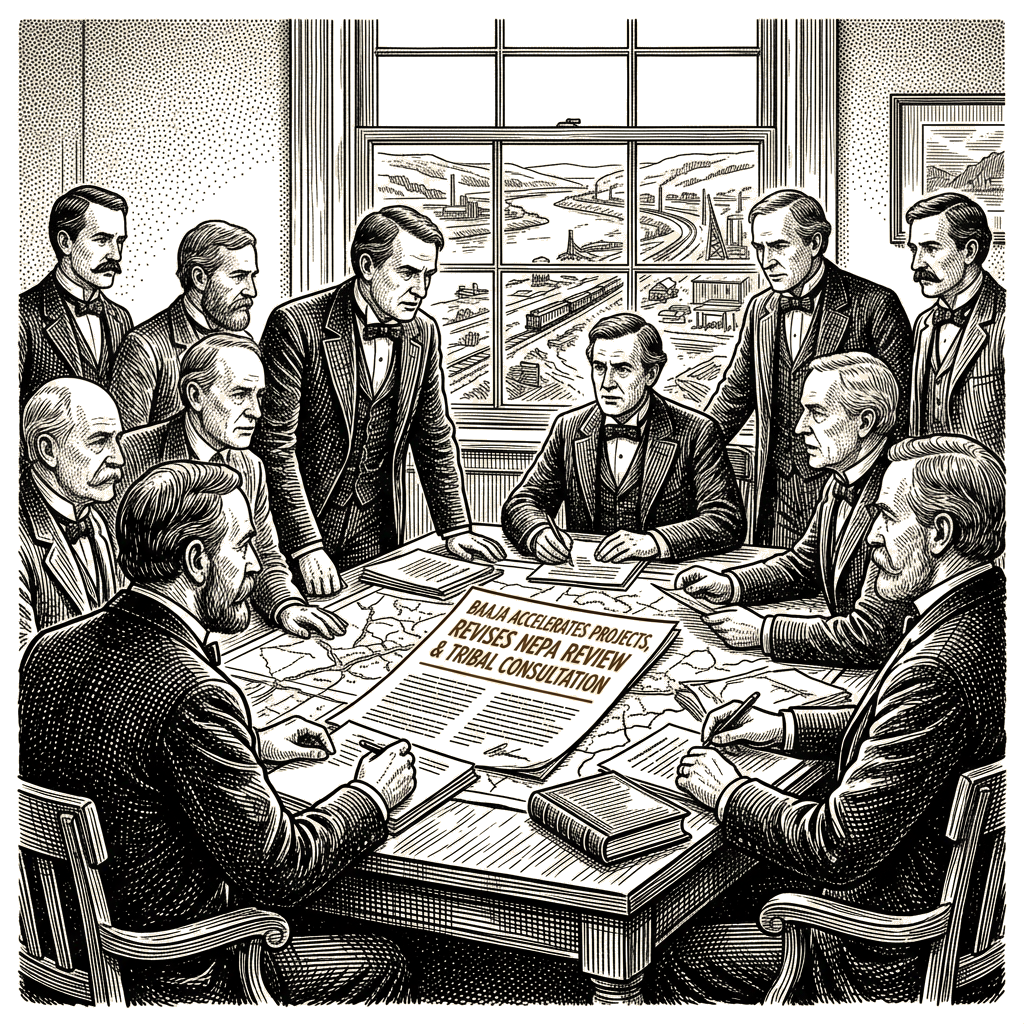
According to The Guardian, the US Senate was preparing an initial procedural vote Monday on the Bipartisan American Affordability and Jobs Act, a 417-page bipartisan bill that sponsors say would make large projects easier to permit. Democratic Sens. Martin Heinrich and Sheldon Whitehouse and two Republican senators sponsored the measure; Heinrich said the sponsors had the votes, and President Donald Trump urged senators to vote for it. According to The Guardian, Baaja would narrow which federal actions trigger National Environmental Policy Act review, limit tribal consultation and other environmental procedures, and effectively eliminate courts’ authority to enforce NEPA. That combination could accelerate decisions without determining which infrastructure gets built: Rhodium Group’s analysis found domestic emissions would fall under a renewable-heavy assumption, while Kircher’s model found they would rise. The first evidence would therefore come from administrative and legal records, not from the statutory text or an aggregate emissions forecast alone.
What Baaja would change
Baaja contains two reforms that are often grouped under the broader label of permitting reform. The first would shorten the time required to decide a project. The second would reduce the number of projects, decisions, and legal participants subject to review. Baaja does both, which makes the bill broader than a change in administrative scheduling. It would alter who must supply information, which governments must participate, which projects encounter environmental procedures, and whether affected parties can seek judicial review.
The bill also crosses several neighboring legal and administrative systems. NEPA’s major-action trigger determines whether environmental review begins. Tribal consultation determines which governments must be consulted and when. The National Historic Preservation Act governs review of historic properties, the Clean Water Act governs specified water permits, and the Endangered Species Act governs species-related review. Standing and judicial enforcement determine whether a decision can be challenged. Grid-interconnection administration determines whether a generator or storage project can obtain network access.
Those systems perform different functions. NEPA, consultation, historic-property review, water permitting, and species review concern legal authority, public information, participation, and accountability. Interconnection queues concern the operation of an electric network. A narrower NEPA trigger cannot determine whether a generator leaves an interconnection queue, and queue reform cannot determine whether a pipeline or transmission line receives NEPA review. Baaja packages these functions together even though one does not substitute for another. Ben King of Rhodium Group treats interconnection reform as central to unlocking transmission; Earthjustice Action president Abbie Dillen said the measure “creates a very accelerated fast track for gas pipelines.”
As described in the source article, Baaja’s central legal move is to reduce the reach of general environmental review while reducing the risk of delay through environmental litigation. The immediate purpose sponsors describe is predictable project authorization: a developer should be able to identify the applicable review path and proceed once the government has the information required for a decision. Another defensible purpose would place greater weight on environmental information and tribal participation, treating speed as one constraint among several rather than the governing objective.
The two diagnoses differ over what current procedures contribute. Proponents describe environmental review as a source of delay that has sometimes been used to impede important projects. Opponents describe review, consultation, and litigation as mechanisms for producing information and assigning responsibility before federal approval. The source article does not measure how much construction delay is attributable to NEPA rather than financing, land, engineering, labor, transmission, or interconnection administration.
Dillen acknowledged that NEPA has been used to slow important projects and that the Supreme Court has already reformed and weakened the law significantly. The article identifies none of those reforms, however, and provides no measured comparison between prior changes and Baaja. The record therefore establishes a concern about delay but no performance baseline against which to judge another reduction in review.
The article also does not specify whether Baaja’s tribal-consultation change would alter timing, triggers, remedies, or another feature. That omission allows sponsors’ statement that last-minute revisions ensured consultation and Indigenous groups’ description of a weakened obligation to coexist in the current record. Mark Macarro, president of the National Congress of American Indians, called the measure “an existential threat to Indian country.” House minority leader Hakeem Jeffries said the bill “falls short in several areas,” including its failure to protect tribal sovereignty.
Neither speed nor information is shown to be wholly absent from current law. A narrower trigger would not necessarily produce predictable authorization if agencies continue to interpret the remaining procedures differently. A shorter review would not preserve the information and participation functions if projects with significant effects fall outside the revised perimeter.
The reach of that perimeter would extend well beyond energy. The article reports that Williams Companies’ Constitution gas pipeline could benefit from changes to Clean Water Act procedures. New York denied the project’s water-quality permit in 2016, and the company revived the project under the Trump administration. Western States and Tribal Nations said it wants to build gas pipelines to serve domestic datacenters and export liquefied natural gas from the West Coast. Separately, the ACLU said Baaja could accelerate plans to convert 11 mega-warehouses into ICE detention centers; attorneys had used NEPA to block the administration’s conversion plans. One legal mechanism would therefore reach projects with different environmental effects, public purposes, and opportunities for participation.
Why faster approval would not settle emissions
Rhodium Group’s analysis found that domestic emissions would decline if Baaja passed. The model assumed, based on a 2025 report, that 85% of capacity added to the grid would be renewables. Ben King said the economics show an impressive decrease in the cost of renewables while fossil fuels are not getting any cheaper. He also noted that the American Petroleum Institute might expect more room for fossil-fuel growth.
Kircher’s model reached the opposite conclusion: domestic emissions would rise. Kircher cited grid operators’ removal of redundant and speculative offers from their queues and pointed to the PJM queue as of 3 August, which The Guardian reported “looks quite gassy.” He described the optimistic case for Baaja as a level playing field in which clean energy wins on economics, but said that understanding was outdated.
The models had not had time for peer review since the bill was introduced on September 30. Kircher described the task of mapping the legal text as “extremely complicated and full of uncertainties.” The source does not disclose enough to determine whether the forecasts differ because of project mix, queue composition, model boundaries, or other assumptions. Nor does the source establish how many projects would be built under either legal regime.
That gap matters because observations about a queue do not establish the final build mix. Queue cleanup can change the relationship between an earlier snapshot and the projects that remain, but only actual construction and connection establish which generation fleet operates. Rhodium’s assumption and Kircher’s queue evidence describe different portfolios; neither resolves the other without reconciled project-level data.
The source reports that 2,060 gigawatts of generation and storage capacity were awaiting grid connection at the end of 2025 and that interstate transmission lines can take a decade to build. The queue total indicates potential delay, not a direct measurement of projects that would be completed if one statute changed. The article does not state how many entries represented viable projects, and queue reform cannot supply missing transmission or make an uneconomic project viable.
Baaja would determine more quickly which projects encounter which review requirements, but Baaja would not determine whether renewable or gas capacity gets built. If the viable queue remained renewable-heavy, the procedural changes could accelerate the technologies proponents describe as competitively advantaged. If gas-heavy projects dominated, the same changes could accelerate pipeline, LNG, and datacenter-related infrastructure. Faster approval could also reorder projects within a queue without changing the amount of transmission available to connect them.
The emissions result also could not be assigned to NEPA alone. Baaja combines an NEPA trigger change, consultation limits, changes under three other statutes, standing restrictions, limits on executive-branch involvement, and queue reform. Any subsequent change in emissions could reflect several provisions, the composition of projects, or conditions outside the legal process.
A causal assessment would require a pre-Baaja baseline organized by project type, federal-action category, and review process. A comparable post-Baaja cohort would then have to be compared with projects exposed to the revised rules and, where feasible, projects outside them. Without that baseline, faster post-enactment decisions could reflect a change in project mix, while lower emissions could reflect differences in which projects actually connect.
The design choices embedded in the proposal
Baaja as described in the article is one point in a broader design space. The following are possible revisions, not provisions reported in the bill.
Baaja as configured. Narrowing the review perimeter and reducing legal exposure could give sponsors more predictable authorization requirements. Projects outside the revised perimeter could receive less environmental information, consultation, and recourse. Implementation would require Congress to define any new federal consultation duties, responsible agencies to issue guidance and apply those duties, sponsors to revise project forecasts, tribal governments to participate as consultees and protocol partners, and courts to interpret the revised standing rules. States, grid operators, and advocacy organizations would also have to adapt to a changed federal baseline. The central implementation problem would be coordination among those systems, not enactment alone.
Scope plus deadline. Congress could define qualifying major federal actions more precisely and pair the revised trigger with procedural deadlines and completeness rules. Sponsors would gain a more predictable path through agencies. The cost would be pressure to resolve environmental information within shorter periods, along with the possibility of less review for projects whose effects had previously been considered significant.
Layered obligations. Congress could narrow NEPA’s role while retaining environmental disclosure, alternatives analysis, and tribal consultation as separate duties with independent enforcement mechanisms. The process could become more focused, but the statutory design would require greater coordination, and projects could remain contested through neighboring laws.
Preserved coverage with faster procedure. Congress could seek greater throughput without reducing the population of projects and effects subject to information-gathering and consultation. NEPA and consultation would retain a shared-information and conflict-prevention function rather than operating only as potential points of delay. This approach could produce a more predictable review universe without excluding potentially significant effects, but it would abandon Baaja’s broad reduction in legal obligations and would not address every source of delay. Implementation would require agency agreement on thresholds and timelines, common project data, sufficient review capacity, explicit tribal-consultation protocols, and an independent route for resolving disputes without recreating the original delays. Evidence would be needed to show which procedural changes improved completion times rather than merely moving administrative work earlier.
Queue and transmission reform. Congress could reform interconnection administration and transmission siting while leaving NEPA’s scope unchanged. That approach would directly address the largest delivery constraint described in the source, but it would leave complaints about environmental review, standing, and detention-center development unaddressed. Grid operators would need comparable data and withdrawal rules, sponsors and states would need better demand forecasts, and federal and state agencies would need to coordinate approvals with transmission planning. The article does not establish whether queue reform alone would reduce the total backlog.
Sector-specific thresholds. Congress could apply different standards to pipelines, transmission lines, detention facilities, and other projects. Closer alignment between review and individual effects could replace a uniform perimeter, but the resulting statute would be more complex and harder to apply consistently.
All six options would require agencies to define new categories, courts to interpret the relationships among review, permits, and standing, sponsors to estimate review duration, tribal governments to establish how consultation will operate, and grid operators to determine how revised rules affect queue entries. Those implementation costs include new guidance, training, data systems, legal uncertainty during the transition, and possible reductions in resources available for consultation. The sponsors’ reported last-minute changes to tribal consultation show that the implementation boundary remained unsettled, while the article’s summary of a 417-page bill does not supply the operative categories needed to verify the final design.
How the project path would change
The source provides named statutes, actors, a large queue, a decade-long transmission timeline, and several review steps. It does not provide a complete statutory sequence, the responsible agency for each project type, stage-by-stage timing, statutory deadlines, agency-routing charts, or the full criteria for revised triggers. The article also contains no official process chart, agency routing rule, or observed timeline for the current review sequence, and it describes no actual practice against which a formal route could be compared; the gap between official and actual process is documented as an absence rather than as a deviation. The following is therefore a partial map of the legal sequence described in the article and the delivery sequence implicated by the backlog, not a reconstruction of an official workflow.
A project sponsor would begin by deciding whether to seek federal action or approval. A transmission developer, pipeline company, or detention-conversion proponent would supply a proposed project, while a grid operator would separately manage interconnection for a generator or storage project. The article provides no application requirements for that initiation step.
A federal agency with jurisdiction would then classify the proposed action. The decision point would be whether the action qualified as a major federal action under Baaja’s revised definition and which other statutes applied. A project excluded from the revised trigger would leave the NEPA branch. The source provides neither the new threshold nor the deciding official, so the map cannot determine which pipelines, transmission lines, or detention conversions would qualify. The immediate constraints would be authority to classify the action and access to enough project information to apply the applicable standard.
The agency would next coordinate NEPA review, historic-property review, water permitting, species review, and tribal consultation. Those pathways would remain separate legal processes even if their work overlapped for a particular project. Consultation would depend on identifying affected governments and exchanging relevant information. The source does not establish the sequencing, interdependence, timing, or staffing requirements among those pathways.
If the project met the revised NEPA trigger, the agency would conduct review within the scope established by the new trigger and the project type. The source identifies review time as a general concern but does not show how much interconnection delay came from NEPA, compare review times across agencies, or provide agency-capacity data.
The agency would then authorize, condition, or deny the project on the administrative record assembled through the applicable pathways. The article does not describe the decision criteria or name the responsible agency for each project type. The decision would depend on the completeness of the project description, the applicable legal standards, the information developed during review and consultation, and the agency’s interpretation of the revised rules.
Advocacy organizations and courts would test the resulting agency action where a legally available route existed. Baaja would reportedly change who had standing to sue and effectively eliminate courts’ authority to enforce NEPA compliance. The exact operation of claims under other statutes would depend on provisions not summarized in the source.
A separate branch would govern grid access. A generator or storage developer would offer capacity to a grid operator, and the operator would determine queue priority and interconnection requirements. Baaja would reform that administrative process, but the source identifies no public waiting-time standard or complete queue-ranking formula. Faster interconnection review could change project order without resolving transmission shortages.
Construction would follow the applicable authorization. An energy project would also need grid access, while a detention conversion would not enter an electricity queue. The dependency is direct: a generator without timely transmission could not deliver power even after receiving legal approval.
The clearest capacity constraint is transmission, with 2,060 gigawatts reported in the interconnection queue and major lines taking as long as a decade to build. Authority is another constraint because Baaja would narrow agency triggers, standing, and judicial enforcement. Information constraints include incomplete project effects, new agency guidance, and uncertainty about the composition of grid offers. Sequencing constraints include projects that receive authorization before transmission or other dependencies are ready.
Every handoff would be a potential friction zone. Sponsors would pass project descriptions to agencies; agencies would determine effects and identify affected tribal governments; administrative records would pass to courts; developers would pass capacity offers to grid operators; and legislative assumptions would pass from Congress to agencies and modelers. The article does not observe information loss at a particular handoff, so no measured delay can be assigned to one transfer. The structural risk is that agencies, courts, grid operators, and project sponsors could interpret the 417-page bill differently.
Several exception paths would follow from the reported changes. A proposal that did not qualify under the revised major-action definition could bypass NEPA review. A project that did not meet revised consultation criteria could receive less tribal consultation. A project without an available legal remedy could complete the federal branch without judicial review of an asserted NEPA defect. The source does not establish the criteria, frequency, or alternatives for those paths, nor does it describe what would happen when an agency, application, or dependency was unavailable.
The formal route assigns review to agencies and, under current law, leaves NEPA enforcement to courts. That route is a statutory inference drawn from the article’s summary, not a documented workflow. The closest element of the account to a contrast is Dillen’s acknowledgment that NEPA has been used to slow important projects and that the Supreme Court has already weakened the law significantly, and the article provides no measured delay attributable to NEPA and no agency-by-agency sequence to place that acknowledgment against. A project-level case file, agency timing data, and observed handoff records would be needed to map an actual-flow difference.
The infrastructure case at full strength
The article attributes a broad argument about slow project approval to Baaja’s sponsors, but not every premise in the strongest infrastructure case. Reconstructed at full strength, that case rests on five propositions.
First, federal approval and grid access are binding constraints. The 2,060-gigawatt queue establishes the scale of interconnection demand, although it does not establish how many entries are viable. Second, some legal delay may reflect institutional uncertainty rather than a necessary public decision. Overlapping statutes, discretionary judicial review, and inconsistent agency treatment can make legal exposure difficult to predict, although the article attributes only the broader concern about slow projects directly to sponsors.
Third, technology selection may follow relative economics after interconnection. Rhodium’s 85% renewable assumption, King’s account of falling renewable costs, and the American Petroleum Institute’s expectation of more room for fossil-fuel growth describe competing assumptions about what developers will pursue. Fourth, a legal framework can improve project selection without selecting a technology in the statute. Heinrich’s formulation was that “If we can create an open, competitive level playing field, clean is cheap, and cheap wins in the marketplace.”
Fifth, permitting reform can precede the next policy cycle. Whitehouse argued that Baaja would prepare the country for later climate legislation, while King described the bill as a way to build more quickly when future climate policy returns. The implied premise is one of sequencing: reduce legal and network frictions first, then set future demand, tax, and land-use rules.
That case draws on project-delivery and market-allocation reasoning: sponsors frame permitting as a level playing field, Rhodium Group links deployment to relative technology costs, and Kircher uses queue composition to test which projects are likely to proceed. Within that tradition, legal rules and network conditions are complementary constraints on investment rather than a single determinant of what gets built.
The strongest support in the article is the scale of the interconnection queue, the decade required for transmission construction, King’s account of declining renewable costs, and the sponsors’ descriptions of simplified federal rules. The case also identifies a systems problem: treating each environmental procedure as an isolated stage can miss the accumulated wait created when generation, transmission, and approval must align.
The least-supported link is the attribution of project delay to the legal mechanisms Baaja would change. The source provides no stage-by-stage comparison of NEPA, consultation, litigation, interconnection administration, financing, land, engineering, labor, or transmission. Baaja could remove one constraint while leaving the others in place.
The information-and-accountability case at full strength
At full strength, the opposing case does not require opposition to every infrastructure project. Environmental review and consultation perform functions that speed alone cannot replace: disclosing effects, bringing affected governments into the process before a decision becomes final, and creating a record that permits oversight beyond the sponsoring agency. A narrow trigger combined with limited standing can concentrate authority in agencies at the point when project scope and effects may be least visible to outside parties.
That case draws on legal-administrative accountability and participation reasoning: NEPA, consultation, historic-property review, water permitting, and species review supply information and participation before federal action, while standing and judicial review preserve scrutiny beyond the sponsoring agency. Earthjustice, the Sierra Club, the ACLU, the National Congress of American Indians, and tribal organizations represent institutional variants of that approach, although the article reports their claims at different levels of specificity.
That case depends on five propositions. Some environmental information cannot be supplied adequately by private project economics. Consultation is a governmental obligation before approval, not a discretionary benefit attached to project timing. A uniform reduction in legal scope distributes consequences unevenly across projects with different effects and public stakes. The divergent emissions evidence does not support confident claims about net outcomes in either direction. Legal accountability remains relevant after speed improves elsewhere because trigger coverage determines what is examined, examination informs available remedies, and standing determines whether a remedy can be sought.
The article supplies several forms of support for those premises. Baaja’s reported effects span energy infrastructure, pipelines, detention facilities, historic-property review, water permitting, species review, tribal consultation, and judicial enforcement. Earthjustice, the Sierra Club, and the ACLU are reported as opposing the measure, and attorneys used NEPA to block the administration’s detention-center conversion plans; those are reported positions and outcomes rather than measurements of the premises above. New York denied the Constitution pipeline’s water-quality permit in 2016 before the company revived the project.
The source also leaves major elements of that case unquantified. The ACLU’s acceleration claim has no project schedule showing when or whether conversion occurs. Macarro’s characterization has no estimate of how many consultations would be reduced or what outcomes would follow. The breadth of Baaja supports concern about concentrated agency authority, but breadth alone does not establish the magnitude or direction of resulting development.
Review-time records by project type, counts of consultations affected by the revised trigger, and realized outcomes for the projects the article describes would bear directly on those premises.
The article reports positions on Baaja from sponsors, federal officials, industry groups, and advocacy organizations, and carries no position from outside those camps. One premise does recur across the camps the article describes: sponsors and clean-energy advocates alike identify federal approval or grid access as a constraint on deployment. The proposition that Baaja’s emissions result cannot be separated from assumptions about the energy mix is not a shared statement in the article; it follows from the divergence the article reports between Rhodium’s renewable-heavy assumption and Kircher’s gas-heavy queue evidence.
Immediate decisions and the next evidence
The immediate process was legislative. Heinrich and Whitehouse said the sponsors had the votes for an initial Senate procedural vote scheduled for Monday, and Trump urged senators to support the bill. After the election, some environmental and tribal advocates asked Democratic leaders to slow the measure. Newly elected Democrats would not take their seats until January, leaving the bill’s proponents time to complete Senate consideration and, technically, House passage before the new Congress took office.
If Baaja advanced, federal agencies would have to translate the new categories into procedures before the revised pathways operated consistently. Courts would determine the scope of NEPA-related claims and the effects of the standing changes. Modelers could incorporate peer review, revised interconnection data, and more explicit assumptions about gas and renewable capacity.
The distribution of consequences would depend on which projects cleared the revised branches. Clean-energy advocates support faster transmission because wind, solar, and battery projects need grid connections. The American Petroleum Institute supports Baaja and has called the measure “a historic opportunity.” Gas companies have stated an interest in expanded pipeline capacity for LNG exports and gas-powered datacenters. Tribal organizations have warned that the bill would weaken the federal obligation to consult tribes, placing greater weight on agencies and sponsors when project effects are identified unless another participation mechanism filled the gap. Environmental organizations have focused on courts’ diminished role and on detention facilities as an application beyond the energy debate.
The common feature across those outcomes would be a changed sequence of decisions. Baaja would determine which projects encounter which review requirements; agencies, courts, grid operators, and communities would determine what happened after a requirement was met. In the medium term, a renewable-heavy build would make the permitting changes a route to faster clean-energy deployment, while a gas-heavy queue would direct the same acceleration toward pipelines, LNG exports, and datacenters. In the longer term, emissions would depend on realized construction and operation, and consultation would depend on agency implementation and the project types that reached the relevant threshold.
The first implementation record would need to show the share of projects entering or bypassing NEPA review; completion time from application to decision by project type; the number and type of projects affected by consultation changes; the volume and resolution of challenges to revised rules; the reduction, withdrawal, and completion of entries in interconnection queues; and the generation mix of projects that actually receive grid access. Realized emissions and project completion would remain the longer-term measures for the models.
The bill-text descriptions, the 2,060-gigawatt queue figure, and Rhodium’s 85% renewable assumption were not independently verified in the article. Resolution requires the operative bill text, Rhodium’s analysis, the underlying emissions models, and primary interconnection-queue data. Until those materials are available, the source article supports a consequential but unsettled conclusion: Baaja could materially change the speed and distribution of infrastructure development, but neither a faster legal process nor a single aggregate forecast establishes which projects will be built, which governments will be consulted, or which environmental effects will follow.
=== END ANALYST OUTPUT ===
Analytical techniques used in this piece
This analysis applies the methods below. Each links to a short, plain-English explainer you can read and reuse.
- Conceptual Engineering
- Asks not just what a concept means but what it should mean, and re-engineers it.
- Process Mapping
- Lays out a process end to end — steps, hand-offs, and bottlenecks.
- Steelman Construction
- Builds the strongest possible version of a position before judging it.
- Tragedy of the Commons
- A shared resource is depleted because each user’s incentive is to take more.