Summary
- Pete Hegseth’s Tuesday briefing can test whether the administration’s troop-centered defense answers the separate question of why the Iran war began.
- The AP Voter Poll gives Congress evidence of broad opposition without establishing a mandate for a floor impeachment vote.
- Thomas Massie’s continued push exposes Republican friction while the missing resolution text and sponsorship map leave the measure’s path unverified.
- House GOP leadership’s opposition makes defer-and-monitor available while leaving referral, a hearing, scheduling and a floor vote unresolved.
By Main Street Independent
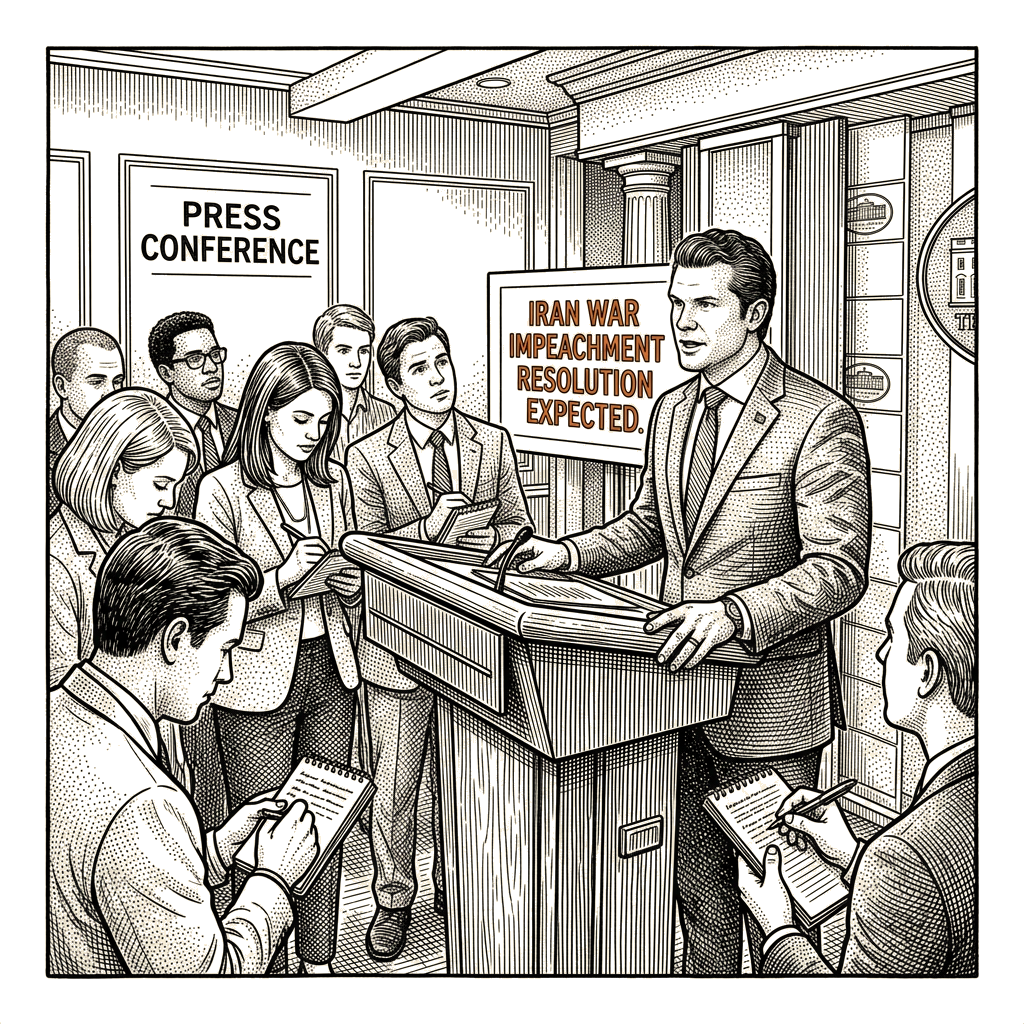
Defense Secretary Pete Hegseth is scheduled to meet reporters Tuesday, in his first press conference in more than 180 days, as Congress is expected to consider an Iran-war impeachment resolution advanced by Republican Rep. Thomas Massie. Hegseth said Monday that he was eager to litigate the policy choices he and President Donald Trump made in Iran and Venezuela, with his defense centered on the choices themselves and the accomplishments he has attributed to U.S. troops. According to the AP Voter Poll, about 6 in 10 surveyed voters said the United States made the “wrong decision” in taking military action against Iran, while only about one-third said the war was “crucial” to shaping their congressional vote. The poll therefore supports congressional scrutiny without supplying an electoral mandate, while Tuesday’s briefing can test whether Hegseth’s defense of military outcomes answers the distinct question of why the war began.
The poll supports scrutiny, not a mandate
The AP Voter Poll surveyed more than 100,000 voters in the United States. Its two central findings are compatible even though they point in different directions. About 6 in 10 respondents said the United States made the “wrong decision” in taking military action against Iran. At the same time, only about one-third said the war was “crucial” to shaping their vote for Congress, below the roughly half who said the cost of living or government corruption was crucial.
The first finding identifies majority disapproval of the military action. The second indicates that most voters who answered the survey did not place the war among their two leading considerations when choosing members of Congress. A voter could regard the conflict as an important contributor to an electoral result without treating it as the central reason for voting one way or another. On the available record, the war was consequential for a substantial minority and politically visible, but the poll does not quantify how much of the Republican Party’s midterm losses can be attributed to the conflict.
AP reported that many Republicans blame the Iran war for the party’s midterm election losses. That is a reported political attribution, not a quantified causal finding. The article does not provide the partisan breakdown of the poll, the survey methodology, a margin of error or district-level cross-tabs. Those omissions limit the translation of national opinion into the incentives of individual members, especially in districts where national margins may not reflect local voting patterns.
The evidence also places both sides of the congressional dispute under the same constraint. Resolution proponents cannot treat opposition from 6 in 10 surveyed voters as a mandate for impeachment when the same survey places the war below the cost of living and government corruption as a voting consideration. House GOP leadership cannot treat the war’s lower salience as evidence that the conflict is politically irrelevant when the same poll records majority disapproval.
The supportable inference is narrower. The poll gives Congress a reason to examine the decision and the military action, but it does not determine whether the examination ends in approval, rejection, delay or a different form of military policy. It supplies neither the factual basis for a specific impeachment allegation nor the congressional coalition needed for a floor vote.
Competing frames answer different questions
Four frames are present in the available account. The dominant-paradigm frame presents the conflict as a presidential choice under nuclear-security pressure. A competing frame draws on congressional accountability from within the president’s own party. The press conference adds a rhetorical frame centered on military personnel, while the historical frame asks how earlier wartime accountability disputes were framed and resolved.
Hegseth’s public position supplies the dominant frame within the supplied account. He called Trump’s decision to start the war a “bold move” and argued, “as the president points out so clearly — you can’t let crazy Islamists have a nuclear bomb.” The article identifies Midnight Hammer as the strike on Iranian nuclear facilities and Epic Fury as the larger war. The framing places presidential decisiveness and the prevention of a nuclear threat at the center of the dispute.
That account does not include the legal authorities relied upon for the named operations, the alternatives considered before escalation or the conditions under which the campaign would end. The absence of those details prevents the visible military outcome from establishing why the United States began the war, what Congress authorized or how the operation was intended to conclude.
The competing congressional-accountability frame is narrower and more procedurally specific in concept, though not in documented detail. AP reported that Massie pushed the impeachment resolution forward over House GOP leadership’s objections and separately reported that momentum is growing to hold Hegseth accountable for the Iran war. The article does not reproduce the resolution’s text, identify its named target or specify its allegations. It also does not document Massie’s rationale, legal theory or intended action, identify whether other members support the measure, establish bipartisan support or explain which decision the resolution would place before the House.
That missing text has direct consequences for the scope of any hearing. A resolution reaching only the defense secretary could leave the underlying presidential decision outside the immediate scope of congressional review. The article does not establish whether Massie’s resolution does so.
Hegseth’s troop-centered argument supplies the press-conference frame. He said, “If you want to take issue with what we did in Epic Fury or Rough Rider or nabbing Nicolás Maduro, you’re taking issue with the troops and what they accomplished, which is historic.” The formulation moves the immediate dispute from the quality of the decision to the standing of the personnel who carried it out. The wording can raise the political cost of criticizing the policy, although the report does not establish that it changes how lawmakers vote. Troops’ accomplishments and the justification for beginning military action can stand or fall independently.
The report provides no contrary evidence about the conduct of U.S. troops. Its evidentiary gap concerns the decision process, not the recorded performance of the service members whom Hegseth invoked. The administration’s account can acknowledge military accomplishments while leaving the reasons for initiating the conflict unresolved.
The press-conference setting also affects the contest. A briefing gives the official control over the sequence and vocabulary of the dispute and allows the administration to decide which account receives the opening position and which questions receive less detail. The gap of more than 180 days since Hegseth’s previous press conference may increase public attention, but attention does not supply documentary evidence or a defined legislative step. Reporters can press Hegseth on decision-specific questions, but the announced structure does not guarantee that those questions will displace the troop-centered account.
The historical frame situates the dispute within the longer institutional relationship between executive decisions to use military force and legislative scrutiny. The available article documents no comparable earlier war-impeachment episode, historical floor-vote rate or earlier defense-secretary briefing from which to infer how a similar dispute ends. It also identifies no constitutional provision, statute or House rule on which Massie’s resolution relies. The frame therefore describes a claim structure rather than supplying a precedent that establishes whether the measure is a conventional oversight mechanism, an extraordinary challenge or another form of congressional action.
The coherence of the competing accounts depends on keeping several propositions separate. Military results do not establish the justification for beginning a campaign. The justification for a campaign does not establish the legality of a particular operation. Broad opposition to the war does not establish the factual basis for a specific impeachment allegation. And public opposition does not establish the votes needed to schedule or adopt a resolution.
The administration can move from military accomplishment to policy justification by changing frames, while Massie can move from broad disapproval to a specific allegation by changing evidentiary objects. Neither move supplies the missing element automatically. Tuesday’s briefing can sharpen the contest between the narratives, but the congressional question remains contingent on authorities, alternatives, costs, objectives and the distribution of support.
Leverage is divided across the decision chain
Pete Hegseth occupies two roles at once: he is the subject of the accountability effort and the official scheduled to defend the policy. His emphasis on troop accomplishments can support the administration’s account of military performance, but the emphasis does not by itself answer the questions raised by the resolution’s advocates.
Donald Trump occupies a second position in the same decision chain. Hegseth said Monday that he was eager to litigate the policy choices he and Trump made in Iran and Venezuela, and he defended Trump’s decision to start the war. Any substantive change in military posture would reach beyond the defense secretary. A process confined to Hegseth could leave the president’s role less directly tested.
Thomas Massie has supplied the clearest documented evidence of intraparty friction. AP reported that he pushed the resolution forward despite objections from House GOP leadership. That establishes a dispute across the party’s institutional hierarchy. It does not establish how many members support the resolution, whether other lawmakers would sponsor it, whether the allegations can be tested through a hearing or whether Massie has the votes required for a recorded floor vote.
House GOP leadership’s opposition is the principal reported obstacle to the measure. The report does not state leadership’s substantive case or reveal whether the opposition concerns the policy, party unity, the resolution’s drafting or the timing of a vote. The opposition establishes the leadership’s position on the immediate proposal, not a complete explanation for that position.
House Republicans cannot be treated as one bloc with one incentive. AP reported that many Republicans blame the Iran war for the party’s midterm losses, while the AP Voter Poll found that only about one-third called the war “crucial” to shaping their congressional vote. The report supplies no partisan breakdown. The reported attribution and the poll measure different things: one describes how some party members explain losses, while the other describes how surveyed voters ranked the war relative to other issues. Some lawmakers may have incentives to distance themselves from the conflict, while others may have incentives to limit attention to it.
Voters supplied the clearest evidence of public opposition but remain distant from the procedural decision. The poll supports congressional attention while providing little indication that the war will dominate an election centered on economic conditions or anti-government sentiment.
U.S. troops are invoked by Hegseth as the reason his defense extends beyond operational judgments. The report attributes historic accomplishments to them but does not include service members’ own testimony, casualty information or an assessment of the war’s effect on military readiness.
The source also leaves out several affected constituencies. Iranian authorities and Iranian civilians do not appear, and the article does not assess the war’s effects across affected populations. Independent military, legal and intelligence experts are absent, as is a full breakdown of congressional positions beyond Massie and House GOP leadership. Their absence from the source does not establish their positions. It does mean that the article cannot show whether a hearing would draw on more than the executive branch’s account.
The evidentiary standard is the same for all participants. Massie must ground the resolution in decisions Congress can examine. Hegseth must explain the authorities, alternatives and objectives behind those decisions. House GOP leadership must identify what process it would support if it rejected the immediate resolution. Applying the same standard keeps the inquiry tied to the available evidence rather than to which party speaks first or speaks most forcefully.
Four paths for Congress and the defense secretary
The status quo is the path most directly described in the article. Hegseth holds the briefing, Congress is expected to consider the resolution and House GOP leadership resists it. Each active participant receives a partial result. Hegseth gains a prominent forum for the administration’s account. Massie maintains visibility on an issue with documented dissatisfaction. Leadership avoids an immediate floor vote while retaining control over whether and when the proposal receives further consideration. Surveyed voters receive the administration’s defense, although the record does not establish whether the briefing will supply enough detail to evaluate the underlying choices.
A press conference could produce a detailed defense or restate the administration’s established position without supplying the underlying decision record. Continued consideration without a defined procedural advance is therefore plausible.
An institutional reversal would occur if House GOP leadership authorized a referral, hearing, floor scheduling or a floor vote. That route would test the proposal’s sponsorship and scheduling capacity. A reversal could also coincide with the Iran war displacing the cost of living or government corruption in voters’ issue rankings, although the record supplies no evidence that such an increase in salience is imminent. Massie’s persistence and leadership’s resistance would not, by themselves, demonstrate enough support to bring the measure to a recorded vote.
A policy reversal would require Hegseth and Trump to change, suspend or end military operations. The article supplies no evidence that such a change is imminent, and the visible institutional dispute does not establish that policy change is the intended consequence of Tuesday’s briefing.
The defer-and-monitor path most directly addresses the evidentiary gaps in the available record. House leadership could defer a floor vote while requesting the complete resolution, a written defense and a record of the policy choices. That approach would preserve leadership’s scheduling option while allowing Hegseth’s briefing and the issue’s immediate attention to pass without turning the press conference into the final test of the resolution. Deferral would become less useful if a new development in Iran made military policy the dominant congressional-vote concern.
Massie’s disclosure-first requirements are specific. Massie could make the complete resolution publicly available if it is not already available, identify the conduct at issue, explain the evidence supporting each allegation, specify the action requested of the House and seek additional sponsorship.
Hegseth’s disclosure-first requirements would extend beyond the briefing’s announced focus. A public, unclassified decision account could cover:
- The legal authority relied upon for each named operation.
- The chronology of major decisions and the alternatives considered at each stage.
- The objectives, end-state conditions and benchmarks for continuing or ending military action.
- The resources, costs and human consequences associated with the campaign.
- The distinct purposes and decision paths for Iran and Venezuela.
- The evidence used to support the administration’s account.
- The expected military, diplomatic and fiscal consequences of the campaign.
- Testimony from military, legal and intelligence officials, including officials outside the defense secretary’s immediate chain of command.
House GOP leadership’s conditional route would begin after review of the public record. Leadership could determine whether referral, a hearing, scheduling or a floor vote is warranted. If leadership selected a hearing or referral, the administration’s response would enter the same record. The article does not establish committee jurisdiction, sponsorship requirements or floor rules, so the route identifies conditional decisions rather than presuming that a particular procedure is available.
Procedural safeguards could keep the inquiry from becoming an open-ended extension of the political argument. A fixed date could govern receipt of the record and any follow-up hearing. The process could require a public account of materials withheld on classified grounds and specify what evidence the resolution must contain before a floor vote becomes appropriate. A published deadline, document index and identification of unavailable evidence would make omissions visible. Cross-party or institutional witnesses could prevent the inquiry from remaining confined to officials’ preferred narratives.
Incentives change across scenarios. Continued visibility is useful to Massie while the issue has low salience. A sudden increase in salience would raise the cost of delay because House leadership might control the response. Hegseth faces the inverse tension: decision-specific disclosure could strengthen his credibility while also supplying a record critics can test.
The process would not decide the war in advance. A documented decision rationale could support the administration’s account even if the policy remained contested. A resolution tied to identified decisions could give critics a more durable basis than broad disapproval of the conflict.
Failure points in the proposed inquiry
The administration could satisfy a general request for explanation with a conference statement that repeats existing assertions while withholding operational details. The briefing would then produce visibility without resolving the legal-authority, alternative, cost or end-state questions.
Massie could continue to characterize the conflict as disqualifying without specifying the authorities, costs or decisions for which he seeks impeachment. Broad opposition would remain disconnected from the allegations and from the action requested of the House.
House GOP leadership could use the additional process to keep the resolution off the calendar indefinitely. The poll’s lower-salience finding creates a related risk: an inquiry prolonged for political visibility could consume congressional attention without clarifying the policy or changing leadership’s position.
If the war remains outside voters’ principal concerns, a hearing may not generate enough political pressure to change leadership’s position. If Hegseth’s written record strongly supports the choices behind the campaign, critics may still lack a specific allegation linking military results to a disputed decision.
A new development in Iran could change those incentives. If military policy became the dominant electoral concern, the issue could bypass a committee-centered process and rapidly change both congressional behavior and the probability of floor action.
Failure to disclose information would not itself establish that the policy was unlawful. It would leave the evidentiary gap in place. The same record would need to test the resolution’s claims and the administration’s defense.
The floor-vote forecast diverges by horizon
The forecast question is whether the U.S. House of Representatives will take a recorded floor vote on the Iran-war impeachment resolution within a defined window after Tuesday’s briefing. The available evidence does not support a measured base rate. It contains no resolution text, sponsorship map, cosponsor count, committee path or jurisdiction, committee status, floor schedule, floor notice, special rule, whip count, House calendar or whip-count timetable.
Two reference classes are possible. The closest class is House impeachment or oversight measures advanced by individual members over party-leadership opposition, which matches the instrument, forum and intraparty conflict described by AP. A broader class is member-driven House oversight measures that reach floor consideration within the same short window. The article provides no outcome count for either class. The narrower class is therefore preferred for mechanism matching, while the broader class remains a comparison for scheduling behavior.
The 30-day additive calibration. An elicited 15% prior is used because no measured base rate is available. The adjustments produce a 15% point estimate:
- Add 3 points for sponsor commitment because Massie has continued pressing after leadership objected. AP reports that Congress is expected to consider the resolution but does not define whether consideration means referral, hearing, scheduling or a floor vote, so the adjustment credits persistence rather than an unspecified procedural advance.
- Add 3 points for member incentives because about 6 in 10 surveyed voters called the military action the “wrong decision,” which could make the issue easier to raise in marginal districts if national opinion translates into district-level pressure. The absence of partisan and district-level cross-tabs keeps the adjustment conditional and modest.
- Subtract 3 points for the issue environment because only about one-third called the war “crucial” to shaping votes for Congress, below the roughly half who named the cost of living or government corruption.
- Subtract 3 points for institutional capacity because House GOP leadership has objected, and the article supplies no broad sponsorship, defined procedural stage, floor schedule or vote count capable of overcoming that resistance.
The calculation is 15 + 3 + 3 − 3 − 3 = 15%, with a plausible range of 10% to 25%. A lower elicited prior of 10%, with the same net adjustment of zero, produces 10%; the central 15% prior produces 15%; and a higher 20% prior produces 20%. Uncertainty in the procedural and sponsorship adjustments supports retaining the wider range rather than treating 15% as a precise outcome.
The 14-day multiplicative calibration. This horizon is an analytic convention for measuring near-term scheduling pressure, not a verified institutional timetable. Starting from non-informative prior odds of 1.00 to 1.00, the adjustments are:
- Multiply by 1.50 for AP’s report that Congress is expected to consider the resolution, a positive but ambiguous signal that does not establish whether consideration means committee treatment, debate or a recorded vote.
- Multiply by 1.30 for Massie’s active push, which shows that one member has moved beyond stating a position but does not show a coalition.
- Multiply by 0.55 for House GOP leadership’s documented opposition, which bears directly on scheduling.
- Multiply by 1.05 for the scheduled briefing, which creates an adversarial process but comes with no reported floor notice.
- Multiply by 1.15 for broad disapproval and by 0.85 for the war’s lower electoral salience. Together, those factors produce a multiplier of approximately 0.98.
The combined multiplier is 1.50 × 1.30 × 0.55 × 1.05 × 0.98 ≈ 1.10. Converting 1.10 to 1.00 odds into a probability gives approximately 52%, with a practical uncertainty range of roughly 30% to 75%. The range reflects missing sponsorship, scheduling and leadership variables rather than a default allowance for imprecision.
The 14-day calibration excludes any documented motive adjustment for Massie or House GOP leadership because the report establishes that Massie is pressing the resolution and leadership is objecting but does not explain why either side is acting. Capacity remains uncertain because the record contains no cosponsor count, committee path, special rule or whip count. No base-rate-defying factor appears in the present record. A new development in Iran could create one, but that would be new evidence rather than a present adjustment.
No separate estimate is possible for adoption after a recorded floor vote. Vote counts, whip counts, sponsorship and the operative terms are missing, so multiplying the floor-vote estimate by an unsupported passage rate would create precision without evidence.
Why the estimates diverge. The longer 30-day horizon carries the lower estimate, so the two calculations cannot be reconciled from the present evidence. The difference comes from how each reads AP’s statement that Congress is expected to consider the resolution. The additive calibration credits Massie’s persistence and declines to credit an unspecified procedural advance. The multiplicative calibration assigns a 1.50 multiplier to the expectation of consideration.
The modal outcomes also differ. Continued consideration without a floor vote within 30 days is the most likely path under the additive calibration. The 14-day multiplicative estimate modestly favors a recorded vote. The shared conclusion is narrower: broad opposition and low issue salience do not establish a voting coalition, and the available questions concern the immediate threat, the president’s choice, the military result and the procedure—not a schedule.
The sign of a committee-referral signal also remains unsettled. The additive calibration treats referral without broader sponsorship as a positive update of 3 to 5 points. The multiplicative calibration treats referral without a hearing schedule as a negative update of about 5 points. No procedural record resolves the difference.
The calibrations also differ in base-rate commitment. One uses an elicited 15% prior with additive adjustments; the other uses non-informative prior odds with judgmental multipliers. Both agree that no measured base rate is available and that confidence is low. The historical frame does not resolve the divergence: both treatments leave earlier war-impeachment episodes, floor-vote rates and comparable defense-secretary briefings unpopulated. Both also leave the resolution’s named target unverified.
Updates that would move the forecast
Several observable developments would alter the floor-vote estimate. A published resolution naming specific conduct, accompanied by bipartisan cosponsors and a scheduled hearing or floor consideration, would add 8 to 12 points. A formal floor notice or special rule would add roughly 15 points.
A committee referral without broader sponsorship would add 3 to 5 points under the 30-day calibration but subtract about 5 points under the 14-day calibration if no hearing is scheduled.
One additional House Republican cosponsoring or publicly backing the resolution would add about 5 points, with the cumulative increase capped at 10 points for multiple such indicators. House GOP leadership’s public agreement to allow floor debate would add about 10 points, while a public commitment to block or shelve the resolution would subtract about 15 points. Leadership blocking scheduling while no additional cosponsors emerge would reduce the estimate by 6 to 10 points.
A poll showing the war displacing the cost of living or government corruption as a principal congressional-vote issue would add 4 to 7 points. A substantive written decision record from Hegseth would not automatically move either estimate unless the record altered sponsorship, procedural access or voter salience.
What the available record does not establish
The article does not supply the resolution’s complete text, named target, allegations, cosponsor count, committee jurisdiction, committee status, floor schedule, floor notice, special rule, whip count, vote count or House and committee calendars. It does not document Massie’s rationale, legal theory or intended action, and it does not state House GOP leadership’s substantive reasons for objecting. The poll’s methodology, margin of error, partisan breakdown and district-level cross-tabs are also absent.
No historical comparison cases, floor-vote rates or comparable defense-secretary briefings appear in the available record. Whether the proposed hearing, referral, deadlines and document index can be executed within the relevant period depends on House and committee calendars the article does not supply.
The Associated Press report remains the controlling source for Tuesday’s briefing, the poll figures, Massie’s effort and the reported attribution of midterm losses to the war; external corroboration of those facts remained unresolved in the available material. The article also does not permit an estimate of the war’s effects across affected constituencies, provide service-member testimony or assess the conflict’s effect on military readiness. It leaves the legal authorities, alternatives, costs, objectives and expected end state of the campaign outside the visible record.
The available evidence therefore establishes a broad political dispute and a scheduled opportunity for the administration to present its defense. It does not establish that a floor vote will occur, that the resolution has sufficient sponsorship, that the war was unlawful or that the poll’s majority opposition will determine the House’s procedural choice.
Analytical techniques used in this piece
This analysis applies the methods below. Each links to a short, plain-English explainer you can read and reuse.
- Argument Audit
- A full structural audit of an argument’s premises, inferences, and load-bearing assumptions.
- Decision Clarity
- Articulates the real stakes, stakeholders, and interests behind a decision facing a third party.
- Probabilistic Forecasting
- Puts calibrated probabilities on what happens next.