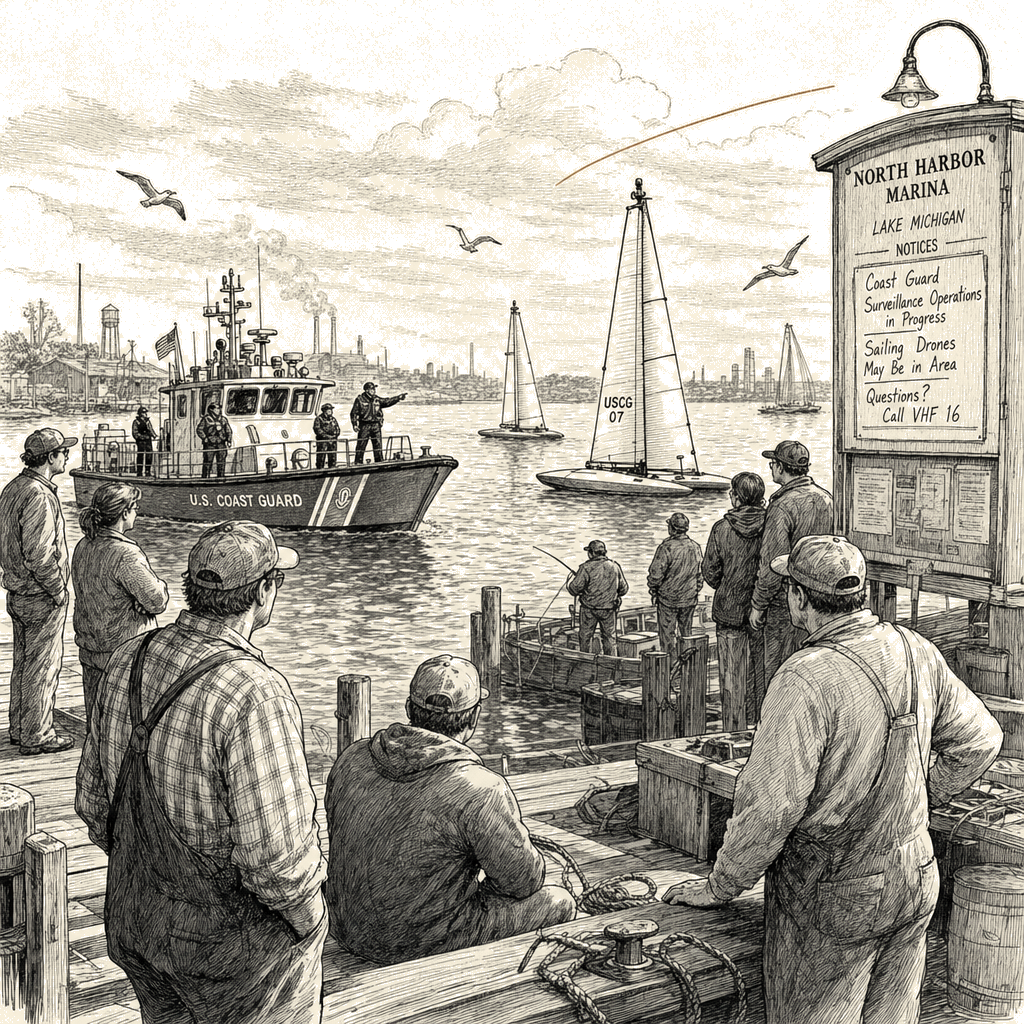
The US Coast Guard said it has deployed at least six Saildrone Voyager vessels on the Great Lakes this summer as part of a $15.5 million contract to “track illicit activity” across the border waters shared with Canada. The 33-foot unmanned surface vehicles, built by California-based Saildrone Inc, can operate for 100 days without servicing and are equipped with radar, optical cameras, and artificial intelligence systems, according to the company and the Coast Guard.
Anthony Popiel, a Coast Guard UAS program coordinator based in the Great Lakes, said the drones “help the coast guard to maximize its awareness and understanding of cross‑border maritime activity, and to help detect or deter vessels that may be involved in illicit activities such as illegal fishing, human trafficking, or narcotics trafficking.”
The contract is funded under the Trump administration’s “One Big, Beautiful Bill Act,” according to the Coast Guard.
But privacy advocates and some recreational boaters said the deployment raises concerns about the scope of government surveillance on waters that roughly 210,000 recreational boats use annually. Petra Molnar, author of The Walls Have Eyes: Surviving Migration in the Age of Artificial Intelligence and associate director of the Refugee Law Lab at York University in Toronto, said the arrangement raises “very troubling” privacy and accountability questions.
“These vessels are equipped with radar and optical sensors capable of continuous monitoring, and they operate under what’s called a ‘contractor‑owned, operated’ model, meaning a private company, Saildrone, is collecting the surveillance data and selling it to the government,” Molnar said. “This is a very troubling arrangement from a privacy and accountability standpoint, as we have very little public information about data retention, who can access what data is collected, or how people using the region recreationally [can] be swept up in a data system built for border enforcement.”
Ryan Weekes, commodore of the Cleveland‑based InterCity Yacht Club, said he understands the need for maritime security but called for transparency about what information is collected and how it is used. “Boaters should have a clear understanding of what information is being collected, how it is being used, who has access to it, and what safeguards are in place to protect privacy,” Weekes said. “Maintaining public trust is an important part of any security initiative.”
Lake Erie, which borders cities including Buffalo, Toledo and Cleveland on the U.S. side, has the highest number of recreational boaters among the Great Lakes that share a maritime border with Canada. Experts questioned whether the drones could meaningfully cover the expanse. “Thirty‑three‑foot vessels — recent announcements suggest the deployment may now involve as many as 16 — cannot actually provide meaningful tactical coverage of that expanse,” Molnar said. “What they can do is generate data, and that is precisely the point of this type of technological experiment: it is less about real‑time interception by one of these vessels but rather it is about building out a persistent maritime domain awareness infrastructure.”
Some boaters see the drones as a useful tool. Steve Hales of the Port Clinton Yacht Club on Lake Erie said, “The Great Lakes are a very soft border with Canada. To protect that, we need to have more coast guard presence or something like the drones.”
A Coast Guard spokesperson said there is no indication that safety on the Great Lakes border waters has changed. “The coast guard’s deployment of unmanned surface vehicles is a proactive step to further strengthen maritime domain awareness, surveillance, and safety throughout the region,” the spokesperson said.
The Trump administration has long accused Canada of allowing illicit drugs into the U.S., a charge that has fueled tariffs on Canadian goods. Data cited by The Guardian shows that tens of millions of dollars’ worth of drugs are seized by Canadian border agents after entering Canada from the U.S. every year. A U.S. Customs and Border Protection representative based in Detroit did not respond to queries about how much of the more than 4,300 pounds of cocaine and nearly 1,000 pounds of methamphetamines seized during the 2025 fiscal year refers to drugs entering the U.S. from Canada. The Coast Guard declined to share specific figures on drug seizures or undocumented migration “for operational security reasons.”
Saildrone’s vessels have been deployed in seas and oceans worldwide. Last October, the company announced a $50 million investment from Lockheed Martin to equip its 65‑foot unmanned vessels with “lethal, combat‑proven defense technology” such as the company’s JAGM missile launcher. A Coast Guard official said it does not envision the use of such systems on the Great Lakes in the future.
The current deployment is not the first time Saildrone vessels have operated on the Great Lakes. In 2023, the company’s drones were used on Lake Erie for scientific research. The surveillance vessels’ locations can be tracked on the Marine Traffic website, where they are listed as pleasure crafts.