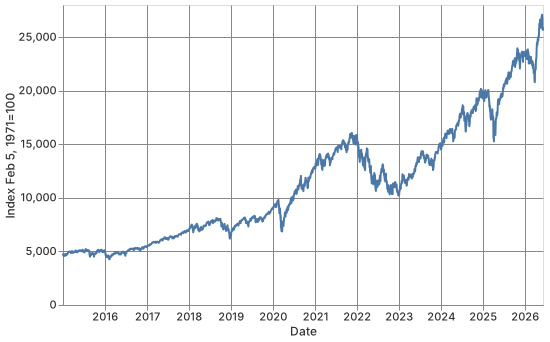
- U.S. stocks ended mixed on June 9 as the Nasdaq Composite fell 1% to 25,929.66, the S&P 500 slipped 0.26% to 7,405.73, and the Dow Jones Industrial Average edged higher to 50,786.01.
- Semiconductor shares led the tech selloff, with Marvell Technology, Micron Technology, and Advanced Micro Devices all falling sharply, driving a 1.9% decline in the PHLX Semiconductor Sector index.
- Existing home sales in May rose 3.2% month-over-month, far exceeding the 0.7% consensus forecast, according to a report cited by The Wall Street Journal.
- Oil prices are expected to remain elevated as countries prepare to rebuild strategic stockpiles and tanker traffic through the Strait of Hormuz is unlikely to resume fully even if U.S.-Iran tensions ease.
- Two high-profile IPOs are scheduled this week: SpaceX and OpenAI, the latter having filed its listing late Monday, with rival Anthropic also expected to go public.
Stocks opened higher on Monday before reversing in midday trading, as selling pressure concentrated in the technology sector. The Nasdaq Composite dropped about 1%, the sharpest decline among the major benchmarks. Chip makers were disproportionately affected: the PHLX Semiconductor Sector index lost 1.9%, its worst single-day performance in weeks, according to The Wall Street Journal. Shares of Marvell Technology, Micron Technology, and Advanced Micro Devices all fell sharply.
Market participants attributed part of the rotation to positioning ahead of the SpaceX initial public offering, widely expected to price this week. “Many investors may be moving portfolios out of stocks that have risen strongly this year to free up cash for the SpaceX IPO,” the Journal’s Heard on the Street staff wrote. OpenAI filed its IPO prospectus on Monday evening, adding to a pipeline that also includes the artificial-intelligence company Anthropic.
Outside the equity market, a closely watched housing indicator offered a more optimistic signal. Existing-home sales in May climbed 3.2% from April, the Journal reported, citing industry data. The increase far outpaced the 0.7% median estimate from economists surveyed ahead of the release. The pickup suggested that lower mortgage rates, which have eased from the peaks of 2025, are beginning to revive a housing market that had been sluggish through the first quarter.
Oil markets remain a source of uncertainty. The Journal reported that countries around the world are moving to rebuild crude stockpiles to a degree not seen before, a process that should keep the market tight even if geopolitical tensions between the U.S. and Iran ease. Additionally, oil tankers are unlikely to resume full-scale transit of the Strait of Hormuz immediately following any de-escalation, adding to supply-side constraints.
The three major U.S. equity benchmarks have alternated between records and pullbacks in recent weeks as investors weigh competing forces: strong corporate earnings and artificial-intelligence enthusiasm against rising oil prices, elevated Treasury yields, and uncertainty about the Federal Reserve’s rate path. The Dow Jones Industrial Average, less exposed to technology shares, has outperformed, closing Monday at 50,786.01, a gain of roughly 86 points from the prior session’s close.