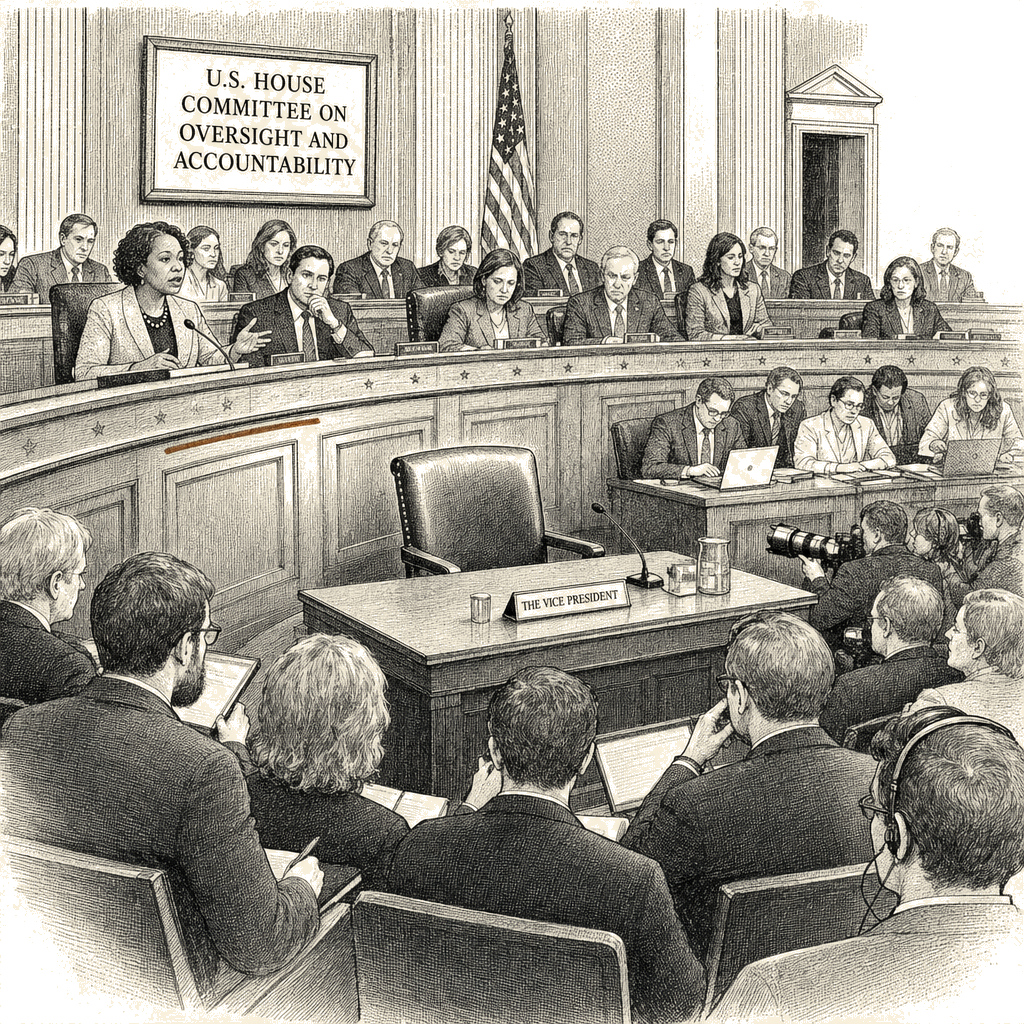
House Democrats on the oversight committee, led by Rep. Robert Garcia of California, plan to call on Vice President JD Vance to testify about the Trump administration’s handling of records connected to Jeffrey Epstein. Garcia will ask the committee chairman, Rep. James Comer of Kentucky, to summon Vance to speak, according to a report from Punchbowl News reporter Max Cohen.
The request comes a day after the New York Times published a detailed story describing how the Epstein documents became a source of internal turmoil inside the Trump administration. According to the Times, Vance warned fellow officials that the controversy represented a “huge problem,” and senior aides held a series of Situation Room meetings — frequently without President Donald Trump present — to address the growing issue. White House chief of staff Susie Wiles, the report said, felt Vance was exaggerating the significance of the matter and believed he had “bought into the conspiracy theories.”
Asked about the reported meetings, Garcia told Punchbowl: “Why are we having meetings in the Situation Room about the Epstein strategy?”
The White House did not immediately respond to a request for comment on whether Vance would agree to appear before the committee.
The Epstein controversy has roiled the administration for months. In 2025, the Justice Department issued a memo concluding there was no evidence of a “client list,” drawing criticism from many Trump supporters. Later, under the Epstein Files Transparency Act, millions of pages of documents were released, a move that continued to fuel public attention on the case. Epstein, a financier and convicted sex offender, died in a New York City jail in 2019 while awaiting trial on sex-trafficking charges.
According to the Times, the Situation Room meetings included then Attorney General Pam Bondi, now acting Attorney General Todd Blanche, FBI Director Kash Patel, White House communications director Steve Cheung, former deputy chief of staff Taylor Budowich, and White House press secretary Karoline Leavitt. Multiple attendees — including Cheung — reportedly viewed the Epstein situation as a “PR disaster,” the Times reported.
Officials explored various responses, including transparency measures that some privately believed would reveal little additional information. They also discussed less conventional approaches, such as the possibility of having Ghislaine Maxwell — Epstein’s former associate who was convicted of sex trafficking — publicly defend Trump in an interview with Tucker Carlson.
Vance argued for releasing all of the files and taking action before Congress could advance the Epstein Files Transparency Act, according to the report. At the same time, aides were said to be focused largely on the possibility of losing support from core MAGA voters, suggesting that concerns about their own base heavily influenced the administration’s deliberation.
The Times wrote that numerous Trump administration officials — Bondi among them — had either “grossly underestimated or simply been blind to the voracious appetite of the MAGA base for information about Epstein.”
Infighting peaked after the Wall Street Journal reported in July that Trump had allegedly sent Epstein a “bawdy” birthday message in 2003 accompanied by a drawing of a woman’s naked silhouette. Trump responded by denying the letter’s authenticity and filing a $10 billion lawsuit against the Journal’s publisher. A Florida judge dismissed the lawsuit in March, but Trump’s legal team refiled it last month.
The political fallout has been most acute for Republican lawmakers who took the hardest stances in favor of releasing all the Epstein files. Rep. Marjorie Taylor Greene of Georgia, one of the few Republicans who voted to force the release, resigned in January after months of being attacked by Trump. Rep. Nancy Mace of South Carolina was defeated in the state’s primary earlier this week, attributing her loss to her support for Epstein file transparency — a position that prompted Trump to endorse her opponent.
Perhaps most notably, Rep. Thomas Massie of Kentucky was ousted after voters rejected him in favor of Ed Gallrein, a challenger recruited by Trump. Massie, a lifelong Republican, had spearheaded the bipartisan Epstein Files Transparency Act alongside Rep. Ro Khanna of California. “Everybody’s paying a price for it,” Massie told NBC News. “Trump became irrationally opposed to that more than [defections on] the ‘big, beautiful bill.’ It struck a nerve with him.”
The congressional investigation continues. On Wednesday, the House oversight committee announced it would ask Alan Dershowitz, Epstein’s former attorney, to appear before the panel. Investigators have also gathered fresh testimony from people associated with Epstein, including his longtime executive assistant, Lesley Groff.