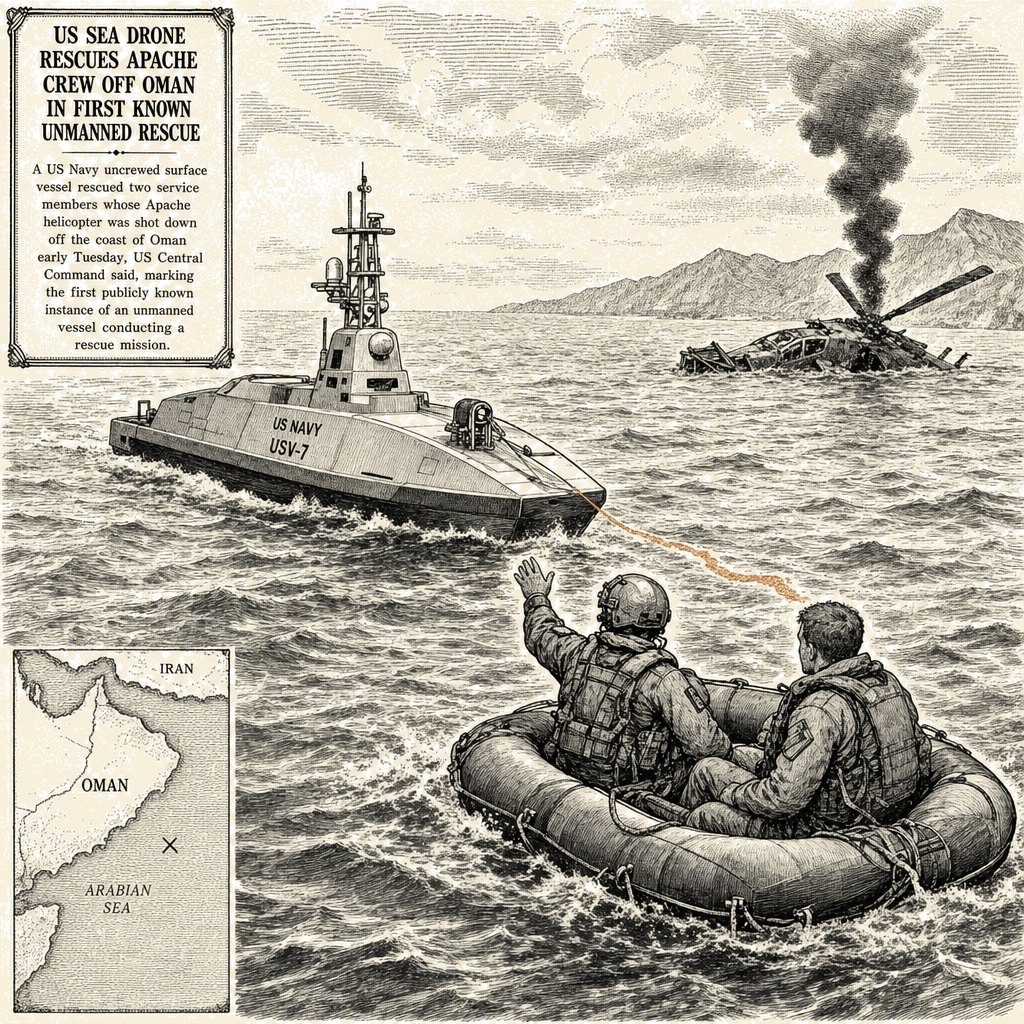
A US Navy Corsair sea drone rescued two service members whose Apache attack helicopter was shot down off the coast of Oman early Tuesday, US Central Command (Centcom) said, marking what the military described as the first publicly known use of an unmanned vessel for a rescue mission.
President Donald Trump said the helicopter was downed by Iran near the Strait of Hormuz, a strategically vital waterway that has been largely blocked to commercial shipping since the start of the US-Iran conflict. The two soldiers “were safely rescued within approximately two hours and are in stable condition,” Centcom said in a statement.
The Corsair sea drone is a 24-foot (7.3-meter) unmanned surface vessel manufactured by Saronic, a Texas-based maritime drone company, according to Centcom. The company’s website lists the Corsair as capable of carrying 1,000 pounds (450 kilograms) and traveling over 35 knots per hour (40 mph).
“The Corsair is about the size of a fishing boat with a flat deck, so it’s designed to be loaded and it’s probably able to hold three to four people,” said Bryan Clark, a naval drone expert at the Hudson Institute. Clark said the vessel is equipped with a 360-degree camera, a radar system for long-range navigation, and an electronic radio sensor for intelligence gathering.
Both experts who spoke with BBC Verify said the drone was likely controlled manually for the rescue. “In this mission it would have likely been controlled remotely by a person with a joystick to make sure they got to the exact location of the crew,” Clark said. “It would have been directed to their known position and they would have just clambered on board, just like would to get on a boat at sea.”
Centcom spokesman Capt. Tim Hawkins said after the rescue that the Corsair was chosen because of “proximity and capability factors.” The US service members were picked up at about 3:30 a.m. local time and taken to another location on the water, then “hoisted up to a helicopter for further transport,” Hawkins said.
Dr. Stacie Pettyjohn, a US military expert at the Center for a New American Security, said the unmanned drone would have been used “instead of sending in a ship or a helicopter where people could have been shot at.” She called the mission “good for a dirty, dangerous missions like this,” even though rescue is not a core mission of the vessel.
The sea drone is operated by Task Force 59, the US Navy’s first unit dedicated to unmanned systems, established in 2021 and deployed to the Middle East in March. The Corsair is part of a broader Pentagon plan to expand drone use. The Navy awarded Saronic a $392 million production contract for its autonomous vessels last year, according to the company.
The Corsair has been in service for several years, with the Navy operating about 50 of them, Pettyjohn said. They are typically used for mine detection and surveillance, but the Navy is “still experimenting with the fleet in the strait to see what it can do.”
Sea drones have become increasingly common in the region. Ukraine has loaded smaller unmanned vessels with explosives to attack Russian ships, and Yemen’s Houthi rebels and Iran have used so-called kamikaze drone boats against vessels in the Strait of Hormuz. “The US sea drones very much emerged off back of the Ukraine war and seeing what they innovated,” Pettyjohn said.