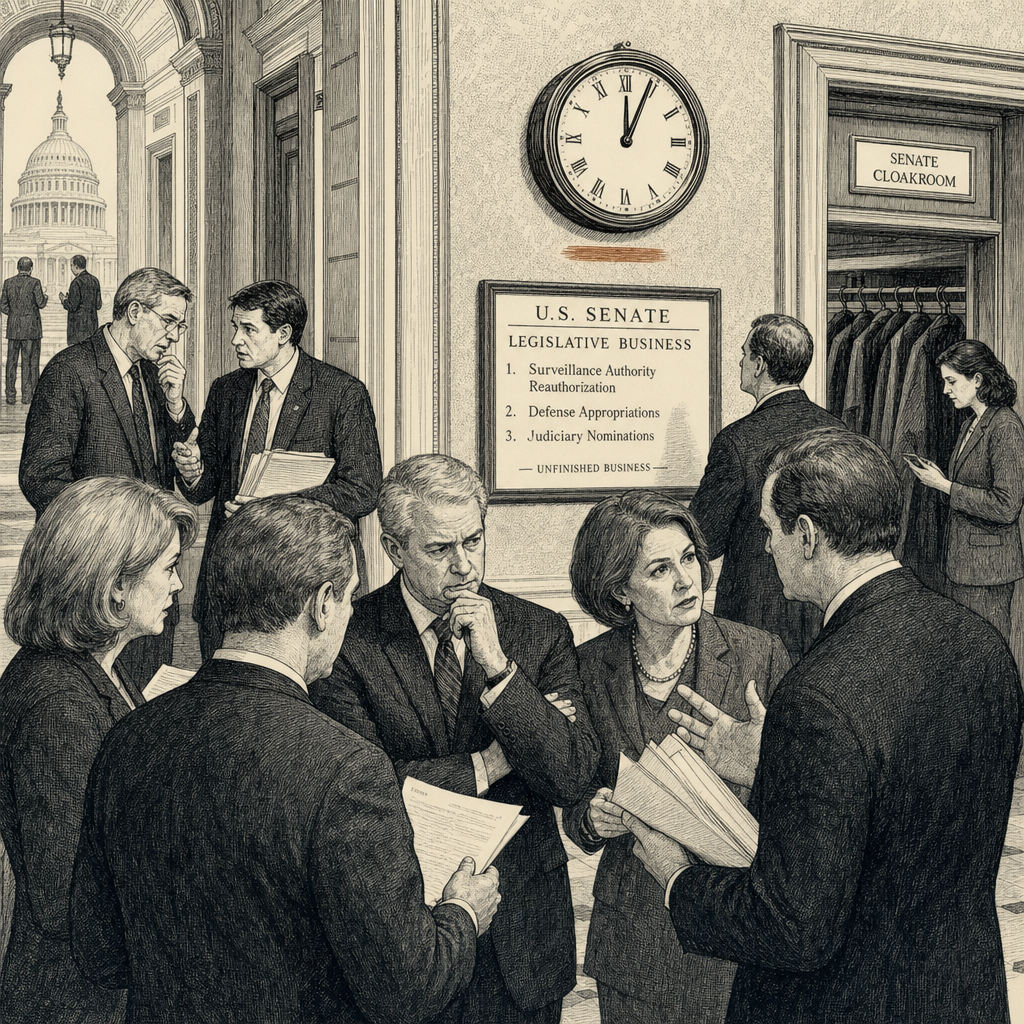
WASHINGTON (AP) — Senate Democrats’ decision to let a key surveillance authority lapse is the latest escalation in a broader strategy of blocking bipartisan legislation to pressure President Donald Trump and Republican leaders, according to lawmakers and aides who described the shift.
The posture marks a sharp turn from a year ago, when Senate Democratic Leader Chuck Schumer was widely criticized within his party for a spring vote with Republicans to keep the government open. Since then, Democrats have forced government shutdowns, slowed Trump’s nominations and now blocked the bipartisan intelligence law as they seek leverage in a Republican-led Congress, the Associated Press reported.
The risky strategy has consequences when government programs go dark, and Democrats have little to show for it so far in terms of policy victories, according to the AP. Republicans say it is a grave threat to national security to let the surveillance law, which aims to prevent terrorist attacks, expire just as millions of people are entering the United States for World Cup games and as celebrations for the nation’s 250th anniversary get underway.
Sen. John Thune, the Republican leader, said the Democratic posture is an escalation that carries real risks. Sen. John Cornyn of Texas said the lapse in surveillance authority leaves the country vulnerable at a time of heightened threat.
Democrats countered that they need leverage in a chamber where Republicans hold the majority and where they have few other tools to influence policy. Sen. Chris Murphy of Connecticut said the party is no longer willing to give Republicans bipartisan cover on bills that do not address Democratic priorities. Sen. Mark Warner of Virginia, the vice chairman of the Senate Intelligence Committee, said the surveillance law needed reforms that Republicans refused to consider.
Sen. Peter Welch of Vermont said the Democratic caucus has become more unified in its approach to negotiations, a shift from earlier in the session when internal divisions sometimes produced mixed signals.
The lapse comes after months of legislative fights in which Democrats have used procedural tools to slow or block Republican priorities. In February, Democrats forced a partial shutdown of the Department of Homeland Security over demands for changes to Immigration and Customs Enforcement policies. In March, the party blocked the SAVE Act, a voter identification bill that Trump had demanded. In April, Democrats sued to block a Trump executive order restricting mail ballot access.
The surveillance law at issue — Section 702 of the Foreign Intelligence Surveillance Act — allows the government to collect communications of non-Americans located outside the United States without a warrant. It expired after Congress failed to pass a renewal before the deadline, following weeks of debate over privacy protections and the scope of government surveillance powers.
Director of National Intelligence Tulsi Gabbard has warned that the lapse undermines intelligence collection capabilities. Sen. Bill Cassidy, a Louisiana Republican, said the expiration was a self-inflicted wound that Democrats would come to regret.
Democratic strategist Joel Payne said the party’s approach carries risks but reflects a calculation that voters will reward confrontation with Trump more than they will punish the party for legislative disruption. Andrew O’Neill, a former aide to the late Sen. Harry Reid, said the strategy echoes tactics Democrats used during the Reid era but has been sharpened by the current political environment.
The White House has not publicly commented on the surveillance lapse. Bill Pulte, the director of the White House Office of American Innovation, said the administration is focused on finding a path forward but did not provide details. Jay Clayton, the U.S. attorney for the Southern District of New York, said the lapse complicates ongoing counterterrorism investigations.