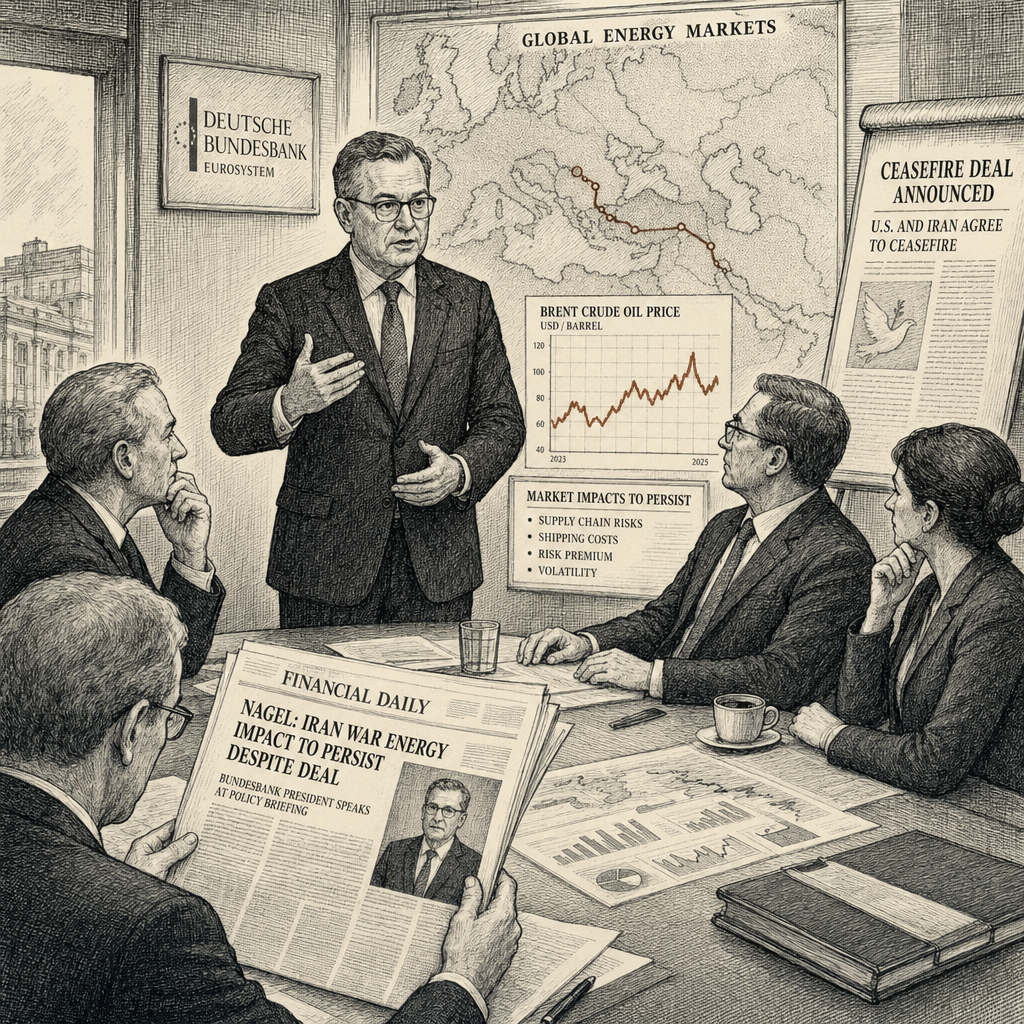
The ceasefire deal between the United States and Iran “offers reason for hope,” Bundesbank President Joachim Nagel said Monday in a speech in Frankfurt, but he warned that the economic fallout from the war in the Middle East will continue for months.
“Fortunately, a ceasefire and the reopening of the Strait of Hormuz are now in sight. There is reason to hope for peace,” Nagel said, according to prepared remarks. “Nevertheless, even if the Strait of Hormuz becomes navigable again soon, it will take months for the oil supply to return to normal.”
The European Central Bank last week raised its key interest rate by a quarter percentage point as inflation accelerated after the outbreak of the Iran war. Nagel, a member of the ECB’s governing council, said the bank was “keeping all options open” for its meeting next month, signaling that further tightening remains on the table.
The Bundesbank president said the ECB is not dealing with a short-term supply shock that policymakers can look through passively. “Monetary policy is not dealing with a short-term supply shock that we can passively look through,” Nagel said.
Nagel added that second-round effects on inflation cannot be ruled out given that high energy costs will persist in the coming months. If inflation expectations rise, wage demands could increase, he said, driving price pressures further.
He also noted that price pressures could rise again when policy measures introduced to lower energy prices expire. Those measures damped the eurozone’s inflation rate by about 0.4 percentage points in May, Nagel said. Headline inflation came in at 3.2%, well above the ECB’s 2% target.
The Bundesbank last week lowered its forecast for German economic growth to 0.5% this year and 0.8% in 2027, down from the 0.6% and 1.3% it had anticipated in December. Nagel said the economy should then pick up speed by 2028.
ECB President Christine Lagarde separately told French radio station France Culture on Monday that the reported U.S.-Iran agreement was “good news.” “One can only welcome it,” Lagarde said, though she cautioned that there had been prior occasions when hopes were dashed just as a deal seemed imminent.
The conflict in Iran, which began in late March, sent oil prices surging and disrupted shipping through the Strait of Hormuz, a strategic chokepoint through which about a fifth of the world’s crude passes. The reopening of the strait has been a central demand in negotiations.