- The Wall Street Journal’s Markets A.M. newsletter, in its June 15 edition, asked readers to share everyday encounters that signaled a market peak was imminent, a question posed as SpaceX held the largest IPO ever and Elon Musk became the world’s first trillionaire.
- Readers recounted anecdotes from past market tops, including a janitor bragging about day-trading profits near the 2000 peak, a dentist leaving a patient to discuss stocks, and a waiter at a Manhattan restaurant asking about Qualcomm.
- Current anecdotes include a broker who had long ignored a client suddenly pitching a private-equity fund, a housecleaner recommending chip stocks, and an extremely conservative investor asking for SpaceX stock.
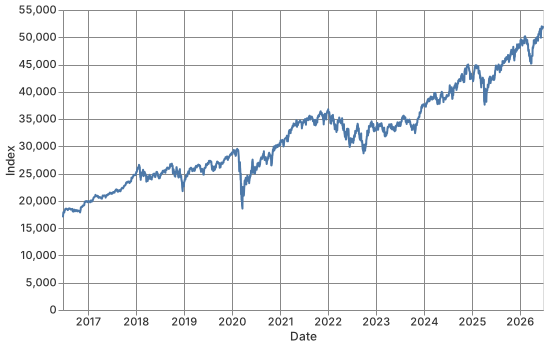
- The Dow Jones Industrial Average stood at 51,202.26 on June 15, according to Federal Reserve data, as stocks rallied on news of a tentative U.S.-Iran deal to end hostilities and reopen the Strait of Hormuz.
U.S. stocks surged premarket Monday after the United States and Iran reached a tentative agreement over the weekend to end hostilities and reopen the Strait of Hormuz, the Markets A.M. newsletter reported. Oil prices tumbled to their lowest since early March, the newsletter said. The Dow Jones Industrial Average closed at 51,202.26 on June 15, according to Federal Reserve data.
In his June 15 edition, newsletter editor Spencer Jakab asked Markets A.M. readers to share their personal “shoeshine boy” moments—an encounter with an everyday person that convinced them a market peak was imminent. The question drew heavily from a classic market-lore anecdote: the apocryphal story of Joseph Kennedy selling stocks before the 1929 crash after a shoeshine boy gave him a hot tip. Jakab wrote that the request appeared “on the eve of the biggest IPO ever, and the minting of the world’s first trillionaire.”
Readers offered a range of stories from past market tops. Bob Trebilcock related that, near the peak of the tech bubble, the janitor at his church bragged about his day-trading profits. Trebilcock said the janitor drove a vintage Corvette with a vanity license plate reading “NAZDAQ” but had to swap it for an old Subaru after the crash. Leon Sandler told the newsletter that when the man who mowed his lawn touted internet stocks in 1999, he sold his own holdings, avoiding the plunge. Sandler was not as fortunate in 2008—he said he had bought a lawn mower.
Geoff Saab said he was at a dental appointment when a client was chatting with the receptionist about search engine stocks. Overhearing them, the dentist left a patient in the chair to recount his market winnings. Roben Farzad, host of NPR’s Full Disclosure, said he was working at Goldman Sachs at the time. Trying to pay the check at an upscale Chinese restaurant in Manhattan, the waiter refused his Amex card and kept repeating an unintelligible word. Farzad said his colleague finally translated: He was asking about Qualcomm.
John Riley said he stopped for an oil change on the eve of the financial crisis, and the mechanic told him about his “scary” stock positions. Spooked, Riley said he dumped most of his own holdings just in time. Christopher Grinnell recalled construction workers clustered around a copy of The Wall Street Journal in 1987 “having an animated discussion” days before the Black Monday crash. Elliot Sommer and his wife sold their silver coins and tea set for a small fortune when the Hunt Brothers attempted to corner the silver market in 1980, but his aunt held out for more and missed the peak. Her butcher had advised her to wait.
Other readers offered broader signs. Dan Weil said expensive renovations at country clubs signal a top because members feel like they have money to burn. John Nowicki said celebrities giving financial advice is a red flag, recalling slugger Jose Canseco being interviewed on CNBC. Sandra Wiegand said she suspected the jig was up in 2008 when her tenant, a stripper who paid her in “smoky bills,” suddenly could not come up with rent. Frank Bittel said he walked into a bar in Columbus the night before a big Ohio State game and found patrons watching business news instead of sports. “It was so incongruous, a bunch of drunken Buckeye fans watching the stock market results,” Bittel is quoted as saying.
Some stories served as “anti-shoeshine boy” moments—encounters that signaled a bottom. Bruce Lebowitz said his daughter-in-law asked him at the March 2009 low whether stocks would “go to zero.” He said he pored over his copy of the Journal the next morning and found beaten-down stocks to buy. John Herrell, managing the finances of a medical clinic during the 1973-1974 bear market, said he got a call from a surgeon in the operating room wondering whether he should sell his IBM stock. The Dow hit bottom that day. “I realized I had found the last seller,” Herrell is quoted as saying.
Recent anecdotes also surfaced. Scot Turner said his broker, who had long ignored his calls, buzzed him recently with a great opportunity—a previously closed private-equity fund. Mark Termes wrote that his longtime housecleaner, who had never mentioned investing, recommended two chip-making stocks to him this month. Financial adviser Jeffrey Weinstein said an “extremely conservative” client who only owns municipal bonds just asked him to buy some SpaceX stock. Warren Wilson, a long-time reader, said he laughed when a chart of recent market performance could not fit in its usual spot on the Journal’s “B” section page. He said he sold a quarter-million dollars worth of stock just before the worst plunge in more than a year.
Jakab, in the newsletter, noted that while the anecdotes do not definitively signal a bubble, the pattern of non-professionals enthusiastically sharing equity tips has historically coincided with market peaks. He closed by quoting reader Scott Zodin’s reflection after a carwash attendant quit to become a day trader two weeks before a crash: “When the king of Armor All leaves to trade stocks, the top is nearer than anyone wants to believe.”