- Chicago resident John Roberts launched a petition calling for a citywide suspension of delivery robots, citing near-misses, collisions, and blocked sidewalks; the petition has gathered about 4,400 signatures.
- Glendale, California, is considering a temporary ban on the vehicles after city officials said the robots appeared without permission and created accessibility problems for elderly pedestrians.
- The Independent Workers Union of Great Britain warned that widespread deployment of delivery robots could devastate precarious workers in London, where many rely on gig-economy deliveries.
- Starship Technologies, a major robot supplier, defended the devices as safe and said they have “slotted into everyday life” since 2018 in the UK.
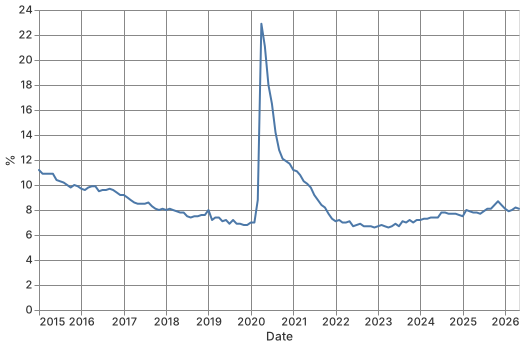
- A Transforma Insight report projects 2.1 million delivery robots will be in operation globally by 2034, while the broader U-6 underemployment rate stood at 8.1% as of June, according to Federal Reserve data.
Chicago resident John Roberts said he initially found the delivery robots “kind of neat” when they first appeared on his street. The feeling changed when he was out walking with his family and had to dodge an approaching machine. “The fact that we were on the one strip reserved for walking, and we were having to get out of the way — it felt a little off,” he told the BBC. Roberts launched a petition calling for a suspension of all delivery robots across Chicago until safety tests are conducted and rules are established. It has collected about 4,400 signatures. He reported collisions and injuries, including an incident where a person was struck by a robot’s safety flag.
The machines — formally known as autonomous urban delivery vehicles — now operate in U.S. cities including Chicago, San Francisco, and Glendale, as well as in the UK, Japan, South Korea, and Germany. Companies such as Starship Technologies use cameras, sensors, and GPS to navigate sidewalks, transporting groceries and fast food. They say the robots can reliably identify obstacles, cross streets safely, and reduce traffic and emissions.
Some cities have pushed back. San Francisco limited the vehicles to less busy parts of the city. Toronto has prohibited them from sidewalks since 2021. In Chicago, they have been banned from two small areas. Glendale City Council member Ardy Kassakhian said the robots appeared without warning and that the council initially did not know which company was operating them. He cited a “stand-off” between a robot and an elderly person, as well as broken-down machines blocking sidewalks. “We need a regulatory framework,” Kassakhian said, “operating rules, insurance requirements, accessibility standards, possibly permitting fees, operational limits in high pedestrian areas, and accountability for the operators.”
In the UK, delivery robots are being piloted in several cities. There have been reports of Uber Eats vehicles vandalised in Sheffield. Starship Technologies European operations director Danny Pass said perceptions need to change. “The robots are friendly, they’re polite and they’re programmed to be careful. They’ve slotted into everyday life in loads of communities since we started out in the UK back in 2018,” he said.
Labor concerns have also emerged. The Independent Workers Union of Great Britain, whose members include delivery drivers, said it has expressed concerns to the government. President Alex Marshall warned that widespread permanent deployment “would mean whole communities in London, where a lot of people are precarious workers, would really suffer. People would be fighting for their lives against these pointless robots.” The broader U-6 underemployment rate, which includes discouraged workers and involuntary part-time workers, stood at 8.1% as of June, according to Federal Reserve data, a measure that labor advocates say could be affected by further automation.
Analysts expect the fleet to expand rapidly. A Transforma Insight report concluded that by 2034, 2.1 million delivery robots will operate worldwide. Regulation remains fragmented: some countries such as South Korea and Japan have taken a liberal approach; others are still deciding.
Roberts said he is fighting for the best possible outcome for pedestrians in Chicago. “There’s a sense that change like this, even when it’s unwanted, is inevitable. But even if none of us can stop the future, we can at least choose which future we move into.”