Summary
- About 20,000 protesters gathered at the G7 summit in France, a sharp decline from the estimated 200,000 who met the G8 in Genoa 25 years ago.
- Protesters set fire to a Tesla as an opening move, targeting what they described as grotesque and unsustainable wealth inequality.
- Elon Musk became the world’s first trillionaire on June 12, 2026, with his wealth reported at $1.4 trillion as of the summit.
- German Chancellor Friedrich Merz declared the summit a success for having “found common language” in its support for Ukraine, while U.S. President Donald Trump’s position on Ukraine aid remained unclear.
- French President Emmanuel Macron reportedly spent the week concerned about Trump leaving early, and British Prime Minister Keir Starmer was caught on a news feed asking whether other leaders were in a meeting he had not been invited to.
About 20,000 protesters gathered at the G7 summit in France this week, a fraction of the estimated 200,000 who met the G8 in Genoa 25 years ago, as activists focused their demonstrations on what they described as grotesque and unsustainable wealth inequality.
Police detained protesters overnight in a kettling operation, which involves containing crowds in a confined area without providing facilities, according to reports from the summit in Evian, France.
One of the opening moves from protesters was to set fire to a Tesla, a Guardian columnist who attended the Genoa protests 25 years ago wrote. The columnist, Zoe Williams, noted that the choice of vehicle reflected a specific target: Elon Musk, who became the world’s first trillionaire on June 12, 2026, with his wealth reported at $1.4 trillion as of the summit.
“The person with £1 in the world is as close to the second-richest man on Earth as that man is to Musk,” Williams wrote.
The smaller turnout at this year’s summit compared to Genoa in 2001 reflects a shift in the nature of protest, Williams argued. The Genoa protests were part of a wider anti-globalization movement that had honed its tactics at the 1999 “Battle of Seattle” outside the World Trade Organization summit. The G8’s security measures in Genoa included a no-fly zone and a heavily fortified “red zone,” and police brutality against demonstrators drew international attention.
Williams wrote that she feels no need to protest the G7 now “because it’s collapsing all by itself,” citing internal divisions among the leaders.
German Chancellor Friedrich Merz declared the summit a success for having “found common language” in its support for Ukraine, according to Williams. But the columnist noted that U.S. President Donald Trump’s relations with Russian President Vladimir Putin are opaque, his support for Ukrainian President Volodymyr Zelenskyy “looks more like coercive control,” and Trump has not committed to any military aid for Ukraine since taking office.
“You cannot watch a rules-based order in its pomp where only most participants are playing by the rules,” Williams wrote. “It’s like watching a game of football with a horse on the pitch.”
French President Emmanuel Macron reportedly spent the week concerned about Trump leaving early, as he did last year, Williams wrote. British Prime Minister Keir Starmer was caught on a news feed asking whether the rest of the leaders were in a meeting he had not been invited to.
“The only sense in which all these leaders are united is in their determination to pretend that their unity has held,” Williams wrote.
The summit also devoted an agenda item to banning social media for under-16s, which Williams described as “the clearest possible signal that governments will unite to do anything, as publicly as possible, to delay the moment when they have to take on the forces of concentrated private capital.”
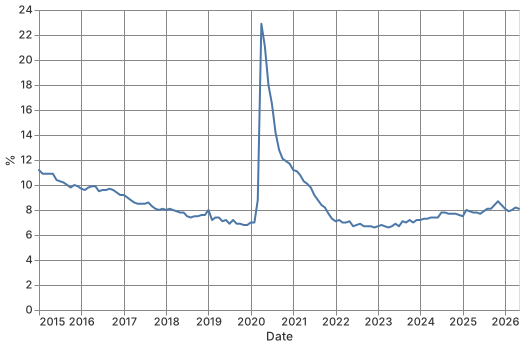
As MSI previously reported, Europe tread carefully with Trump at the G-7 after the Iran war strained the alliance. The broader U.S. underemployment rate, as measured by the U-6 indicator, stood at 8.1% as of the article’s publication date, according to FRED data.