The International Energy Agency on Wednesday projected global oil demand will fall by 1.1 million barrels a day this year — sharply deeper than its prior forecast of a 420,000-barrel-a-day decline — as the monthslong Gulf supply shock drives prices higher and disrupts flows through the Strait of Hormuz.
The Paris-based energy watchdog, which represents Western nations and their allies, said in its latest monthly report that supply will begin to recover in 2027, rebounding to 8 million barrels a day, as the U.S.-Iran interim deal expected to be signed this week gradually normalizes trade through the vital waterway. The IEA described the agreement as “an encouraging step forward,” but cautioned that “a full recovery will not be immediate, however, as mines will have to be removed from the main shipping lanes and supply chains will take time to normalise.”
The agency revised its demand forecast from a June projection, now expecting a contraction of 1.1 million barrels a day this year — a downgrade from its prior estimate of a 420,000-barrel-a-day decline. Next year, it forecast demand growth of 2 million barrels a day as trade flows normalize, prices fall and the economic outlook improves.
The U.S. and Iran have reached a preliminary agreement to end hostilities, with a formal signing scheduled for Friday, the IEA said, citing reports. The Wall Street Journal reported that the deal includes waivers on U.S. sanctions targeting Iranian oil sales and the lifting of blockades in the waterway, which normally handles roughly one-fifth of the world’s oil and natural-gas flows.
Brent crude, the international benchmark, fell below $80 a barrel on Wednesday, while West Texas Intermediate futures traded at $75 a barrel. Both benchmarks settled more than 5% lower in the previous session, marking their lowest closes since early March.
The IEA said global supply will fall by 3.9 million barrels a day this year as roughly one-fifth of the world’s oil supply remains bottled up in the Persian Gulf, before rebounding to 8 million barrels a day next year. In May, total global output was 13.6 million barrels a day below prewar levels. Exports from Gulf producers fell by 1.1 million barrels a day and were nearly 15 million barrels a day below February levels.
Iranian exports were hit particularly hard by the U.S. blockade, dropping by 1.4 million barrels a day to just 230,000 barrels a day, the IEA said. Some of those losses were offset by ship-to-ship transfers in the Gulf of Oman, a route often used to obscure cargo origins; such transfers climbed sharply in May and reached as much as 1.8 million barrels a day by early June.
The drawdown in global stockpiles has helped cap oil price gains, the IEA said. Global observed inventories fell by 143 million barrels in May, accelerating the average pace of stock draws since the conflict began to 3.8 million barrels a day. OECD government inventories fell by 163 million barrels to their lowest level since December 1990.
Factors that have eased pressure on the market include softer global demand, weaker crude imports by China, stronger U.S. exports, and increased use of pipeline routes from Saudi Arabia and the United Arab Emirates, the agency said.
Market watchers said a full recovery of Strait of Hormuz flows will take months as shippers face logistical and security challenges including vessel repositioning, port scheduling and insurance coverage.
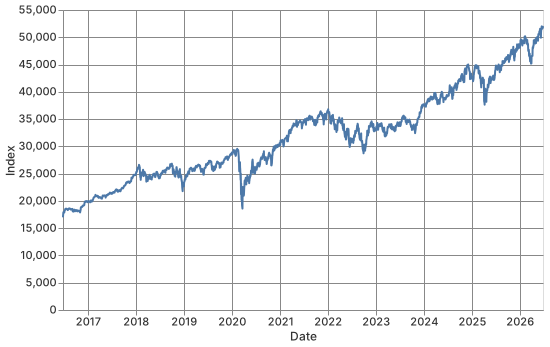
MSI has reported that the Dow Jones Industrial Average closed at 51,999.67 on June 17.