President Trump on Wednesday defended his agreement to end the three-month Iran war, saying he wanted to avoid an “economic catastrophe” that could have resulted if the conflict the U.S. launched had continued. Speaking to reporters at the Hôtel Royal in Évian-les-Bains, France, where he and other world leaders gathered for the Group of Seven meeting, Trump said he was influenced by the stock market’s rise as he worked toward a resolution.
Trump said he did not want to be compared with former President Herbert Hoover, who was president during the 1929 market crash that led to the Great Depression. “He was always the one I didn’t want to be,” Trump told reporters. “I didn’t want to see an economic catastrophe.”
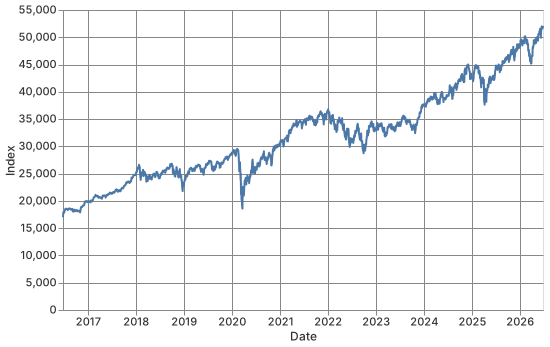
The Dow Jones Industrial Average stood at 51,999.67 on Wednesday, according to FRED data.
It was an acknowledgement by Trump that his decisions were swayed in part by the global reaction to the three-month conflict, which pushed up energy costs during a midterm election year. Some of Trump’s own allies turned against him, saying he abandoned his America First policies that he campaigned on.
The “memorandum of understanding” Trump announced Sunday, which still hasn’t been released publicly, would see Tehran reopen the strategic waterway after the U.S. lifts sanctions on its oil sales, providing the regime with much-needed revenue. Iran also committed not to seek a nuclear weapon — a statement it has made before — but how it would do so will be the subject of negotiations with the U.S. over the next two months.
Trump threatened Iran with more attacks if it didn’t abide by the terms of the agreement. “If they don’t honor that, we’ll probably go back to bombing them until they honor it,” Trump said. “It’s amazing what bombs can do.”
The president’s comments were his latest full-throated defense of an agreement drawing criticism back home. The interim agreement is widely seen as the biggest foreign-policy bet of the president’s second term.
The pact was met warmly by the G7 leaders in this pristine Alpine town. “I support it, I think it’s necessary,” said French President Emmanuel Macron, who hosted the summit. But he conceded that it didn’t solve every problem, including the nuclear issue, and that the risk remained that the deal could collapse. Macron cited his concern of a return to fighting in Lebanon between Israel and Hezbollah, an Iranian proxy militia, or that Tehran could insist on collecting tolls in the Strait instead of allowing the free flow of trade.
Trump is scheduled to head back to the U.S. on Wednesday night after a glitzy dinner in Versailles, the palace for French kings outside of Paris. In Washington he will face resistance from Iran-policy hawks who say the president is giving up far more than he is getting, arguing Trump had to pay a heavy price to revive commercial shipping in the Strait of Hormuz, which was open before the war began. Trump did all this without receiving clear guarantees Iran will drop its nuclear ambition, critics say.