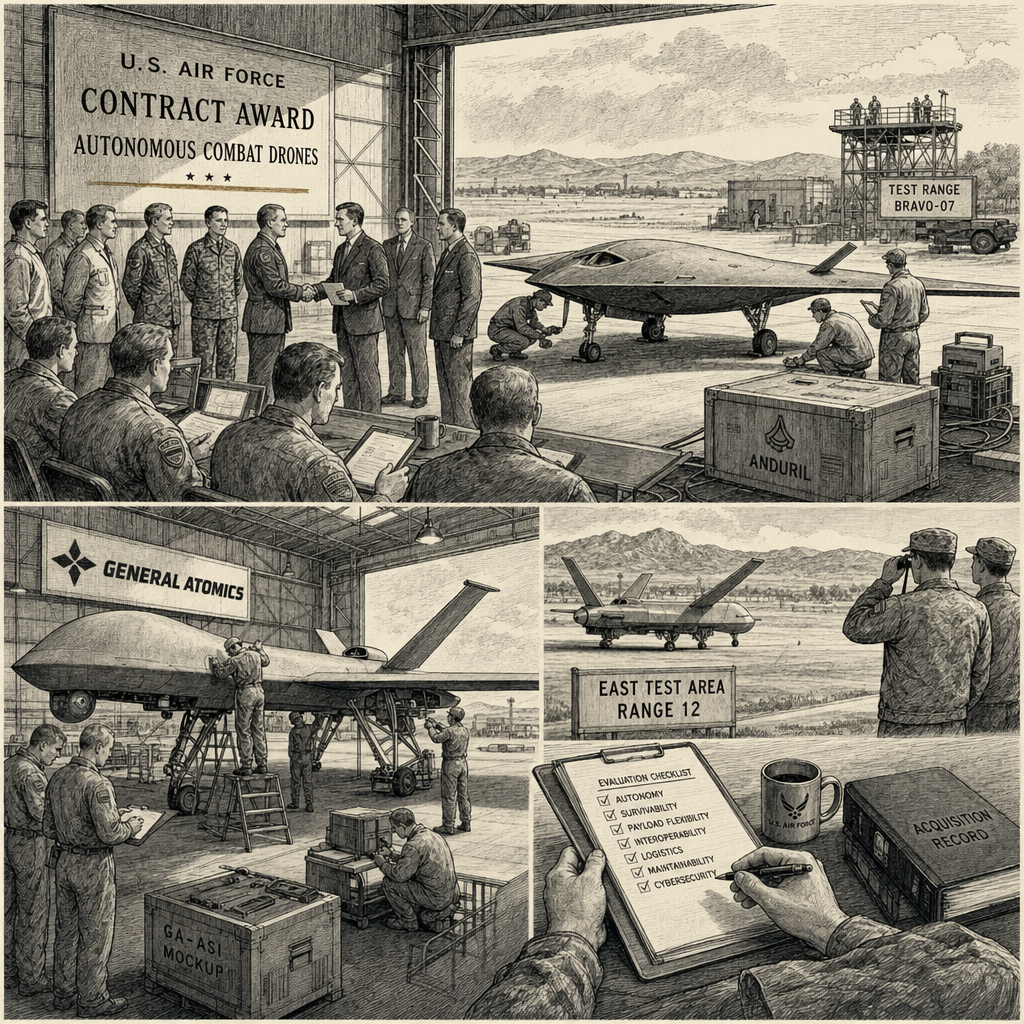
The U.S. Air Force has taken a major step toward reshaping its combat air fleet, awarding contracts to Anduril Industries and General Atomics for a new generation of autonomous drone fighters designed to strike deep into enemy territory alongside human-piloted warplanes. The collaborative combat aircraft, or CCA, represent what the service describes as “the next critical evolution of air power.”
General Ken Wilsbach, the Air Force chief of staff, said the new drones will “change how we project power and generate mass in highly contested environments.” The term “highly contested environments” is military shorthand for airspace defended by advanced interceptors and surface-to-air missile systems fielded by China and Russia.
The two drones — General Atomics’ FQ-42 and Anduril’s FQ-44 — differ in design. The FQ-42 carries its missiles in an internal weapons bay, while the FQ-44 carries munitions externally on its wings. Both are built to fly autonomously with limited human command, a departure from today’s Reaper drones, which are flown remotely by human operators on the ground.
Col. Timothy Helfrich, the Air Force’s portfolio acquisition executive for fighters and advanced aircraft, said buying the drones from two companies will promote “continuous competition” and “drives the best outcomes in schedule, cost, and performance.” The Air Force has also awarded separate, undisclosed contracts to Anduril, Shield AI, and RTX’s Collins Aerospace to develop the software that will control the autonomous fleet.
The Pentagon’s budget request for fiscal 2027 includes more than $1 billion for the CCA program specifically, with a total of more than $9.5 billion planned across the next five years. An Air Force spokeswoman said the contract terms and the number of aircraft in the initial deal are classified.
Air Force officials said they want the drones to cost roughly one-third the price of a manned F-35 fighter, which runs about $82.5 million. By comparison, the newest Reaper, the MQ-9B SkyGuardian, costs about $30 million. The military plans to buy roughly 150 of the new drones by the end of the decade and about 1,000 in total.
Caitlin Lee, a drone expert and director of acquisition and technology policy at the RAND Corporation, said the Pentagon’s shift toward larger, more expensive autonomous aircraft reflects the need to operate in regions where U.S. aircraft face a different threat environment than the one in Ukraine. “China’s diverse missile inventory and formidable electronic warfare capabilities can destroy or render ineffective U.S. aircraft on the ground or in the air,” Lee said. “Building large numbers of CCA at low cost will ensure some aircraft ‘live to fight another day.’”
The new drones are also designed to escort longer-range aircraft such as bombers, tankers, and cargo planes, according to Lee.
Stacie Pettyjohn, a senior fellow and director of the defense program at the Center for a New American Security, said the drones are likely to evolve from air-to-air combat roles into ground-strike missions over time. “I think we always want the leading edge,” Pettyjohn said, “and to the extent possible, to have uncrewed systems forward, since they are going to be at risk.”