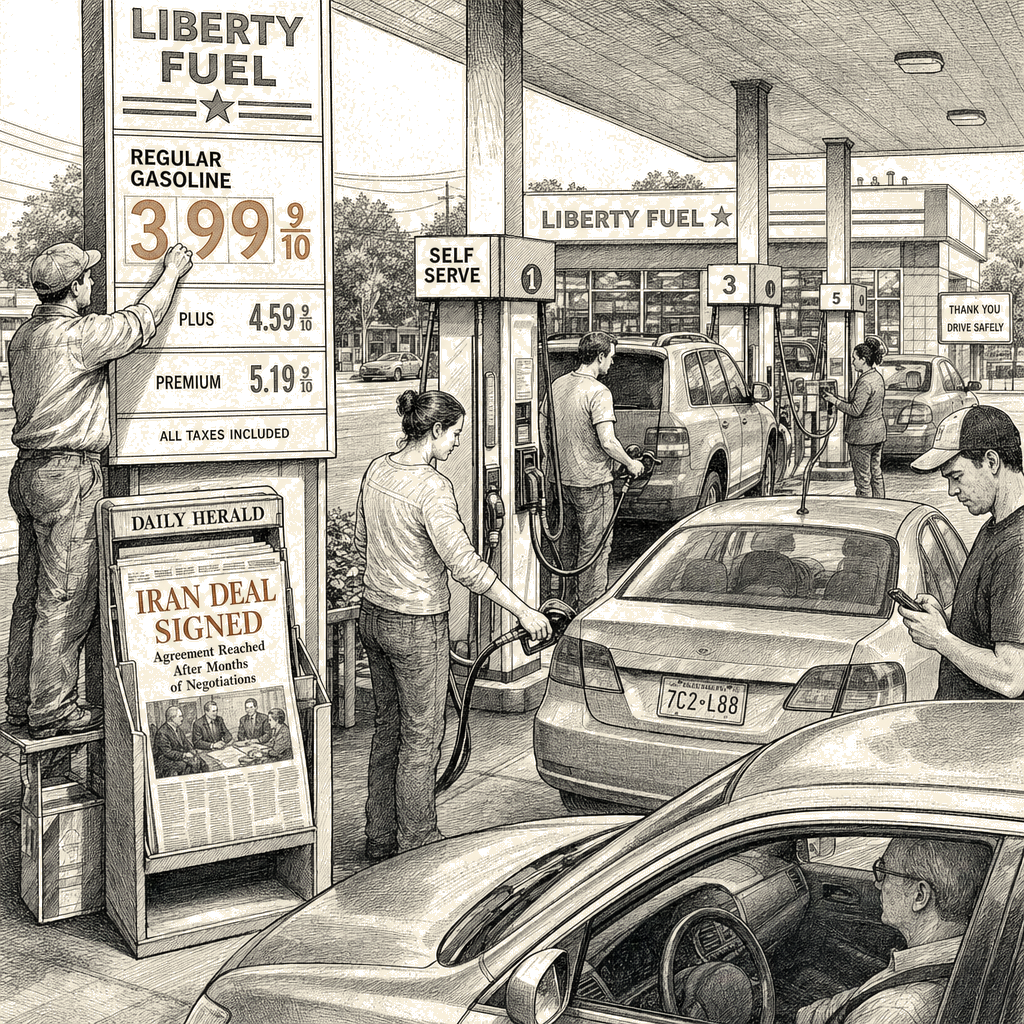
The average price of a gallon of regular gasoline in the United States fell to $3.999 on Thursday, dipping below the $4 threshold for the first time since March, after President Donald Trump signed a preliminary agreement with Iran to end the war and reopen the Strait of Hormuz.
The decline has provided some relief for drivers who have faced soaring fuel costs during the conflict. But prices remain about $1 a gallon higher than they were before the U.S. joined Israel to attack Iran in February, according to the motor club AAA, and are approximately 25% higher than a year ago — a continued strain on household budgets across the country.
MSI previously reported that the war had driven gas prices to multi-year highs, with the national average hitting $4.16 as recently as early June when President Trump said prices were “not very high.”
Higher gasoline prices have also pushed up airline fares, while consumer goods such as groceries and shoes have increased in cost amid global supply chain disruptions linked to the conflict.
Even with crude oil prices falling — Brent crude dropped below $78 a barrel on Thursday, and the U.S. benchmark crude fell to just over $74 — experts warn that the sticker shock at checkout lines is likely to exceed the relief at the pump.
“Product prices across the United States are projected to keep climbing for the rest of 2026,” Patrick Penfield, a professor of supply chain practice at Syracuse University, told the Associated Press on Thursday. Penfield pointed to depleted inventories and ongoing supply chain consequences from the war. He noted that farmers already paid higher costs for fertilizer and other supplies in the spring, which will “ripple through to increased food prices by autumn.” At the gas pump, Penfield said limited U.S. refinery capacity “remains a significant bottleneck” toward bringing prices down.
The war has pushed U.S. inflation to its highest level in three years. The rising fuel costs have contributed to the broader price increases that the Federal Reserve has been monitoring.
The national average of $3.999 masks significant regional variation. In California, regular gasoline averaged about $5.64 a gallon on Thursday, according to AAA, followed by $5.57 in Hawaii. By contrast, prices in Indiana and Texas sat at about $3.40 and $3.49 a gallon, reflecting differences in proximity to supply and state tax rates.
The recent relief at the pump stems from cooling crude oil costs — the main ingredient in gasoline. Brent crude, the international benchmark, fell below $78 a barrel on Thursday, while U.S. benchmark crude dropped to just over $74 a barrel. That remains above the prewar level of roughly $70 but well below the $100-plus price seen weeks ago.
On the shipping front, major vessel operators have begun moving ships through the Strait of Hormuz after Wednesday’s signing of a memorandum of understanding, according to maritime data from Lloyd’s List Intelligence. Some operators reported that only limited side shipping routes were open.
U.S. Central Command said in a statement Thursday that it has lifted its blockade on all maritime traffic entering and exiting Iranian ports and coastal areas in the Strait of Hormuz. “American forces are not impeding the transit of vessels to or from Iranian ports on the Arabian Gulf and Gulf of Oman,” the statement said.
Despite the reopening, experts cautioned that it could take weeks or months for commercial shipping through the strait — a conduit for about a fifth of the world’s oil supply — to return to prewar volumes.