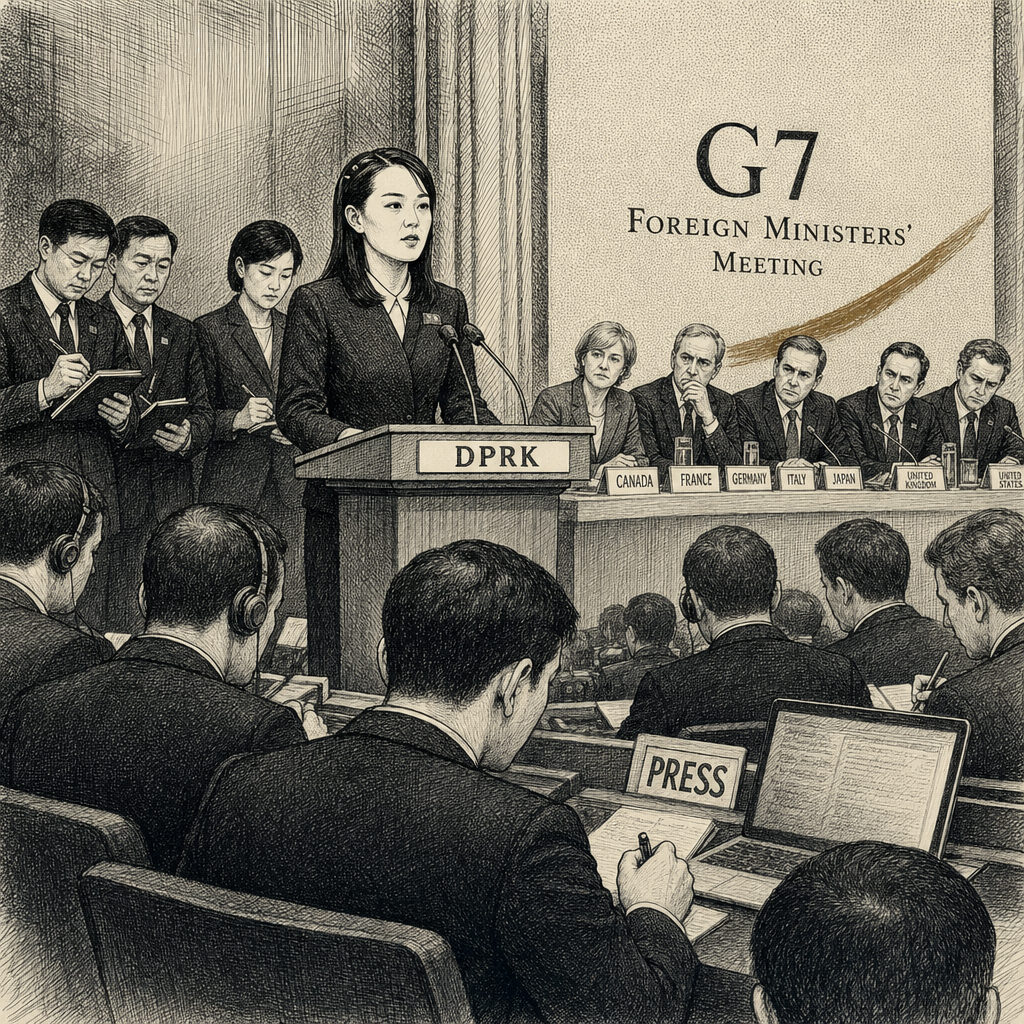
Kim Yo-jong, the powerful sister of North Korean leader Kim Jong-un and a senior official in the ruling Workers’ Party, issued the statement Thursday through the Korean Central News Agency (KCNA), Pyongyang’s state-run outlet. The remarks were a direct response to a joint statement released the previous day by leaders of the Group of Seven (G7) nations, who had gathered in Evian-les-Bains, France, for their annual summit.
In the G7 communique, the leaders reaffirmed their commitment to the “complete denuclearization” of North Korea, in accordance with existing United Nations Security Council resolutions. The summit statement came amid a prolonged diplomatic standoff: North Korea has conducted repeated missile tests over the past year and has consistently refused calls to return to denuclearization talks.
Kim Yo-jong dismissed the G7 demand outright, calling denuclearization “an irreversibly finalized agenda” that “can never be realized.” She characterized the nuclear arsenal as the country’s “core interests” and framed the issue as a matter of sovereignty.
“Nuclear weapons are powerful means of defending sovereignty and cornerstone for ensuring peace, defined by the law of the DPRK,” she said, according to the KCNA statement. DPRK stands for North Korea’s official name, the Democratic People’s Republic of Korea.
The North Korean official added that her country’s nuclear arsenal is “a means for self-defense.” In a pointed warning directed at Washington and its allies, she said that “anyone who tries to hurt the core interests of a nuclear weapons state would make the worst option of inviting disaster.”
Thursday’s statement continues a pattern of bellicose rhetoric from Pyongyang in response to international pressure. Kim Yo-jong has served as one of her brother’s most prominent public voices on foreign policy, issuing statements that frequently condemn U.S.-led initiatives and joint military exercises.
The G7 summit reaffirmation of the “complete denuclearization” goal reflects a longstanding position shared by the United States, Japan, South Korea, and other allies. However, North Korea has not engaged in substantive denuclearization negotiations since the collapse of the U.S.-North Korea summit in Hanoi in 2019. In recent months, Pyongyang has taken an increasingly confrontational stance, passing a law in 2022 that enshrined its nuclear status as irreversible and conducting a series of weapons tests that have drawn new rounds of international sanctions.