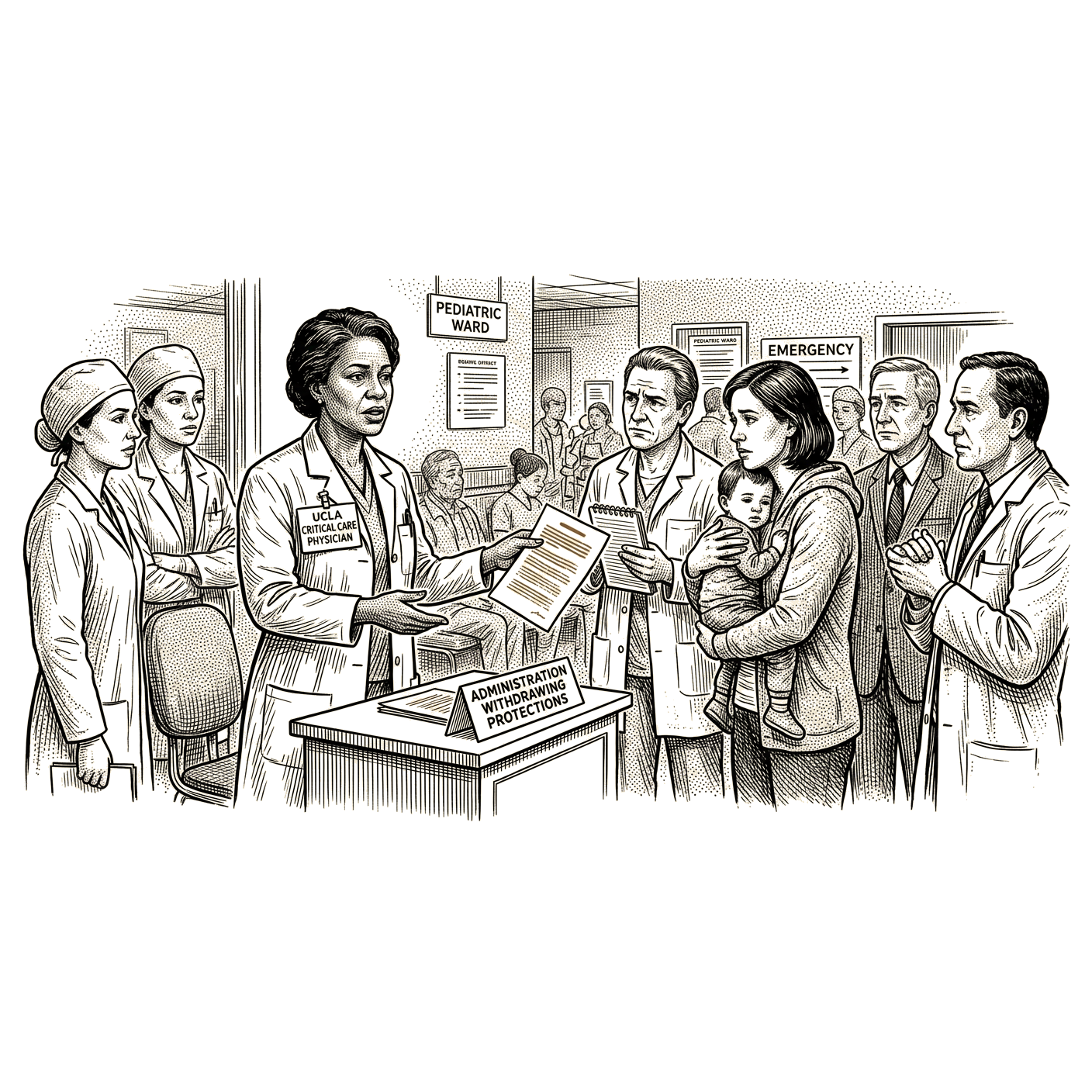
Dr. Robert B. Shpiner, a clinical professor of medicine in pulmonary and critical care at the David Geffen School of Medicine at UCLA who has practiced for more than 40 years, said the administration’s actions represent a systematic withdrawal of guarantees that once surrounded a child’s first hours in a U.S. hospital. Writing in The Guardian, he described a sequence of policy changes that, read individually, appear as reasonable measures of fiscal discipline, local control, or parental choice, but when arranged in the order a child grows, reveal a deliberate pattern.
The pattern begins at birth, Shpiner wrote. Under Health Secretary Robert F. Kennedy Jr., the routine childhood immunization schedule has been narrowed from 17 diseases to 11, and the hepatitis B birth dose is among the casualties. Shpiner said a hepatitis B infection caught in infancy turns chronic in roughly nine out of 10 cases, compared with about one in 20 in adults, producing cirrhosis and liver cancer decades later. He also noted that refusals of the vitamin K injection for newborns — which prevents bleeding into the brain — nearly doubled between 2017 and 2024, based on an analysis of more than 5 million births. “We are bringing back diseases that medicine spent a century learning to stop,” he wrote.
As children reach toddler age, Shpiner said they meet the next subtraction. The administration’s budget would cut the WIC fruit-and-vegetable benefit for small children by as much as three-quarters, from $26 a month to $10. Head Start, which serves more than half a million of the poorest preschoolers, was marked first for elimination and then for a freeze, with its federal staff cut by about a fifth.
By school age, Shpiner wrote, a child may be among the nearly four in 10 American children insured through Medicaid or the Children’s Health Insurance Program. He said 2 million fewer children are enrolled than when the president took office, citing Georgetown University’s count, and that the federal government’s data already shows a drop of at least 1.5 million. The largest reduction to food stamps in the program’s 60-year history has begun pushing 4 million people off the rolls, many of them parents. A $1 billion program that bought locally grown produce for school cafeterias was canceled outright last year, with the Agriculture Department explaining it “no longer effectuate[s] the goals of the agency.”
For children with disabilities, Shpiner wrote that the administration announced Tuesday — while he was drafting his piece — that it would move oversight of the Individuals with Disabilities Education Act, which guarantees 7.5 million such children an education, to HHS, and shift the Office for Civil Rights to the Justice Department. “No one has explained how this helps a single child,” he wrote. “It satisfies a campaign promise to abolish the Department of Education. That is the whole thing.”
Shpiner said the administration is also switching off the instruments that would register the harm: states no longer have to report whether children on Medicaid have been immunized, and vitamin K refusals were never counted federally to begin with. “Any clinician knows that silencing the monitor does not stabilize the patient,” he wrote. “It only ensures that no one hears the alarm. A government that did not expect to find damage would not work this hard to avoid looking for it.”
The administration’s answer, Shpiner said, is that voters wanted this and that Washington has no business in a child’s breakfast. “You can argue against any single one of these decisions on its merits,” he wrote. “What no argument accounts for is the consistency of who pays.”
Shpiner noted that last week, Kennedy asked a federal appeals court to fast-track its review of a March ruling that froze his vaccine changes, after a judge found 13 of his 15 new advisers unqualified to sit on the panel and the changes themselves arbitrary and capricious. Kennedy wants the reconstituted committee acting before the autumn respiratory season, Shpiner wrote.
Reflecting on his decades in medicine, Shpiner said the lesson of the early AIDS years in Los Angeles was plain: “The cost of looking away is paid in lives, and it is paid later, by the people least able to absorb it. We are looking away again.” He concluded, “This time the patients are children, and this time it is by design. You can measure a society by what it promises a newborn it will never meet. We are taking the promise back, one program at a time.”