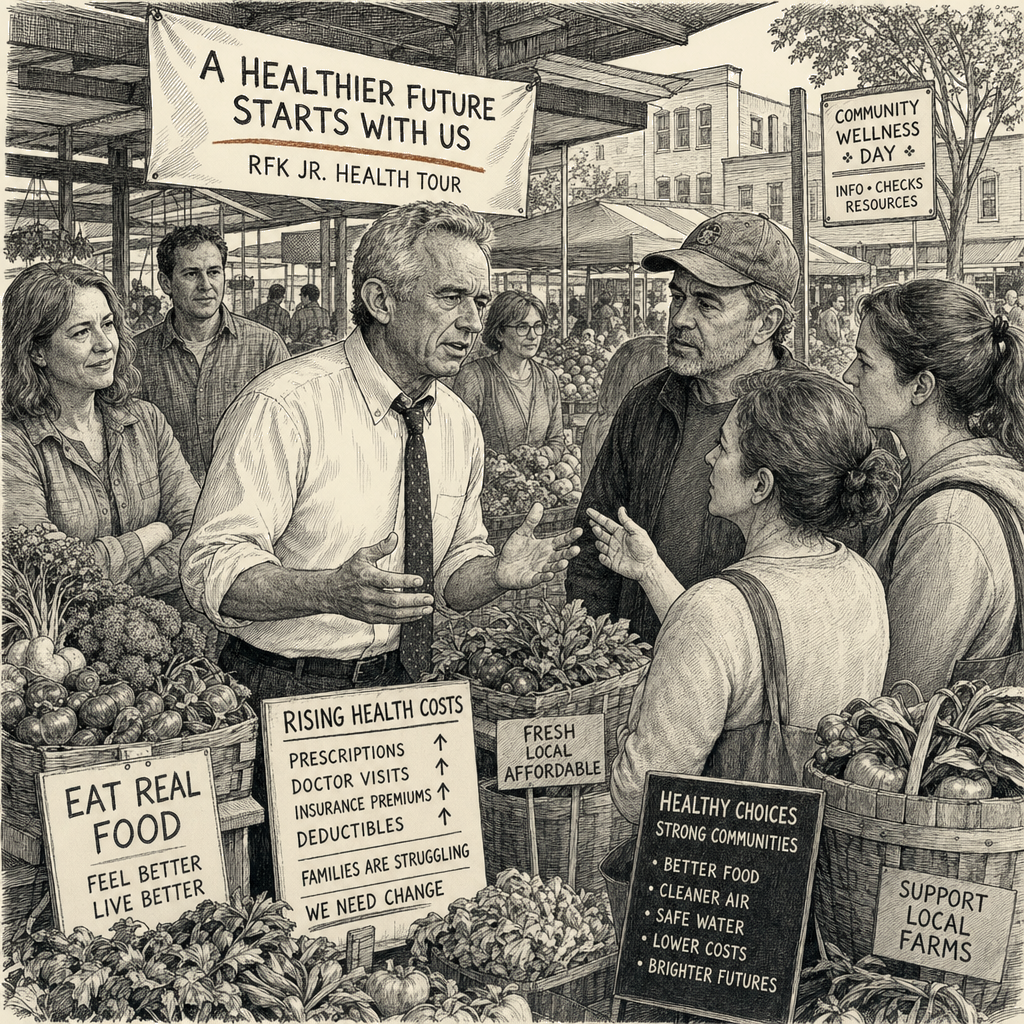
CHARLOTTE, Mich. — Health Secretary Robert F. Kennedy Jr. brought his “Take Back Your Health” tour to central Michigan this week, appearing alongside freshman Republican Rep. Tom Barrett at an apple orchard to promote healthy eating, but the events were repeatedly interrupted by voters demanding to know how the administration would address rising healthcare costs.
At the Charlotte, Mich., orchard event hosted by the conservative nonprofit America First Policy Institute, two audience members shouted questions at Kennedy before security escorted them out. “What about affordable healthcare?” one asked. “Did you not cut $790 billion last year?” Kennedy dismissed the figure, calling the Medicaid cuts referenced by the questioner a “myth,” according to the Wall Street Journal, which documented the exchange.
Republicans’ One Big Beautiful Bill Act last year cut more than $1 trillion in projected healthcare spending over the next decade, mostly from Medicaid, though spending on the program is still expected to rise due to cost increases and other factors.
The tension on display in Charlotte — and repeated at other stops across Michigan — underscores a deepening challenge for Republicans heading into the midterm elections this fall. Kennedy’s “Make America Healthy Again” platform, which focuses on chronic disease, chemical food additives, and dietary guidelines, polls well in isolation. An April survey by KFF, a health policy research nonprofit, found that 75% of respondents favor stricter regulation of food additives. But the same poll showed healthcare costs are a more potent factor than food or vaccines when voters assess candidates.
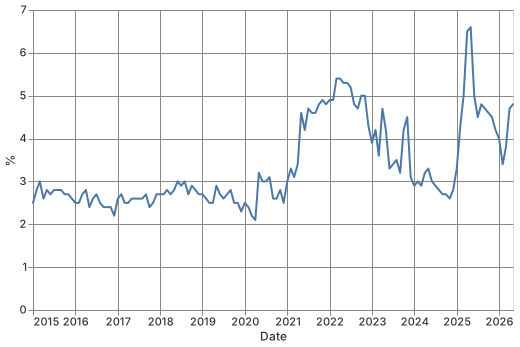
Consumer anxiety over costs is sharp. The University of Michigan’s Survey of Consumers, released this month, shows households expect prices to rise 4.7% over the next year. That level of inflation expectations can weigh on consumer sentiment regardless of the headline inflation rate.
Kennedy’s appearance alongside Barrett, whose seat is rated as a top Democratic target this cycle, reflects the White House’s strategy of deploying Cabinet secretaries to competitive districts to promote the administration’s agenda while avoiding violations of the Hatch Act, which restricts partisan political activity by federal employees. The tour is billed as a series of official site visits and policy events; Kennedy has nonetheless appeared alongside Republican candidates at multiple stops.
At the apple orchard, Kennedy addressed roughly 130 Michiganders, promoting revised dietary guidelines and urging the crowd to reconnect with what he called the “sacred ritual” of cooking. “If you are obese or overweight, it’s not your fault,” Kennedy said. “It’s because the government has been lying to you for 50 years.”
Kennedy traveled earlier in the week to a nutrition nonprofit’s greenhouse and farm in Holland, Mich., where he appeared with Rep. Bill Huizenga, whose district the nonpartisan Cook Political Report recently moved from “likely Republican” to “lean Republican.”
Not all attendees were persuaded. Mary DeBord, a 90-year-old Charlotte resident, said she used to vote Republican but plans to withhold support from Barrett. “He’s against vaccinations,” she said of Kennedy. “People died from all these plagues of disease until they started vaccinating kids.”
Collin Garn, 28, a Charlotte meat-shop owner who described himself as politically independent and a fan of Kennedy, said he will vote for Barrett based on personal acquaintance but is unlikely to support other Republicans. “A lot of guys my age are not interested in going to war for Iran,” he said. “People my age can’t afford housing. People are struggling just to pay their student loans.”
Kennedy’s trip followed similar swings through Wisconsin, Ohio, and Colorado. At a stop in Clinton Township, Mich., announcing new grant opportunities for addiction services, and at the Holland farm, local reporters pressed Kennedy on healthcare costs. He said only ineligible people would lose Medicaid under the Republican-backed changes and emphasized the administration’s focus on chronic disease. “The administration has completely changed the approach to public health in this country, and it’s a message that we want to get out to everybody,” he said.
Democrats are looking to exploit the disconnect. Erik Polyak, executive director of 314 Action, a group that works to elect Democrats with public-health and science messaging, said voters should tie Kennedy to healthcare costs and vaccine changes. “There’s this narrative out there that he’s this unique asset for Republicans, but we think that’s totally backwards,” Polyak said. “RFK Jr. is a political liability for Republicans, full stop.”