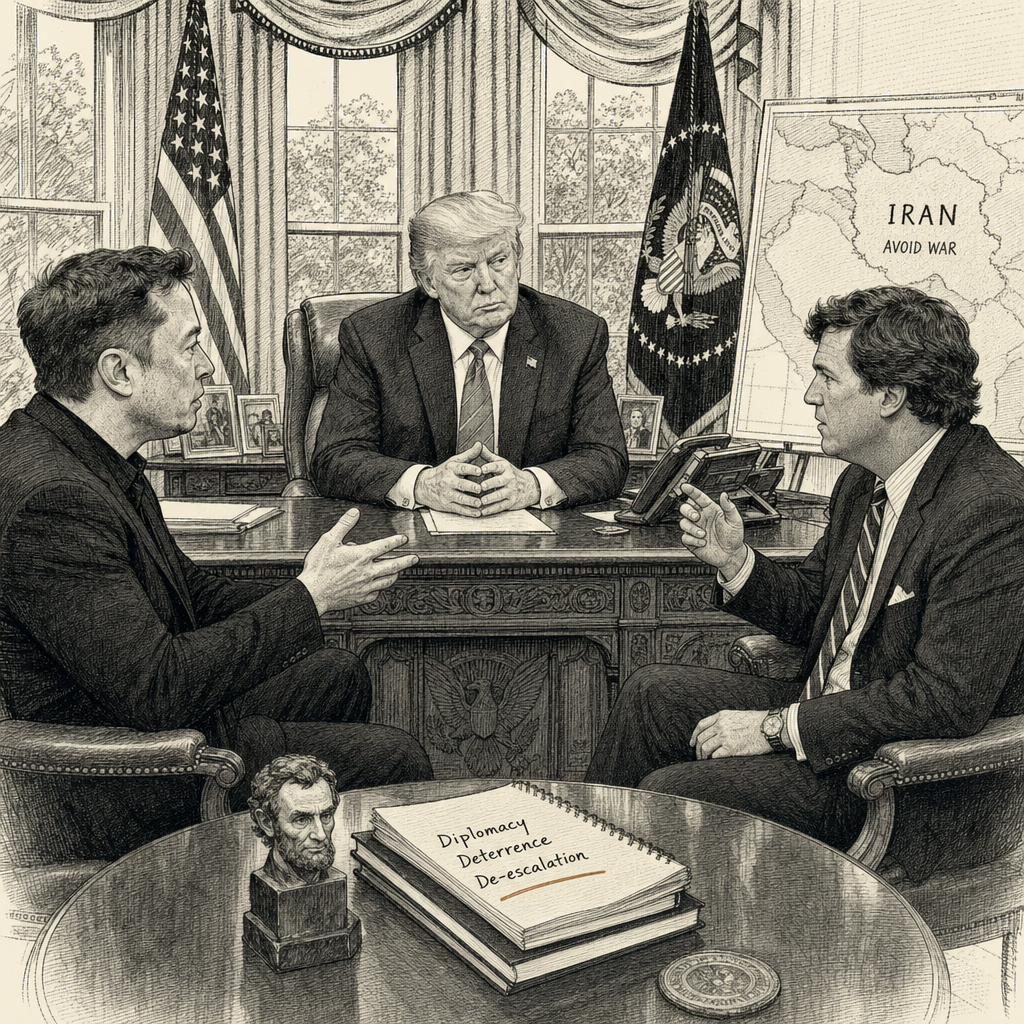
President Donald Trump told Elon Musk and Tucker Carlson in an Oval Office meeting early last year that he would not go to war with Iran, according to a new book by New York Times reporters Maggie Haberman and Jonathan Swan.
The book, “Regime Change,” scheduled for publication Tuesday, reports that Trump declared the assurance during a meeting with Musk, the SpaceX CEO and world’s richest person, and Carlson, a rightwing commentator who had criticized Trump’s refusal to criticize Israeli Prime Minister Benjamin Netanyahu over the Gaza war.
According to Haberman and Swan, Carlson “had criticized Trump for refusing to knock Netanyahu over the Gaza carnage; now he would make clear to the president that a broader war would be his ruin.” The authors quote Carlson telling Trump, “They want you to go to war with Iran,” and Trump responding, “We’re not doing that.”
Trump is also quoted as saying: “I don’t think there’s ever been an American president as powerful as I am.” The authors write that Carlson, “struck by this hubris,” replied: “Certainly not since FDR. Really, the only thing that could wreck it is war with Iran.”
The meeting occurred before Trump launched a military campaign against Iran on Feb. 28, 2026. An agreement ending the war was signed earlier this week.
As MSI previously reported, Trump has repeatedly denied that the Iran war violated his “no new wars” campaign pledge, including in a June 8 statement contradicting years of his own public remarks on the subject. The war also created well-documented cracks in Trump’s conservative-media support.
The book also recounts Trump’s reaction to images from Israel’s September 2024 attack on Hezbollah, in which pagers and other devices carried by the group’s members were remotely detonated across Lebanon.
Haberman and Swan write that Trump “regaled” Musk and Carlson with “lingering” descriptions of the injuries. “He had seen pictures, he said. Mutilated genitals and missing hands. He was horrified by the injuries, but fascinated as well, lingering on the scenes and the details,” the authors write.
The authors quote Trump describing a survivor’s injury: “looked like a great white shark came and just took a chunk out of him. It was like a shark bite. It was horrible.”
Trump “grew volatile, repeating, ‘It’s horrible, horrible!’” according to the book.
Haberman and Swan write that the depiction of Trump’s reaction was informed by Carlson, a critic of Israel and the Iran war. Musk, who was then leading the “department of government efficiency” initiative, is depicted as “transfixed” by a golden pager presented to Trump by Netanyahu.
The authors describe Trump as “at once enthralled and horrified” by the attack’s indiscriminate nature. “Many of the devices had detonated in public, and it was hard to know who was holding a pager when it exploded,” they write. “The indiscriminate nature of the killing and maiming had shocked Trump, and while he was taken by the ingenuity, he showed a measure of disbelief at its recklessness.”
Excerpts from “Regime Change” have also included accounts of Trump’s decision to go to war with Iran, Situation Room discussions about the Jeffrey Epstein scandal, and attempts to suspend legal rights amid an immigration crackdown. The authors note that Carlson’s words and Trump’s words are presented in quotes, indicating personal knowledge of the words and situations.