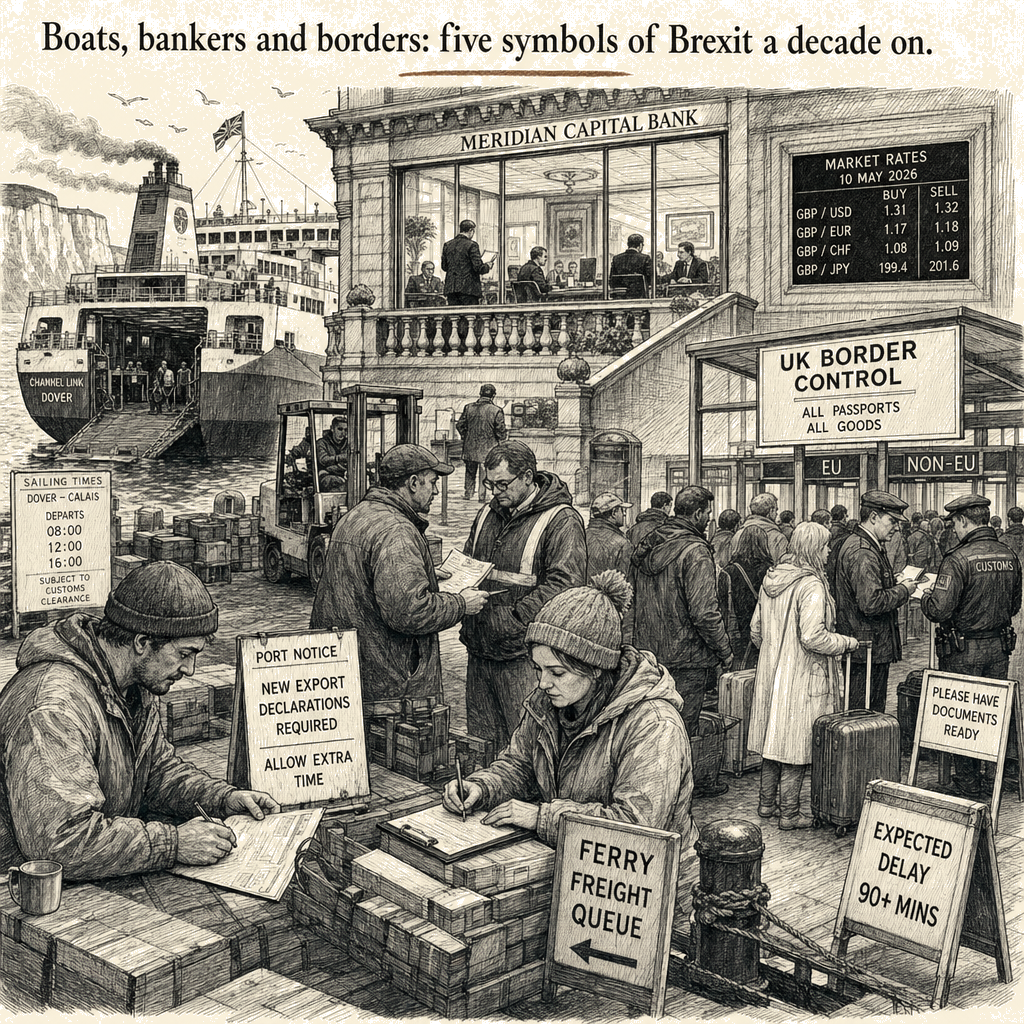
Ten years after the UK voted 52% to 48% to leave the European Union, the promised benefits of Brexit remain unevenly distributed. The June 23 anniversary of the 2016 referendum offers a measure of the campaign’s central promises — control of borders, sovereignty over fishing waters, a manufacturing renaissance and a financial hub freed from Brussels — against the reality that has unfolded over the subsequent decade.
Manufacturing: Nissan’s Sunderland plant grapples with decline
The fate of Nissan’s factory in north-east England was a totemic issue in the run-up to the vote. For leavers, the site near Sunderland represented British manufacturing prowess. For remainers, it symbolised what could be lost. The British car industry was firmly opposed to leaving the EU. Carlos Ghosn, Nissan’s chief executive at the time, argued that remaining made “the most sense for jobs, trade and costs”. The people of Sunderland voted 61% to 39% in favour of Brexit.
Theresa May, installed as prime minister after the vote, could not publicly admit Brexit threatened jobs at Nissan. In a deal whose details remained secret for more than two years, the Japanese carmaker was eventually granted £61m in state aid to persuade it to invest in new models. The government gave it another £101m in late 2022, and it is now in talks for more support.
Yet even that support could not fully compensate for the years of uncertainty with the prospect of a “no deal” Brexit threatening 10% tariffs on exports overnight. The UK’s trade and cooperation agreement with the EU in 2021 avoided that fate but added extra non-tariff barriers to car exports.
In 2016, the Sunderland factory made 507,000 cars, just shy of its 2012 record. Last year, it managed just 273,000. It is hard to disentangle exactly how much of that decline is due to Brexit — although Nissan warned privately that being left out of the latest batch of EU rules could create another “existential threat”. The negative impact has been partly masked by challenges including the coronavirus pandemic, the Ukraine war energy crisis, Donald Trump’s deglobalisation drive and Nissan’s own leadership chaos and 20,000 global job cuts.
This month the Sunderland factory secured a potential deal to produce cars for the Chinese manufacturer Chery. If confirmed it could transform the fortunes of the factory — albeit preserving jobs rather than adding thousands of new ones.
Brian Gu, the vice-chair of Chinese carmaker Xpeng, said this month that when looking to manufacture cars in Europe, the UK faces a disadvantage. “We will probably want to focus on the largest market first. The EU is one big market,” he said.
Fishing: ‘Nothing changed with Brexit’
One of the campaign’s most striking images was the clash between Brexit-supporting fishing crews sailing up the Thames led by then Ukip leader Nigel Farage and a pro-remain flotilla headed by rock star Bob Geldof. More than nine in 10 fishers told pollsters they intended to vote leave. Despite making up only about 0.3% of the British economy, the sector played an outsized role.
Freed from Brussels’ common fisheries policy, Britain was supposed to control access of foreign boats to UK waters and negotiate its own catch quotas. But many fishers felt betrayed by Boris Johnson’s 2020 deal, which allowed EU boats to continue fishing six miles off the coast until 2025.
That anger reignited last year after Prime Minister Keir Starmer extended EU vessels’ access to British waters up to 2038 as part of his “reset” deal. Mike Cohen, the head of the National Federation of Fishermen’s Organisations, said fishers were “enormously aggrieved”. “Given access to British waters was a valuable thing, we thought we’d be able to get something in return,” Cohen said.
The UK distant waters fleet now comprises just the Hull-based Kirkella, which catches cod and haddock in Arctic waters. Its owner sold the other boat in 2022 after the UK’s whitefish quota was slashed during negotiations with Norway.
Britain imported £4.1bn of seafood last year, double the value of its exports (£2bn), according to the public body Seafish. More restrictive immigration rules made it harder to recruit skilled overseas workers for crews.
“Nothing changed with Brexit,” said Derek Meredith, the owner of three fishing boats at Brixham in Devon. Soaring fuel prices and rising costs are making it harder to make a living, he said. “If I could sell all three of them today, they’d be gone.”
Travel: Blue passport a pyrrhic win; Irish passport demand soars
About 70% of the 54m UK passports in circulation are now the navy colour that replaced the burgundy EU-issue passport, a visible sign of Brexit that was brandished by victorious Brexiter ministers. But it proved a pyrrhic win. About 70m of the 90m UK overseas trips a year are made to Europe, latest data shows. Passport holders now share a lane with non-EU visitors and their blue passports get stamped every time.
The rocky introduction of the EU’s entry-exit system (EES) has turned queues into a fraught experience in some places, as border officers take biometrics. Even if most people experience little delay, Greece announced an exemption for UK travellers this summer, seeing bookings bounce compared with Portugal or Spain. When Etias is introduced, Britons will face a €20 (£17) charge to visit the EU.
Perhaps the most damning statistic is the surging demand for Irish passports — up 2,500% since the year before the referendum — granted to those of particular foreign ancestry. Its cover bears an Irish harp, not the royal coat of arms.
Social care: EU workers left during toxic debate; vacancies soared
The febrile debate left many of the thousands of EU staff caring for elderly and disabled people anxious about their future. Nadra Ahmed, chair of the National Care Association, recalled: “I think for six months before the referendum, we started to see this disquiet amongst our European colleagues. The Brexit debate was quite toxic. It kind of didn’t feel like they were going to be very welcome.”
In the years that followed, recruiting and retaining EU workers got increasingly hard. Raj Sehgal, who operates six care homes in rural Norfolk, said: “It just became impossible: we weren’t getting the applications.”
Kieran McCormick, who runs a recruitment agency for nurses and care workers across Northern Ireland, said: “We have seen the volume of European healthcare workers coming to work for us fall off the face of the earth.”
The number of unfilled vacancies across the care sector in England shot up from 78,000 in 2016-17 to 132,000 five years later. In response, the government allowed overseas recruitment in 2022. Annual applications for health and care visas peaked at 161,600 in the year ending November 2023, and one in three new starters in the sector was recruited from abroad. By 2024, the Conservatives tightened rules, and Labour later effectively ended overseas recruitment of care workers.
Sehgal said with local workers still hard to come by, he has been casting around for overseas students, but “the calibre of applicants is not the same”. McCormick said: “We don’t have a sufficient workforce to meet demand.”
City of London: Adaptation not collapse
Before the referendum, executives warned that bankers would flock to continental hubs. Estimates said up to 75,000 City jobs and as much as £10bn in tax revenue could be lost. But Miles Celic, chief executive of lobby group TheCityUK, recalled meeting then-Brexit minister David Davis in October 2016 in hopes of getting the City included in UK Brexit negotiations: “[Davis] listened very politely and at the end of it, he said: ‘I’m not worried about your industry, your industry is big enough and smart enough to look after itself.’ And that pretty much was what we subsequently saw … The industry has basically been fine. It has adapted.”
Ultimately only 7,000 jobs were lost to continental Europe, according to EY’s last Brexit tracker report in 2022. About 1.1 million people are still employed across the City today. Bosses have toasted regulators for tearing up the EU rulebook, scrapping banker bonus caps and loosening listing rules. The skyscraper 22 Bishopsgate, put on ice just before the vote, was restarted after four months and completed in 2020.