The ongoing crisis in the Strait of Hormuz has refocused attention on the global network of maritime chokepoints that underpin international trade, according to a report by The Wall Street Journal. The narrow waterway between Iran and the Arabian Peninsula, a vital artery for energy shipments, has been at the center of conflict since the U.S.-Iran war began earlier this year. Even before the latest closure, experts warned that normal traffic could take weeks to resume following peace negotiations, the Journal reported.
Iran said Saturday it had closed the strait again because Washington had failed to stop clashes in Lebanon. The U.S. military disputed Tehran’s announcement, stating that traffic continued to flow. The back-and-forth underscores the volatility of a passage through which one-fifth of the world’s oil and a significant share of liquefied natural gas travels from the Persian Gulf to international markets, especially to Asian economies such as South Korea and Japan.
The Strait of Malacca, linking the Indian and Pacific Oceans, is the fastest sea lane for energy from the Middle East to Asia. It is the world’s biggest oil transit chokepoint, the Journal reported, citing data from the U.S. Energy Information Administration that showed 23.2 million barrels of oil per day passed through its waters in the first half of 2025. China, which imported nearly 8 million barrels of crude oil daily through the strait in that period, is especially reliant on it. The importance of the passage was spotlighted when Indonesian Finance Minister Purbaya Yudhi Sadewa in April floated the idea of charging tolls for ships transiting the channel, a suggestion Indonesian officials later walked back.
The Panama Canal, connecting the Pacific and Atlantic Oceans, is a crucial funnel for trade to and from U.S. ports. The U.S. Federal Maritime Commission estimates it handles about 40% of U.S. container traffic, or roughly $270 billion annually. The canal became embroiled in U.S.-China tensions after President Trump said he wanted to take back control of it and criticized Beijing’s involvement. Hong Kong-based conglomerate CK Hutchison had operated two ports on either end of the canal before the Panama Supreme Court voided the contract in January.
Egypt’s Suez Canal provides a maritime route from Asia to Europe, handling large volumes of energy supplies and container ships. It is the third-largest oil transit chokepoint in the world, the Journal reported, with nearly 5 million barrels of crude passing through its waters daily in the first half of 2025, according to the EIA. In 2021, the 1,300-foot containership Ever Given ran aground and blocked the canal for six days, triggering massive disruption in global supply chains.
The Turkish Straits, the waterways between the Black Sea and the Mediterranean, are a conduit for oil from Russia and Kazakhstan as well as grain from Ukraine. Western sanctions on Russian oil set off a traffic jam in the passageway in 2022, the Journal noted. Sandwiched between Yemen and Djibouti, the Bab el-Mandeb Strait connects the Red Sea to the Gulf of Aden and is an important route for Middle Eastern oil. Iran threatened this spring to shut the strait with help from its Houthi allies in Yemen, the Journal reported.
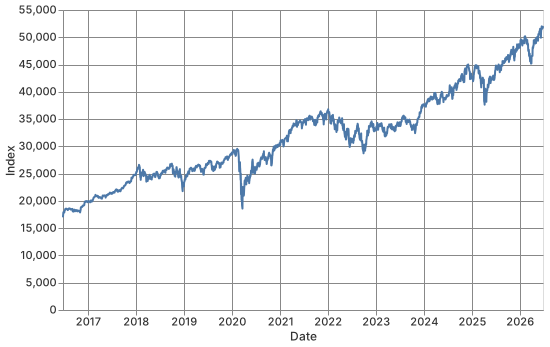
Overall economic jitters from the crisis were reflected in financial markets. The Dow Jones Industrial Average closed at 51,492.55 on June 21, as investors weighed the continuing uncertainty around energy supply lines and the potential for further disruption at global chokepoints.