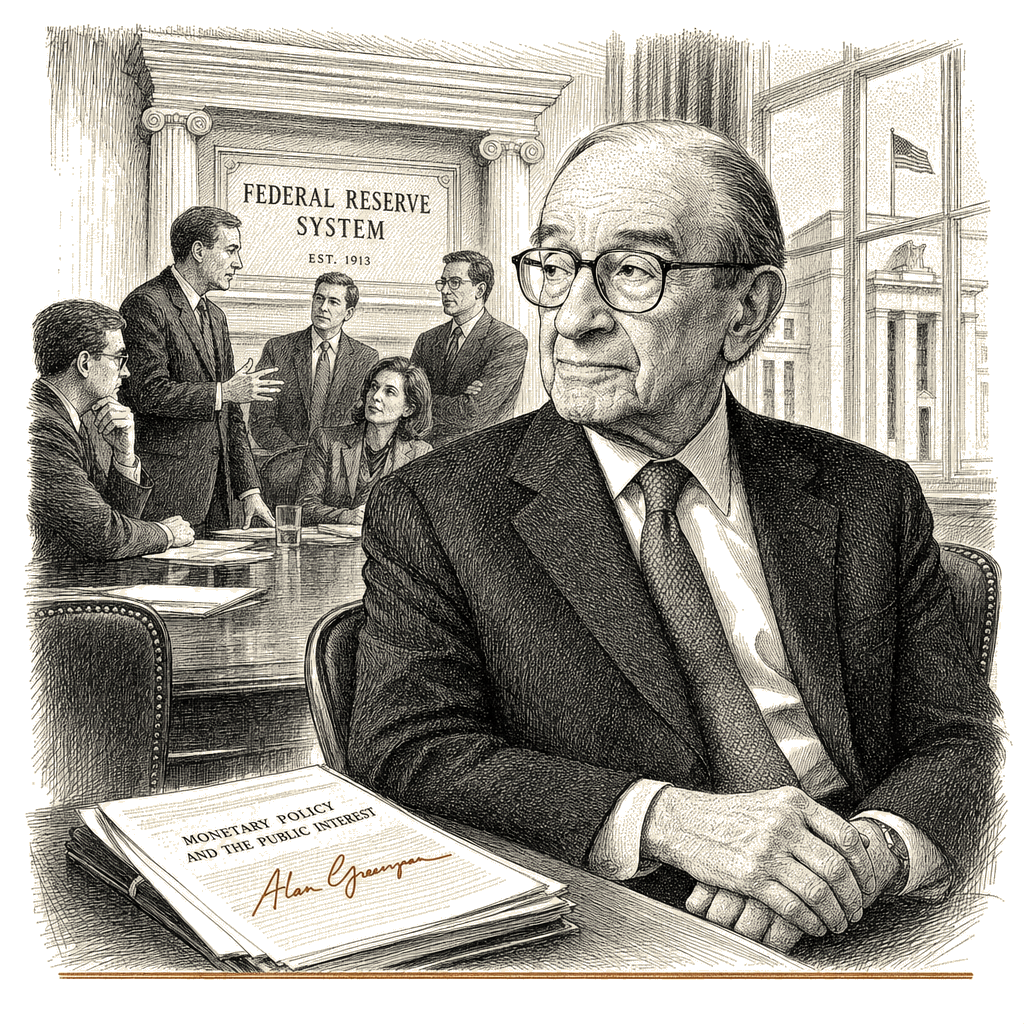
Alan Greenspan, who as Federal Reserve chairman steered U.S. monetary policy for nearly two decades through booms, busts and the dot-com era, died Monday at his home in Washington. He was 100.
His wife, NBC News correspondent Andrea Mitchell, said he died from complications of Parkinson’s disease. Mitchell said in a statement reported by NBC: “He was a giant of a man who helped shape the U.S. economy for decades under presidents of both parties, but was always honest in acknowledging his mistakes.” According to Mitchell, “To me he was my husband, who shaped my life from our very first date in 1984.”
Greenspan was appointed Fed chair by President Ronald Reagan in 1987 and served five terms under Reagan, George H.W. Bush, Bill Clinton, and George W. Bush. He was confirmed just months before the October 1987 stock market crash, when the Dow Jones Industrial Average fell more than 30% in a single day. His swift statement of confidence in the economy and facilitation of cheap credit helped stabilize markets, and the episode cemented his reputation as a steady hand.
Princeton economist Alan Blinder, who served as vice chairman of the Fed under Greenspan in the 1990s, recalled Greenspan’s willingness to let the unemployment rate drift lower than conventional wisdom held was safe. “He was willing to watch and wait as the unemployment rate drifted lower and lower and lower and lower, and we still had no inflation,” Blinder said.
That gamble paid off through much of the 1990s, as productivity gains from personal computing allowed the economy to grow without sparking price pressures. Greenspan’s perceived ability to stabilize markets earned a moniker, the “Greenspan put” — the idea that the Fed would act as a backstop against losses.
But critics argued that his easy-money policies inflated the dot-com bubble of the late 1990s and later fueled the subprime mortgage crisis. Greenspan also pursued a light touch on regulation, declining to use the Fed’s authority to crack down on risky lending practices. His libertarian philosophy was shaped by novelist Ayn Rand, with whom Greenspan was closely associated in the 1950s and 1960s. Greenspan contributed chapters to Rand’s book “Capitalism: The Unknown Ideal.”
“Greenspan said that Ayn Rand put the moral foundation under capitalism for him,” Rand’s biographer, Anne Heller, said.
Greenspan believed that banks had a natural incentive to avoid undue risks. He thought the financial industry could be relied upon to self-regulate because it would always be in its best interests to do so, according to the BBC. That view was broken by the 2008 financial crisis, which began two years after Greenspan left the Fed.
Testifying before Congress in October 2008, Greenspan said he was “in a state of shocked disbelief” that financial institutions had failed to protect their own shareholders. “I have found a flaw,” he said. “I don’t know how significant or permanent it is. But I have been very distressed by that fact.”
Economist Vincent Reinhart called Greenspan’s admission “courageous.” “For Alan Greenspan to say, ‘Well, maybe markets don’t always get it right,’ is a reflection on his entire career, not just his tenure at the Fed,” Reinhart said.
Former Treasury Secretary Lawrence Summers described Greenspan as someone who stood for thoughtful, politically aware but not politically driven policymaking, according to the source material.
Janet Yellen, who served under Greenspan as a Fed governor and later became Fed chair and Treasury secretary, recalled the difficulty of dissenting during policy meetings. Yellen said that when she was the eighth person at a table and each previous person had supported Greenspan’s proposal, she found it “intimidating” to say anything other than that she also supported it.
Greenspan was born in New York City on March 6, 1926, and raised by his mother after his parents separated. He studied clarinet and saxophone at the Juilliard School and played in dance bands, including a stint with saxophonist Stan Getz. After earning an economics degree from New York University, he founded a successful economic forecasting firm.
Outside of policy, Greenspan married Andrea Mitchell in 1997 in a ceremony presided over by Supreme Court Justice Ruth Bader Ginsburg. The couple was a fixture on the Washington social scene. He received the Presidential Medal of Freedom and an honorary knighthood from Queen Elizabeth II.
Greenspan is survived by Mitchell. His death closes a chapter on one of the most consequential — and eventually contested — careers in American central banking.