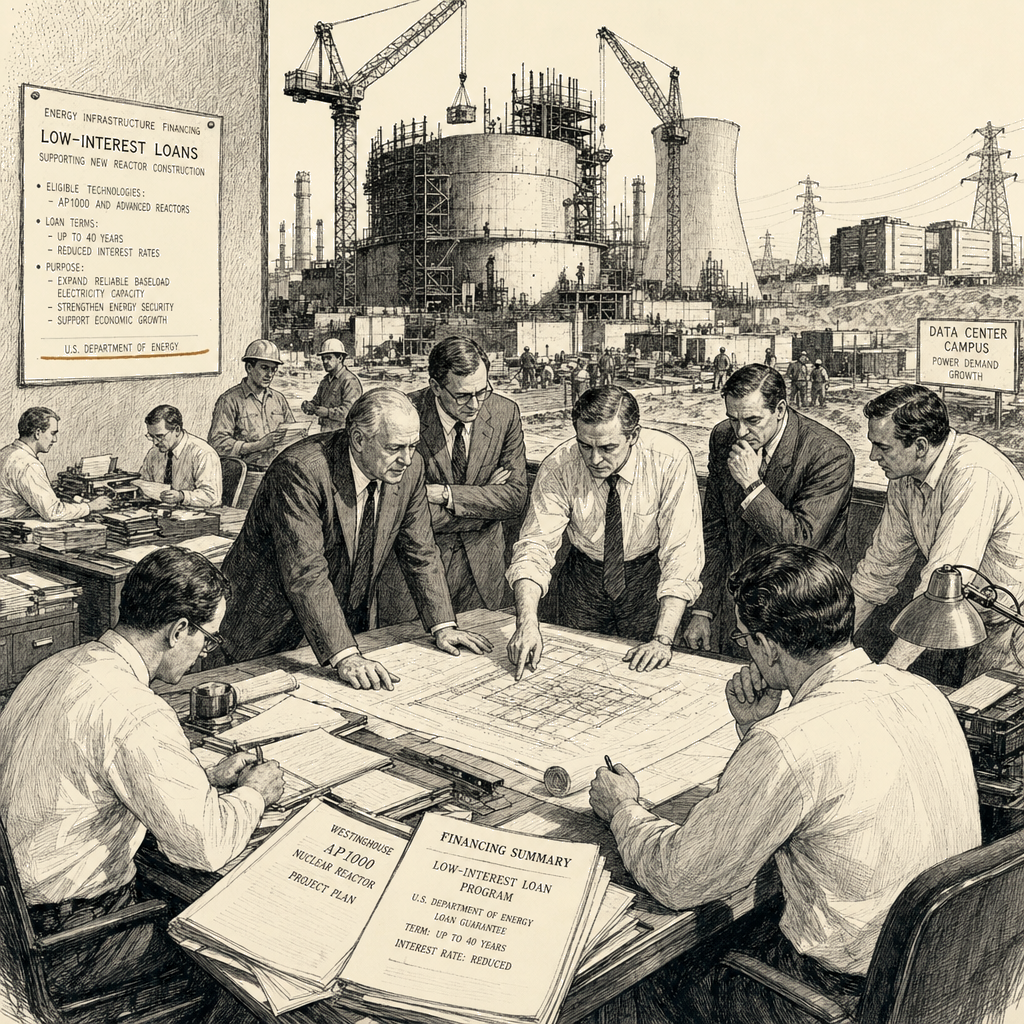
The Trump administration’s Energy Department plans to offer $17.5 billion in low-interest loans for utilities to finance equipment orders for the Westinghouse AP1000 nuclear reactor, the company’s flagship design, in a bid to jumpstart large-scale nuclear construction in the United States for the first time since the troubled Vogtle project in Georgia.
Energy Secretary Chris Wright said the conditional loans were part of a broader Trump administration mission to “unleash the next American nuclear renaissance.” The loans “will also help accelerate the timeline of building those large-scale reactors by up to three years, lowering construction costs and ensuring the United States is able to deliver on President Trump’s bold and ambitious energy addition agenda,” Wright said.
The Energy Department said five loans will be available for projects with two reactors each — enough to support construction of ten reactors in total. Seven utilities have signed formal letters of intent for the five available project loans, according to the department, which did not name the utilities. The companies would form partnerships with Westinghouse and each have at least one potential site for a reactor, the department said — primarily locations with an existing reactor or large power plant, or sites that have done previous licensing work with the Nuclear Regulatory Commission.
Westinghouse CEO Dan Sumner said the new AP1000s could begin coming online starting in 2035. “It really kick-starts fleet-scale nuclear development in the United States,” Sumner said.
The loan program faces a difficult recent history. The only two AP1000 reactors completed in the U.S., at Georgia’s Vogtle nuclear power plant, were originally expected to cost $14 billion but ultimately exceeded $30 billion. They were supposed to come online in 2016 and 2017 but did not begin operation until 2023 and 2024. A similar AP1000 project in South Carolina was abandoned in 2017 after costs spiraled past $9 billion. No U.S. utilities were eager to pursue new Westinghouse reactors after those experiences, and investors and regulators have been wary of cost and timeline risks.
The Energy Department said that by using low-cost government loans to make a steady series of bulk equipment purchases, the nuclear power supply chain could be supercharged — getting equipment ordered and manufacturing underway while projects work through permitting, regulatory hurdles, and final investment decisions. Westinghouse said it would provide fixed-price contracts for stable equipment pricing.
There are roughly 160 long-lead-time items required to build one AP1000 reactor, according to Westinghouse, including pressure vessels, steam generators, and reactor coolant pumps — 170-metric-ton hermetically sealed systems that move water through the reactor core. The company said about 150 of those items can be manufactured in the U.S. Westinghouse standardized the AP1000 design based on the last reactor built in Georgia, meaning that if one project falls behind schedule, equipment could be delivered to others, the Energy Department said.
A 20-year power-purchase agreement with large tech companies would likely also be needed to move projects into construction and lower cost risks for utilities, the Energy Department said. Tech giants have been backing nuclear projects ranging from small modular reactors to rebooting shutdown reactors. The department said it has been coordinating with tech companies, engineering firms, utilities and others to figure out risk sharing.
Interest in nuclear power is surging as electricity demand rises across the country, driven in large part by the buildout of data centers for artificial intelligence. The AP1000 reactor produces about 1,100 megawatts of electricity — enough to power a midsize city or a major AI data center. Several large power companies, including Duke Energy, Dominion Energy and PacifiCorp, have told regulators and investors that they aim to bring new large or small nuclear projects online in the coming decades. States including New York and Illinois have also expressed interest in expanding nuclear generation.
MSI previously reported on the broader surge in nuclear interest, as AI demand and public support drive a potential industry revival. Nuclear power sees revival as AI demand, public support rise
Outside the U.S., Westinghouse has built four AP1000 reactors in China, which then licensed the design, modified it and now builds it as the “CAP1000.” Another 11 are under construction in China, according to an International Atomic Energy Agency database.
In an executive order last year, Trump outlined plans to revitalize the nuclear industry and begin construction on ten large reactors by 2030. The government also aims to support smaller reactor designs still in earlier stages of development. Last fall, the U.S. said it would partner with Westinghouse to get $80 billion of new reactors under construction, with 20% of the company’s profit flowing to the federal government above $17.5 billion. The Energy Department said the new loans are separate from that agreement but complementary.