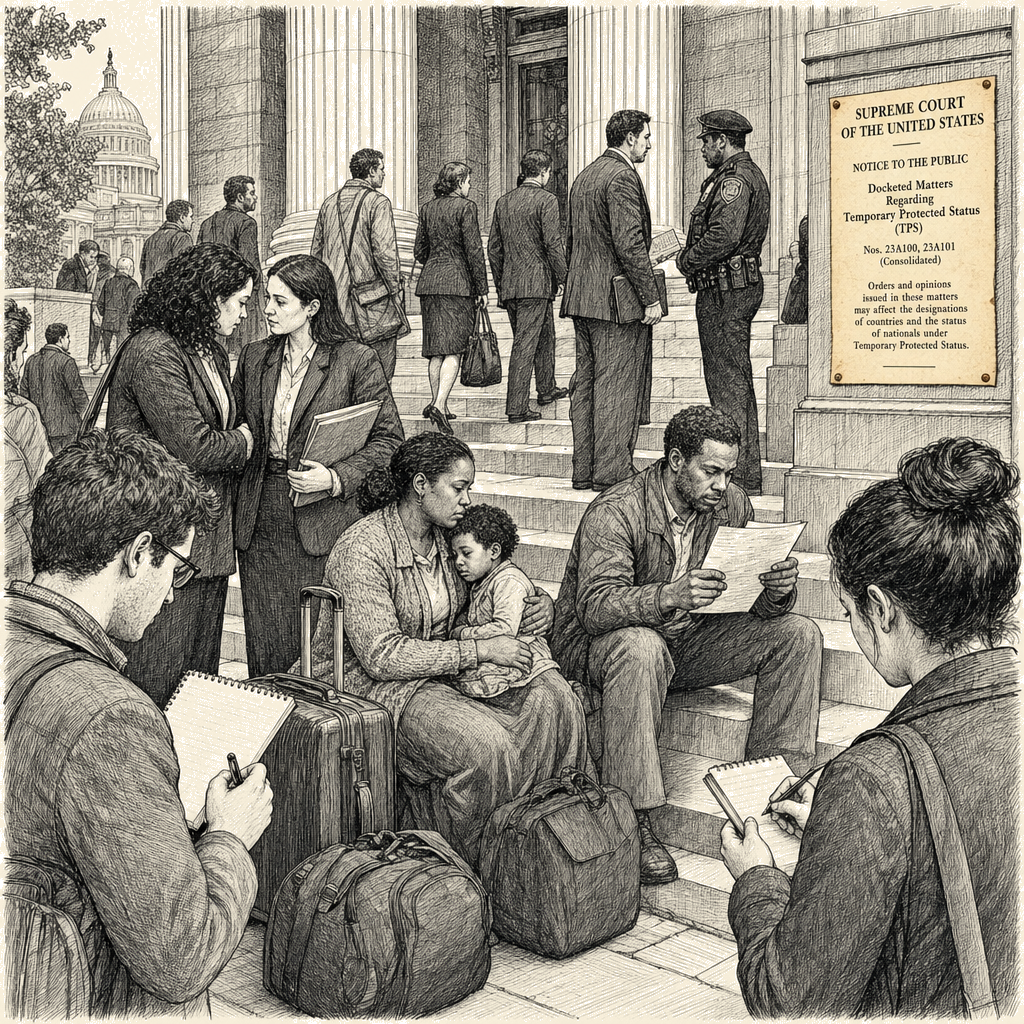
The Supreme Court ruled Thursday that President Donald Trump has the authority to end humanitarian protections for hundreds of thousands of immigrants from Haiti and Syria, issuing a 6-3 decision that clears the way for mass deportations of people who have been living and working legally in the United States, in some cases for decades.
Justice Samuel Alito, writing for the court’s conservative majority, held that the 1990 law establishing Temporary Protected Status gives the president virtually unreviewable power to terminate the program. “The Secretary’s TPS designation decisions are not subject to judicial review,” Alito wrote in the opinion. The court’s three Democratic-appointed justices dissented.
Congress created TPS in 1990 to allow migrants from countries experiencing armed conflict, natural disasters, or epidemics to live and work legally in the U.S. until conditions improved. Every president before Trump, Republican and Democrat, had renewed the protections for eligible countries. The Trump administration has moved to end TPS for 13 of the 17 countries whose citizens held the status when he took office in 2025. The remaining four — El Salvador, Lebanon, Sudan, and Ukraine — could face termination when their designations come up for renewal this fall.
The decision came in a pair of cases covering about 350,000 Haitians and 6,000 Syrians, according to court filings. Alito rejected arguments from immigrant-rights advocates that the administration had shown racial animus in its decision to end the protections. “None of the cited statements by either the president or the secretary was overtly racial, and in substance all expressed policy views that could rest on race-neutral justifications,” he wrote.
The U.S. State Department currently warns Americans in the strongest terms not to travel to Haiti or Syria because of the dangers of crime, terrorism, kidnapping, and limited health care.
Advocates for TPS recipients warned of significant economic and social consequences. “Revoking TPS protection is not just cruel; it is economic self-sabotage that will rip billions out of the U.S. economy and destabilize communities nationwide,” Todd Schulte of FWD.us, a bipartisan immigration-reform group, said in a statement. According to the group, 200,000 Haitian TPS holders are in the U.S. workforce, including 15,000 agricultural workers, 13,000 nursing assistants, and 8,000 caregivers. The group said TPS holders generate an estimated $5.9 billion for the U.S. economy each year and pay a combined $1.5 billion in federal and state taxes.
Migrants who lose their protected status will likely revert to illegal status, meaning they will lose their work authorization and face deportation, many of them forced to leave behind American-born children, according to the NPR report.
The Trump administration took office with about 1.3 million immigrants from 17 countries legally residing in the U.S. under TPS. The Supreme Court’s ruling is expected to serve as precedent for the administration’s efforts to end protections for people from a dozen other countries, including Afghanistan, Nepal, South Sudan, and Venezuela.