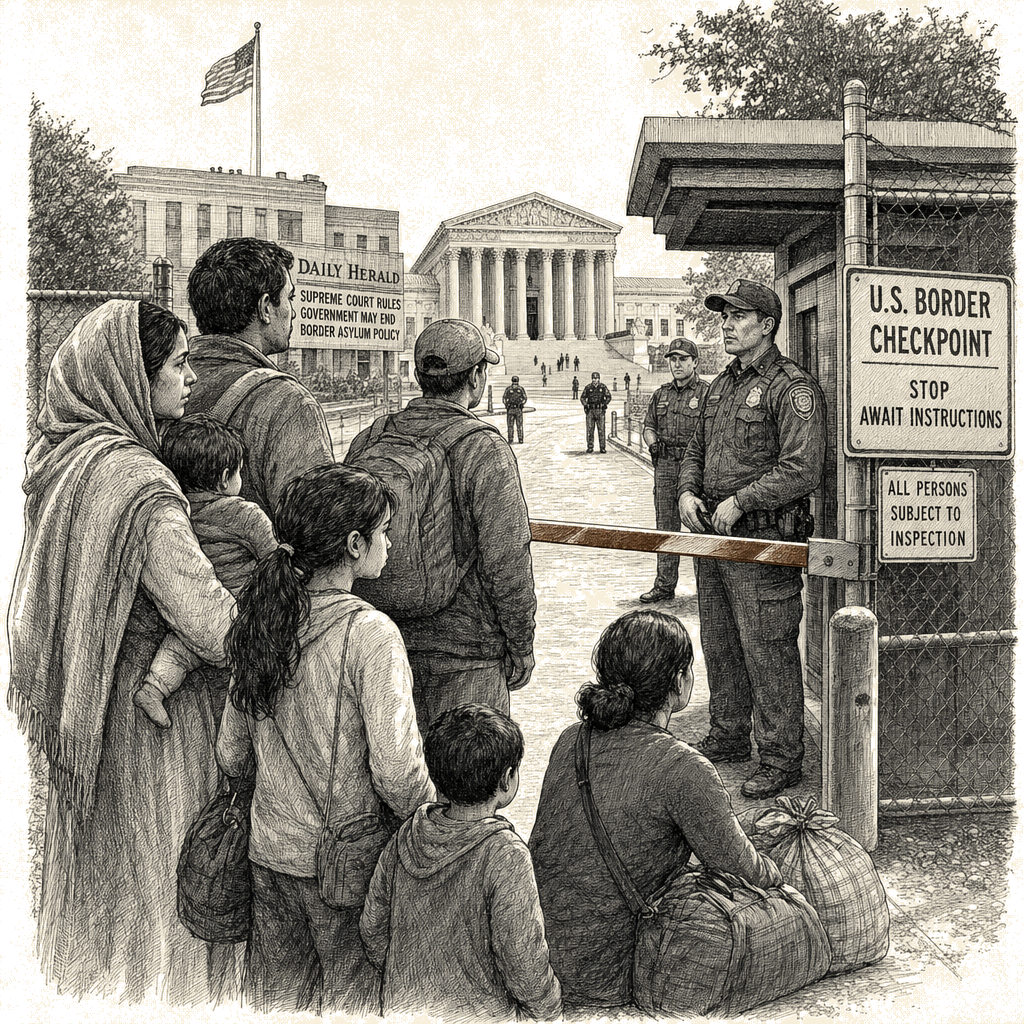
The Supreme Court on Thursday ruled that the Trump administration may turn back asylum seekers at the U.S.-Mexico border before they cross into the country, a 6-3 decision that overrides a central protection in federal immigration law and gives the executive branch broad authority to block access to asylum procedures.
Justice Samuel Alito wrote the majority opinion, joined by Chief Justice John Roberts and Justices Clarence Thomas, Neil Gorsuch, Brett Kavanaugh and Amy Coney Barrett. Justices Elena Kagan, Ketanji Brown Jackson and Sonia Sotomayor dissented.
At issue was the meaning of the phrase “arrive in” in the Immigration and Nationality Act. The Trump administration argued that a migrant does not “arrive in” the United States until they physically set foot on U.S. soil, and that the government may block entry before that point — effectively preventing asylum claims from being made at all.
“In ordinary speech, no one would say that a person ‘arrives in’ a place … before the person enters that place,” Alito wrote in the majority opinion.
Sotomayor filed a 35-page dissent — nearly twice the length of Alito’s opinion — warning of severe consequences for people fleeing persecution. She argued that the interpretation ignored the statutory context and the government’s own longstanding position that any noncitizen arriving at a port of entry must be inspected and allowed to apply for asylum.
“The Court’s illogical interpretation is driven almost entirely by a fixation on a single word: ‘in,’” Sotomayor wrote. “Words, however, must be read in context and with attention to how they fit into the statute as a whole.”
She continued: “Because the Court today blesses the Executive Branch’s decision to slam the door shut on all who are fleeing persecution, despite the detailed inspection and asylum system that Congress enacted and commands, I respectfully dissent.”
Sotomayor’s dissent highlighted that under the ruling the government may now block asylum seekers even when ports of entry have ample capacity to process them, including when an asylum officer is available.
“They may do so even if the asylum seeker is at the threshold of a port of entry designated to receive all noncitizens who seek entrance into the country. Even if the port of entry has ample capacity to inspect that person, including an available asylum officer trained to process asylum applications. Even if the asylum seeker is certain to be persecuted, or killed, if she is turned away,” she wrote.
The ruling allows the administration to resume a practice the Trump administration deployed during its first term, when Customs and Border Protection officers stationed at international bridges turned back migrants before they could reach ports of entry. President Joe Biden ended the policy in 2021, but after Trump’s re-election the Justice Department asked the Supreme Court to review lower-court rulings that had blocked it.
Lower courts had repeatedly invalidated the practice, with advocates and attorneys arguing it violated federal law and the country’s tradition of providing refuge to those fleeing persecution.
The case was originally filed in 2017 by Al Otro Lado, a legal and humanitarian service provider based in California and Mexico, and a group of asylum seekers who were subjected to the turnback policy.
The shift toward limiting asylum access at the southern border began during the Obama administration, which used a “metering” system to control the flow of asylum seekers as backlogs for visas and green cards grew. The Trump administration formalized and expanded the practice by stationing officers at the border line.
Sotomayor compared the turnback practice to the fate of the St. Louis, a passenger ship carrying Jewish refugees that was turned away from the United States before World War II. About half the passengers who were returned to Western European countries were killed after Germany invaded, the opinion noted.
The Trump administration has described the asylum system as “a huge loophole in our migration laws,” according to Deputy Secretary of State Christopher Landau, who made the comment during a United Nations gathering last September. The Department of Homeland Security under Trump has not only pursued turnbacks but has also urged immigration courts to summarily dismiss asylum claims and increasingly sent migrants to third countries where they have never been, according to the source material.
The decision comes after a series of court battles over Trump immigration policies. MSI previously reported that the Supreme Court in March heard arguments on whether the administration could revive “metering” — the same policy at the center of Thursday’s ruling — and that a federal appeals court in April blocked a separate Trump executive order suspending asylum access at the border. Those cases are among the related stories cited in this article.
The ruling marks the end of a legal battle spanning three administrations and significantly expands the executive branch’s power to control the border without providing individual access to asylum procedures.