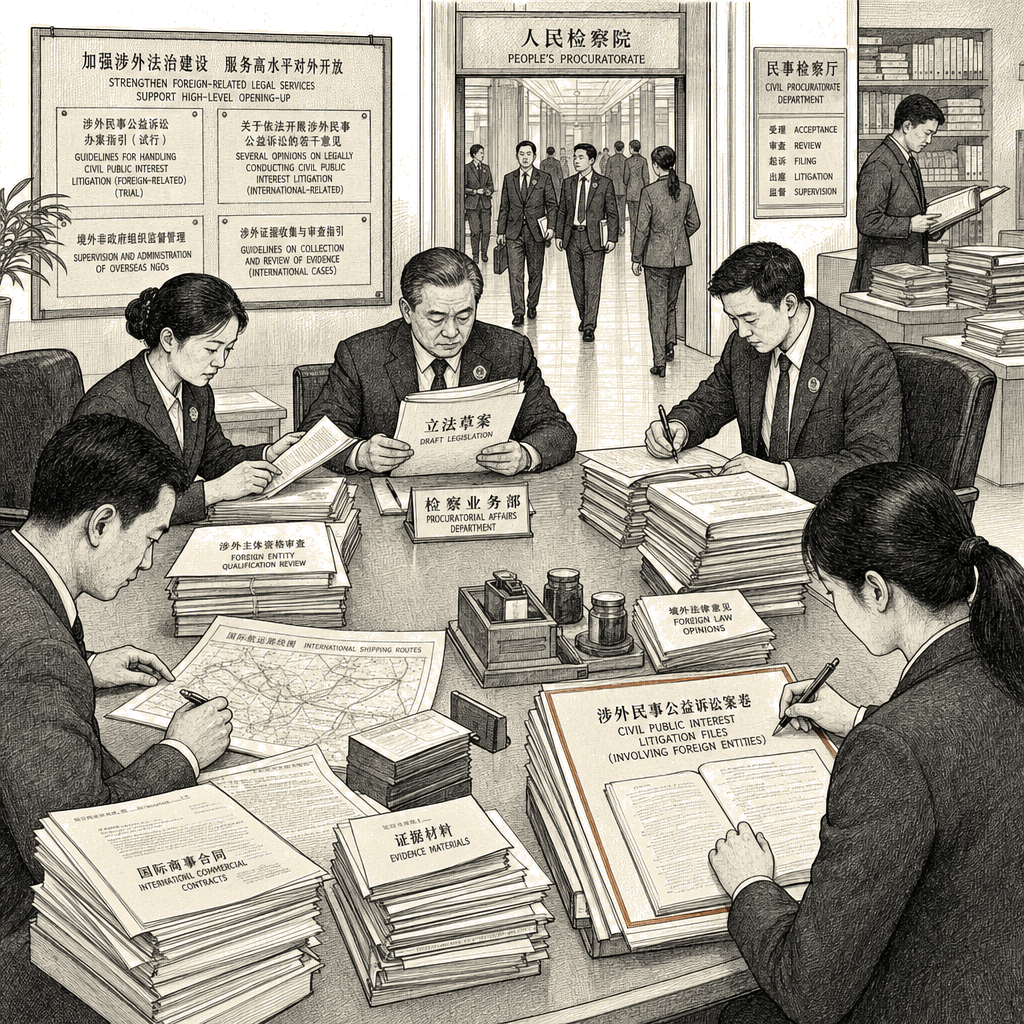
Chinese senior lawmakers reviewed a bill this week that would empower state prosecutors to file civil suits against foreign organizations and individuals who allegedly damage China’s interests, state media reported, as Beijing continues to expand its legal toolkit for countering economic pressure from the United States and other Western governments.
The proposed law on “procuratorial public-interest litigation” went through its second reading at a legislative session concluding Friday, according to state media. The latest draft includes a new provision stating that prosecutors “may initiate public-interest litigation against unlawful acts committed by foreign organizations or individuals that infringe on” China’s national and public interests, the reports said.
Most bills in China’s legislative process are passed after a third reading. Legal experts cited by the Wall Street Journal said a third reading for this proposed law could take place by the end of this year. Beijing has not specified what acts would be subject to such litigation or what interests the law would protect.
The provision, if approved, would add to existing Chinese law that already allows Chinese companies and individuals to file civil suits against foreign parties to seek compensation for losses caused by foreign sanctions. Defendants in civil lawsuits may be ordered to pay compensation and damages, and can face criminal penalties if they fail to comply. In China, citizens and foreign nationals involved in civil litigation — typically commercial disputes — may also be barred from leaving the country, a practice known as “exit bans.”
Consulting firm Trivium China wrote in a client note that public-interest lawsuits can result in court injunctions and compensation orders that damage companies’ revenue, operations and reputation. “In other words, it adds another layer of risks for companies to navigate,” the firm wrote. Trivium said the law, once passed, will add “another spanner to Beijing’s growing counter-sanctions legal tool kit.”
The American Chamber of Commerce in China, which represents more than 800 mainly U.S. companies, said its members “will be closely watching how the law is implemented in practice.” James Zimmerman, chairman of AmCham China, said in a statement: “For businesses operating in China, transparency, predictability, due process, and consistent application of the law are important factors in maintaining confidence and supporting continued investment.”
Chinese officials have called for more robust legal tools to counter what they describe as foreign coercion, particularly Western governments’ use of economic and diplomatic sanctions to pressure Beijing on issues including human rights, trade and technological competition. In recent weeks, the official newspaper of China’s top prosecutorial agency has published essays advocating the use of civil suits to combat outside interference and “long-arm jurisdiction” that impacts Chinese parties, according to the Wall Street Journal. “When foreign measures cause harm to China’s interests, such as threats to the security of key industrial and supply chains or the blockade of important technologies, procuratorial agencies can explore initiating public-interest litigation to demand cessation of such infringements and compensation for losses,” one of the essays said.
China has in recent years been expanding its legal mechanisms for resisting pressure from the U.S. and other Western governments that have imposed sanctions targeting Beijing’s industrial policies, its treatment of Muslim minorities in Xinjiang and its restrictions on civil liberties in Hong Kong. In 2021, Beijing adopted an “antiforeign sanctions law” that prescribed mechanisms for retaliating against foreign sanctions, including visa denials for foreign nationals, seizure of their assets in China and restrictions on their ability to transact with Chinese counterparts. The 2021 law also allowed Chinese entities and individuals to file lawsuits in Chinese courts to seek compensation for damage caused by foreign sanctions.
More recently, Beijing announced new regulations this year mandating punitive actions against foreign groups and individuals who threaten China’s access to vital resources or who drop Chinese suppliers in response to political pressure, as well as foreign parties who assert “unjustified extraterritorial jurisdiction” over Chinese entities and people, according to the Journal. Penalties include restrictions on doing business and investing in China, as well as travel restrictions. Chinese entities targeted by foreign sanctions can also seek compensation through Chinese courts.
As MSI previously reported, China on June 22 barred dual-use exports to 10 U.S. defense contractors and excluded 46 U.S. companies from government procurement in a tit-for-tat response to a Pentagon list of Chinese firms Beijing says aid its military.