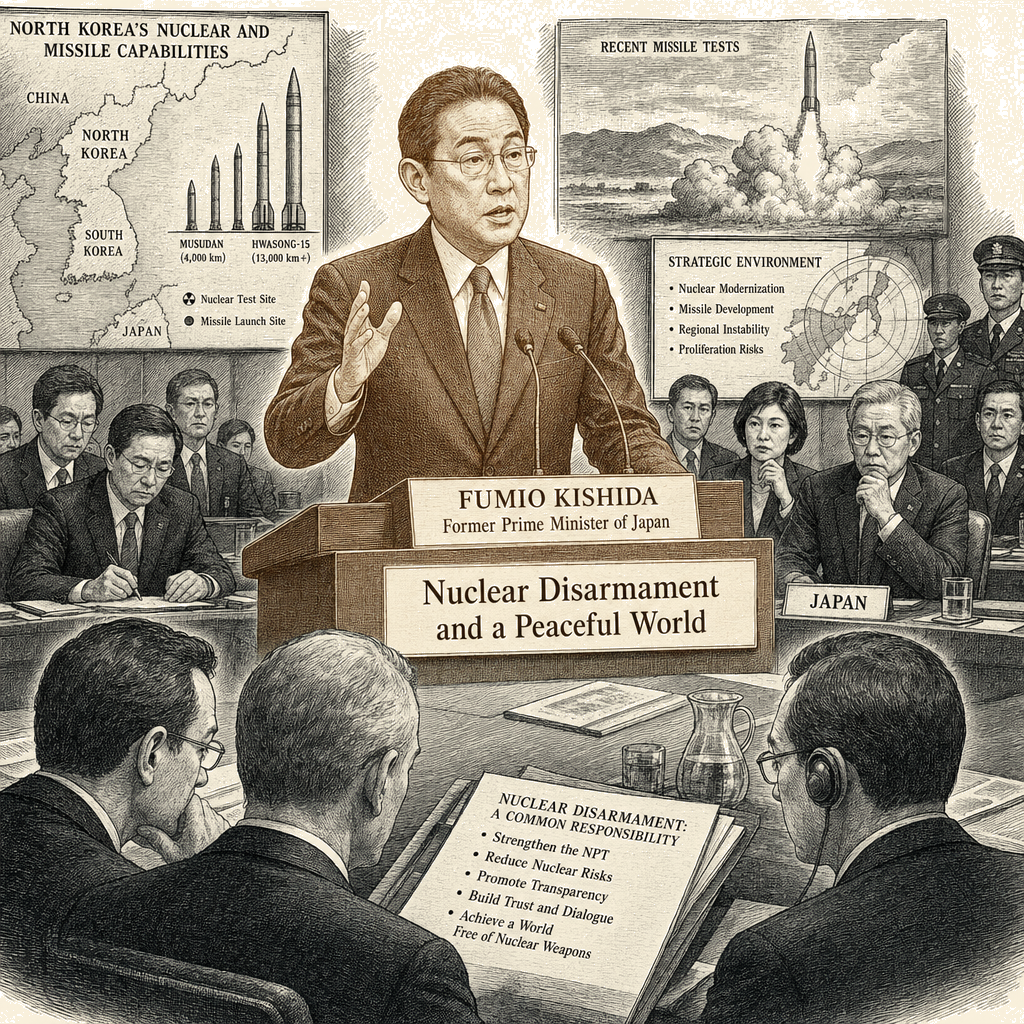
Former Japanese Prime Minister Fumio Kishida said Friday that North Korea’s expanding nuclear and missile programs have made the pursuit of global nuclear disarmament increasingly difficult, but urged Japan not to give up on the long-term goal of a world without nuclear weapons.
Speaking at the Foreign Correspondents’ Club of Japan in Tokyo, Kishida described East Asia’s security environment as the most severe since the end of World War II. North Korea has accelerated its weapons development in recent months, testing ballistic missiles with cluster-bomb warheads in April and, according to state media, calling in late June for an accelerated expansion of its nuclear forces.
“Japan must strengthen its defense capabilities and further reinforce the Japan-U.S. alliance,” Kishida said. “At the same time, we must not give up the ideal of pursuing a world without nuclear weapons.”
Kishida, whose parliamentary constituency is in Hiroshima, made nuclear disarmament a centerpiece of his diplomatic agenda during his tenure as prime minister. In 2022, he became the first Japanese leader to attend a review conference of the Treaty on the Non-Proliferation of Nuclear Weapons, where he presented the Hiroshima Action Plan — a set of practical steps aimed at advancing disarmament while acknowledging the deteriorating security environment. The plan calls for maintaining the record of non-use of nuclear weapons, increasing transparency around nuclear forces, continuing reductions in global stockpiles, strengthening nonproliferation, and promoting the peaceful use of nuclear energy.
Kishida said the international security situation surrounding nuclear weapons is “undeniably severe,” citing Russia’s invasion of Ukraine, instability in the Middle East, and North Korea’s weapons programs. He argued that stronger national security and nuclear disarmament should not be viewed as mutually exclusive.
“Reality and ideals are not incompatible,” he said. “The issue is not choosing one or the other, but determining how to bring reality closer to the ideal.”
Drawing a direct link between the war in Europe and East Asian security, Kishida recalled his unannounced visit to Kyiv in March 2023, where he met Ukrainian President Volodymyr Zelensky. He said he delivered the message that “Ukraine today may be East Asia tomorrow.” Russia’s invasion demonstrated that security in Europe and the Atlantic cannot be separated from security in the Indo-Pacific, he said.
East Asia faces overlapping concerns that include North Korea’s nuclear and missile development, China’s growing military power, and tensions across the Taiwan Strait. Kishida said Japan’s vision of a free and open Indo-Pacific seeks to improve regional connectivity, promote prosperity, reject coercion and intimidation, and uphold freedom and the rule of law.
Addressing U.S. foreign policy under President Donald Trump, Kishida said “America First” should be regarded as a structural trend rather than a temporary development. He noted that countries such as Japan, which have limited natural resources and relatively constrained domestic markets, depend on international law, multilateralism, free trade, and the rule of law. Kishida emphasized the importance of maintaining the Japan-U.S. alliance while preserving an international system governed by widely accepted rules.
Kishida also called for continued dialogue with China despite security concerns and political tensions between Tokyo and Beijing. China is Japan’s largest trading partner, while Japan remains one of China’s major economic partners, he said.
“That is precisely why dialogue is important,” Kishida said.
He recalled meeting Chinese President Xi Jinping twice during international gatherings while serving as prime minister, and also held talks with Chinese Premier Li Qiang during meetings connected to Southeast Asian nations and a trilateral summit involving Japan, China, and South Korea.
“It is regrettable that fewer people are now willing to engage in dialogue between Japan and China,” Kishida said.
He called for communication not only between governments but also through business, people-to-people exchanges, sports, and culture. Stable relations between Japan and China would serve both countries’ national interests and contribute to regional peace and stability, he said.