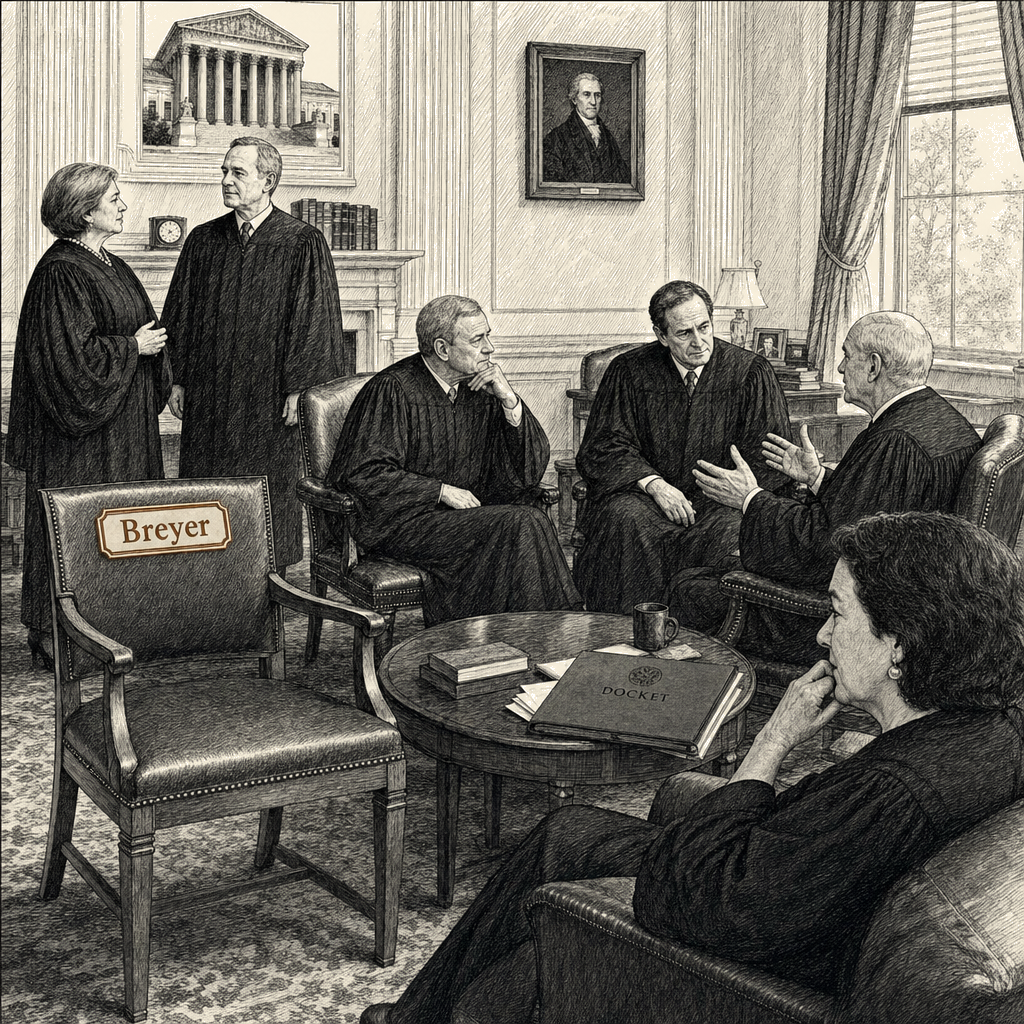
Relationships on the Supreme Court that appear to be fraying over the past term have led several current justices to look back fondly on the era of retired Justice Stephen Breyer, whom they regarded as a unifying presence capable of lowering the temperature, according to people close to the court.
Breyer, nominated by President Bill Clinton in 1994, served for 28 years before retiring four years ago. He was known for lightening the mood with anecdotes about modern architecture and knock-knock jokes from his grandchildren, even as he fought for pragmatic center-left rulings on a court that tilted right. Yale law professor Justin Driver, who served as a Breyer law clerk, said Breyer regularly walked the halls to visit with colleagues. “He was a central figure in being able to talk to everyone at the court,” Driver said.
The justices’ interactions have increasingly drawn public attention this term. Last week, the court issued six major decisions that divided it 6-3 along ideological lines. In an asylum case, Sotomayor read portions of her dissent aloud from the bench, prompting Alito, who wrote the majority opinion, to issue an impromptu retort. Alito said he had not known that Sotomayor was going to read her dissent. A court spokeswoman said the exchange was based on a misunderstanding.
Breyer’s successor, Justice Ketanji Brown Jackson, who once clerked for Breyer and is ideologically similar to him, has adopted a more confrontational style. She has repeatedly criticized the conservative majority over its use of short-form emergency orders. Melissa Murray, a law professor at New York University, said she understood why Jackson might see compromise as futile with a 6-3 conservative supermajority. “I’m not saying it’s a bad take,” Murray said of Breyer’s penchant for compromise. “I think it’s fine if it works. But with a 6-3 conservative supermajority, appeasement doesn’t work anymore.”
Other exchanges have drawn notice this term. Sotomayor suggested at a public event that Justice Brett Kavanaugh lacked empathy for blue-collar workers, a remark she later apologized for. Justice Clarence Thomas delivered a provocative speech denouncing the historical progressive movement while also calling for greater collegiality. Chief Justice John Roberts has said the end-of-term rush makes it difficult for the justices to get along and that the summer recess is when tempers cool.
Breyer’s relationships with the court’s senior conservatives ran deep. Roberts became audibly choked up while paying tribute to Breyer from the bench in April 2022. Thomas sat next to Breyer for more than a decade, and the two were often seen whispering and trading jokes during arguments. Alito took to Breyer early on — at a welcome event after Alito’s 2006 confirmation, Breyer helped arrange for the Phillie Phanatic, the mascot of Alito’s beloved Philadelphia Phillies, to make a surprise appearance.
Now 87, Breyer splits his time between Massachusetts and Washington, has an appointment at Harvard, and is working on a memoir due out next spring. He stays in touch with the justices and still works out of his Supreme Court chambers with a law clerk, but no longer carries the influence he once did.
In an interview, Breyer declined to comment on the current dynamics at the court, but reflected on his approach to disagreement: “If you’ve listened to what they say, and see where they’re coming from, sometimes — and not always by any means — sometimes you can advance the discussion a little.”
Thomas, speaking at a judicial conference this spring, acknowledged that the court’s culture has shifted. “It’s a different court now,” he said.