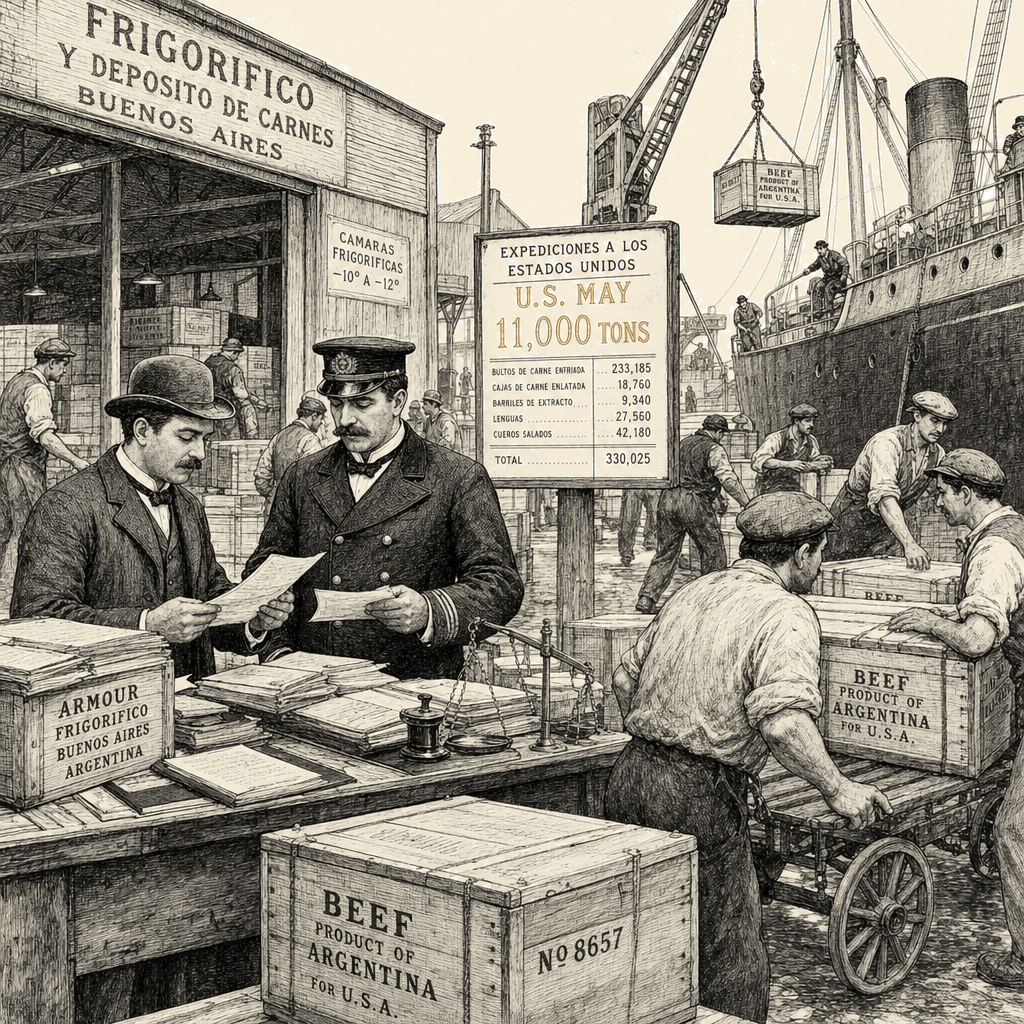
Argentine beef exports to the United States have risen sharply, with May shipments reaching 11,000 metric tons — matching the volume exported during the first eight months of 2025, according to a report by PromArgentina’s Trade Intelligence Office based on official statistics.
The value of those shipments rose to $86 million in May, a 369% increase from the same month a year earlier, more than quadruple the amount recorded in May 2025, the report said. Beef has become one of the leading contributors to Argentina’s export growth to the U.S. market, according to the report.
The increase followed President Donald Trump’s decision to expand Argentina’s annual duty-free beef quota from 20,000 metric tons to 100,000 metric tons. Former Argentine Undersecretary of Agricultural Markets Javier Preciado Patiño, who leads RIA Consultores, told United Press International that Trump said the expansion was intended to help contain U.S. domestic beef prices. The U.S. cattle herd remains at historically low levels, with the smallest inventory in 75 years, according to former Argentine Undersecretary of Livestock José María Romero.
“Trump did it,” Preciado Patiño told UPI.
Preciado Patiño said Argentina has already exported about 41,000 metric tons under the new 100,000-metric-ton duty-free quota and that “once the statistics are updated, the total will exceed 50,000.”
He said stronger U.S. demand also reflects a decline in the country’s cattle inventory.
“Trump said he wants to bring more beef from Argentina to help contain domestic prices. Beef prices are currently high worldwide and Argentina is receiving very favorable prices for cattle production,” he said.
Romero said the United States is expected to import more than 2.5 million metric tons of beef this year. “In that context, supplier countries have increased exports to that market,” Romero said.
He added that the expanded duty-free quota has created a new opportunity for Argentine exporters.
“Following the agreement, the sector found an opportunity to supply lean beef, most of it destined for processing, up to a volume equivalent to 4% of U.S. beef imports with zero tariffs,” he said.
Data from the Institutional Agricultural Report showed that between January and May 2026, Argentina exported 4,841 metric tons of fresh beef and 37,934 metric tons of frozen beef to the U.S. market, compared with 2,734 metric tons of fresh beef and 14,326 metric tons of frozen beef during the same period in 2025. Combined shipments increased from 17,060 metric tons to 42,775 metric tons, a 151% year-over-year increase.
While exports grow, domestic beef consumption in Argentina has continued to decline. Per capita beef consumption stood at 47.5 kilograms, or about 105 pounds, per person annually in May, the lowest level in the past 20 years, according to the Chamber of the Meat Industry and Trade of Argentina, known as Ciccra.
Romero said the decline is even more significant when compared with earlier years. Consumption was 21% higher in 2001, 50% higher in 2007, 28% higher in 2011, 23% higher in 2023 and also exceeded current levels during the COVID-19 pandemic in 2021, he said.
“Domestic consumption is the lowest in our history,” Romero said.
Preciado Patiño said the trend reflects a structural shift in consumer habits and declining purchasing power.
“We are seeing a reconfiguration of consumption patterns. Beef is more expensive to produce and also more expensive for consumers. As a result, many families are choosing lower-cost proteins such as chicken and pork,” he said.