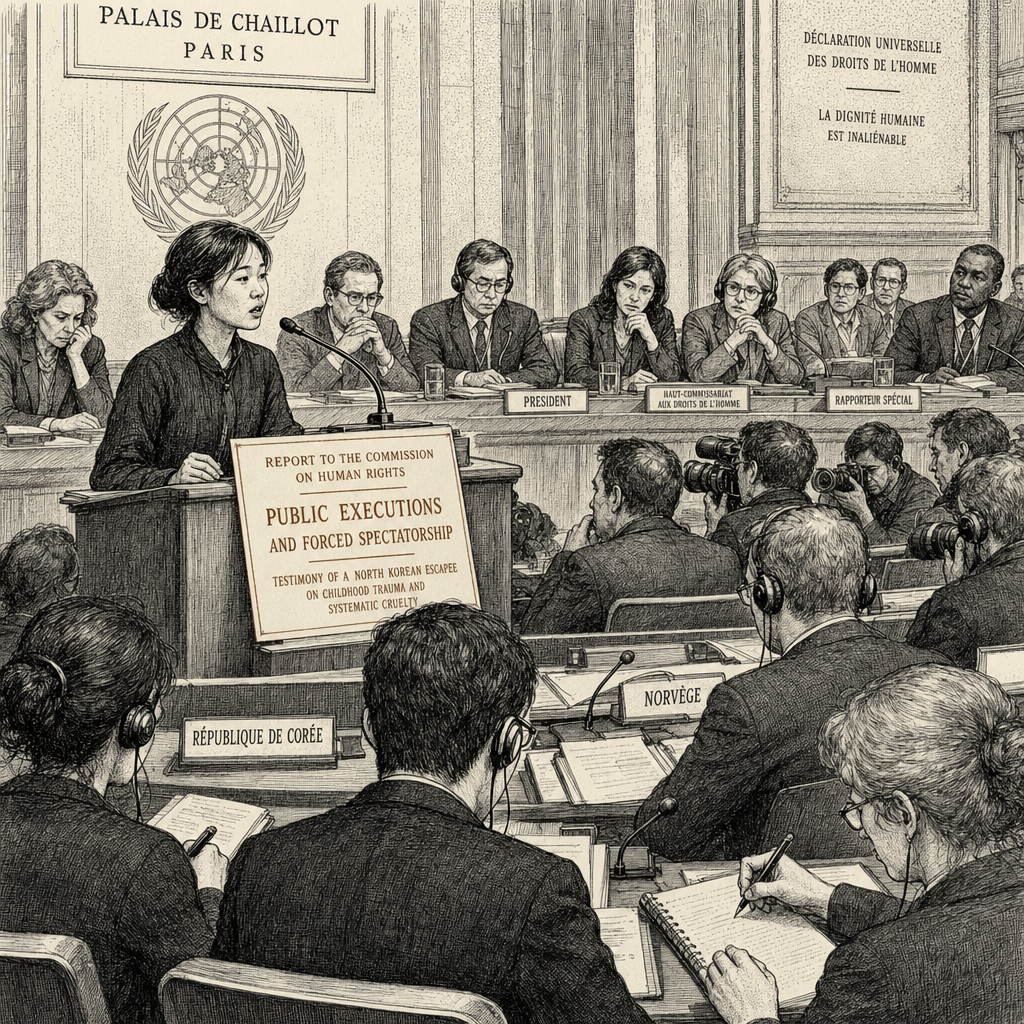
Escapee testifies at Paris congress of witnessing execution at age 9
Eunju Kim, a North Korean escapee and co-author of the memoir “A Thousand Miles to Freedom: My Escape from North Korea,” testified at the 9th World Congress Against the Death Penalty, a three-day event held in Paris from Tuesday through Thursday. The congress, organized by the French nonprofit Together Against the Death Penalty with support from France, the European Union and Switzerland, brought together death penalty abolitionists, policymakers and human rights advocates.
Kim described witnessing an execution as a child and discussed the psychological trauma suffered by North Koreans ordered to observe such killings. The Transitional Justice Working Group said it was the first time North Korea’s use of public executions had been addressed at the congress.
The Seoul-based organization presented findings from an April report titled “Mapping North Korea’s Executions Before and After the COVID-19 Pandemic,” which examined executions and death sentences carried out before and after North Korea closed its borders during the pandemic. The group also formally asked U.N. High Commissioner for Human Rights Volker Türk to place greater emphasis on executions when reporting on North Korea’s human rights situation at the U.N. General Assembly.
Ethan Hee-Seok Shin of the Transitional Justice Working Group said North Korea’s executions frequently appear to be extrajudicial and arbitrary, with defendants denied fair trials. “When international human rights standards, the 2014 report of the U.N. Commission of Inquiry on human rights in North Korea and the findings of U.N. working groups are considered together, North Korea’s actions clearly constitute crimes against humanity,” Shin said.
The 2014 U.N. commission concluded that North Korean authorities had committed systematic, widespread and grave human rights violations, including extermination, murder, torture, imprisonment and enforced disappearance.
Members of the Transitional Justice Working Group also visited the French Foreign Ministry to discuss executions, enforced disappearances and North Korea’s transnational repression across national borders and through the Internet. The group said it agreed with French officials to develop further cooperation and information sharing.
Elizabeth Salmón, the U.N. special rapporteur on human rights in North Korea, cited the group’s execution report during the congress. Salmón said her report to the U.N. General Assembly in October would focus on the severity of executions in North Korea and violations of the right to life. She is scheduled to submit her annual report in October.
French President Emmanuel Macron opened the congress and reaffirmed France’s support for the worldwide abolition of capital punishment. The World Congress Against the Death Penalty has been held every three years since its launch in 2001 and is one of the largest international gatherings devoted to ending capital punishment.