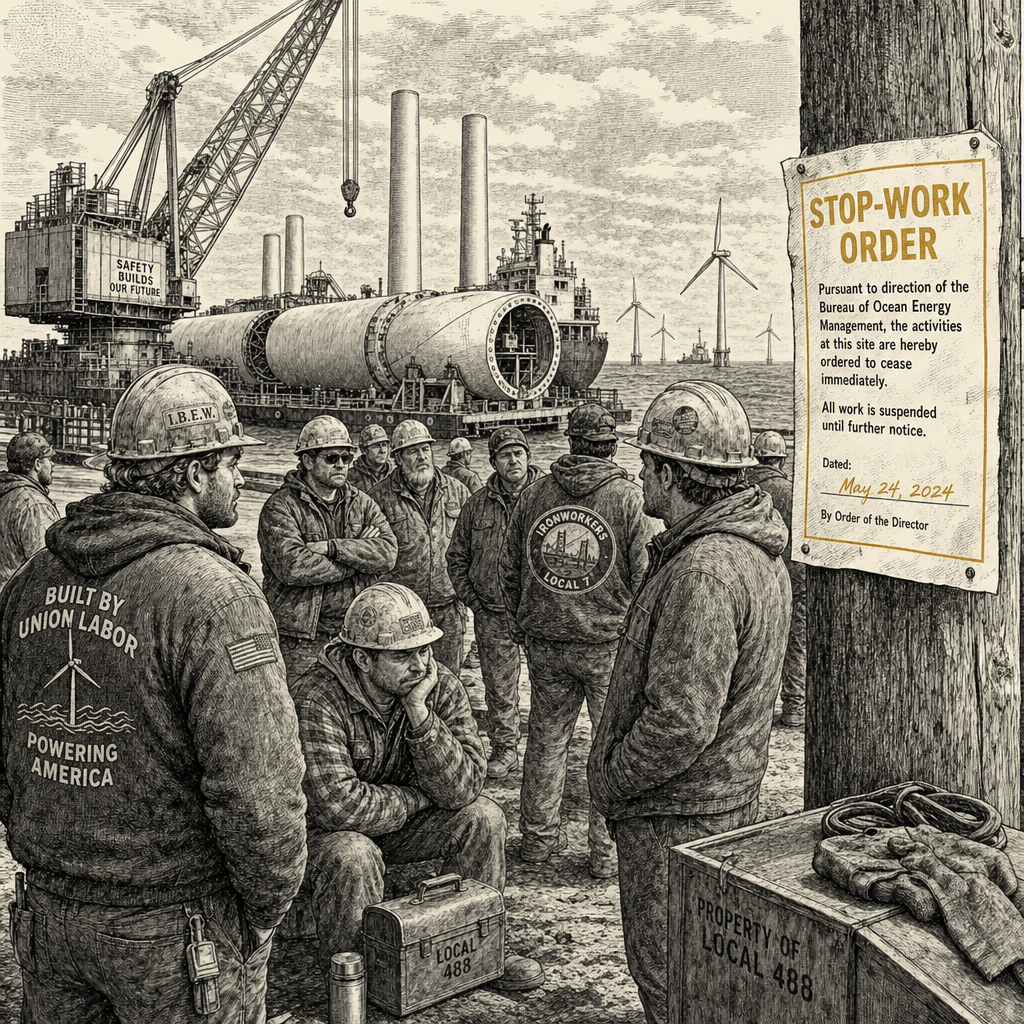
Union workers face uncertainty after administration pivots to lease buyouts
After losing multiple court battles over stop-work orders on offshore wind projects, the Trump administration abandoned its legal challenge in June 2026 to a federal ruling that tossed an executive order freezing all wind permitting and leasing. The administration has instead shifted strategy to buy out wind project leases, completing four deals that total more than $2.6bn, according to the Interior Department. That includes nearly $900m paid to Bluepoint Wind and Garden State Wind to cancel offshore wind leases, and $765m to Invenergy to abandon four wind projects in California, New York, and Maine.
The shift has left union workers who built the projects facing financial uncertainty. Thomas Kilday, a furnace electrician with IBEW local 99 in Providence, Rhode Island, was in the middle of a 28-day shift on a vessel off the Atlantic coast working on the Revolution Wind Project in August 2025 when the administration issued its first stop-work order.
“No one really knew what was going on. We didn’t know what it meant for us. We just knew that everything was up in the air,” Kilday told the Guardian. “You plan your whole life around being gone for 28 days, and to come out here and have it thrown up in the air, worrying what does this mean for me, for my pay for the next four weeks, what’s going to happen? There’s a lot of uncertainty.”
A federal court granted an injunction blocking the stop-work order in September 2025. In December 2025, the administration issued another 90-day stop-work order, citing national security, before a second judge issued an injunction in January 2026, according to Kilday. When the second order came, Kilday was home for the holidays. “I just spent a bunch of money on Christmas gifts for my family, and it was not what I wanted to be thinking about,” he said. “Six months out of the year we’re away from home, and for what little time we do have at home, not to be able to just focus all of that time and energy on our families, it’s tough.”
Revolution Wind began delivering power to New England in March 2026, citing the work of more than 1,000 local union workers. The project is expected to power more than 350,000 homes and businesses, and construction is over 90% complete, according to the company.
Will Gonzalez, a construction laborer with Laborers’ local 385 in Fairhaven, Massachusetts, worked on the Vinyard Wind 1 project off Martha’s Vineyard, a project the administration tried to halt in January 2026 but that is now completed and fully operational. He criticized Trump’s opposition, arguing it stems from the president’s experience trying to stop a wind turbine project near his golf course in Scotland, a case he lost on appeal in December 2015.
“It’s a personal vendetta,” Gonzalez told the Guardian. “Good union jobs – we shouldn’t be trying to take those off the table. That just doesn’t make any kind of sense. Families obviously need good jobs … why take those jobs away?”
Gonzalez said he and his co-workers have left training and certifications unused because of the halting of wind projects. “All of us that worked on that Vinyard Wind 1, obviously, we would have loved to segue right into another project,” he said. “We’re fully trained, ready to go, willing and able, so it directly affected us. But you move on. You [have] got to move on. You can’t sit and dwell on that, because that’s not going to pay the bills.”
Pat Crowley, president of the Rhode Island AFL-CIO, said the administration has lost in court five times on stop-work orders for five wind projects in the Rhode Island area. “We’re five for five taking on the Trump administration,” he told the Guardian. “What the Trump administration is doing is just throwing money away for the sake of their ideology.”
A spokesperson for the Interior Department denied that the cancellations and stop-work orders have had any impact on jobs, stating that no jobs were eliminated because the leases were not supporting employment. “Rather than waiting years for the projects to materialize, the Trump administration is prioritizing investments in existing infrastructure and functioning supply chains that can create jobs now and deliver economic benefits faster,” the spokesperson said. “This approach puts more people to work more quickly, using proven, affordable, and reliable energy rather than relying on projects tied to leases that were not producing jobs in the first place.”
The White House directed comment to the Interior Department. The spokesperson did not respond to a question asking for clarification and did not comment on Trump’s prior opposition to wind turbine projects involving his golf courses.