Ruling cites state law closing competency records
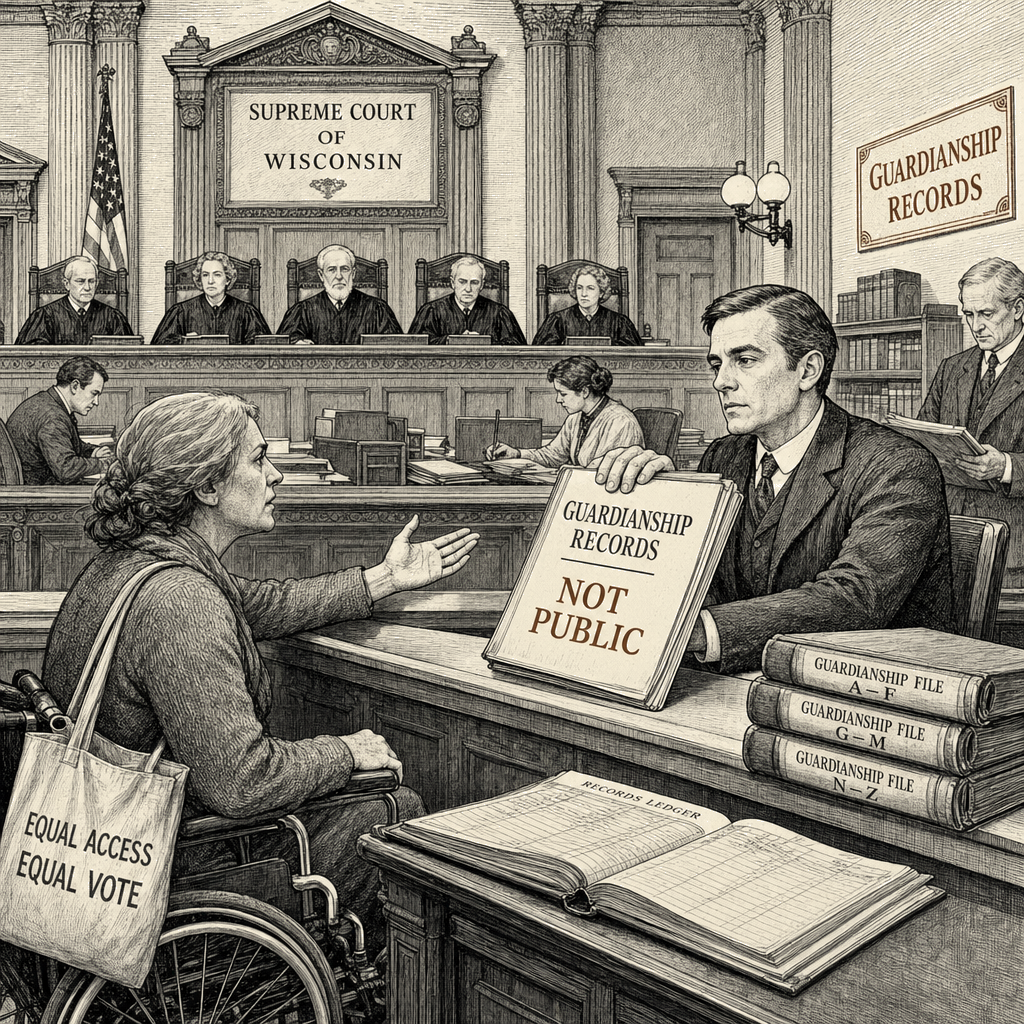
The Wisconsin Supreme Court on Tuesday ruled 5-2 that records of people placed under guardianship are not public, blocking a conservative activist’s effort to use the records to check for potentially ineligible voters in the state.
Ron Heuer, leader of the Wisconsin Voters Alliance, filed the suit in 2022 in Walworth County. He sought guardianship forms to verify whether individuals under guardianship were eligible to vote. After the 2020 election, the Alliance filed 13 lawsuits in 13 counties seeking similar Notice of Voting Eligibility forms to cross-check against the voter registration list.
The court’s four liberal justices were joined by conservative Justice Brian Hagedorn in the majority, according to reports on the ruling. Two conservatives dissented.
Justice Janet Protasiewicz, writing for the majority, said the ruling “is rooted in the legislature’s choice to protect the privacy of individuals subject to guardianship proceedings.” She cited a portion of state law that says “court records pertinent to the finding of incompetency are closed.”
“The legislature said, with limited exceptions, ‘court records pertinent to the finding of incompetency are closed,’” Protasiewicz wrote. “We hold that the forms at issue here are ‘closed’ under that statute. Thus, the Alliance does not have a right to the forms under our public records law, and the Alliance is not entitled to a writ of mandamus.”
In the dissenting opinion, Justice Annette Ziegler said the majority was applying the law to documents not covered by the statute.
“The majority’s conclusion fails to recognize this important distinction: A finding of incompetency is distinct from a finding that one has lost the right to vote,” Ziegler wrote. “Instead, it adopts an overbroad and unworkable definition of what records pertain to a finding of incompetency to include [the guardianship forms].”
Ziegler added that holding the forms shielded from public records law “runs counter to the statute’s language, scheme and the presumption of open government.”
Many, but not all, disabled people in the United States who are under guardianship lose their right to vote. In Wisconsin, a guardianship order is granted by a court giving a person certain legal rights over another who is determined to be unable to make decisions about their life.