- The U.S. labor force is projected to expand by only 9.1 million people in the decade ending 2030 and then contract by 2.1 million in the following decade, according to demographer Steven Ruggles.
- Ruggles said the shift could bolster workers’ bargaining power and drive wages higher, creating incentives for businesses to adopt labor-saving technologies such as artificial intelligence.
- A new working paper from MIT economist Daron Acemoglu and colleagues found that slower population growth historically leads to higher GDP per working-age adult and higher wages.
- Economists broadly agree AI will boost productivity, but are divided on whether it will eliminate more jobs than it creates.
Demographer forecasts 2.1 million decline in U.S. workers by 2040
The U.S. is in the midst of a protracted slowing in its labor force that will give way to an outright decline, according to research published in May by Ruggles, a professor at the University of Minnesota and a 2022 MacArthur Genius grant recipient, in the Proceedings of the National Academy of Sciences. Over the 10 years ending in 2030, the labor force will have seen its smallest expansion since the decade that ended in 1960, Ruggles forecast. In the decade after that, he projects a contraction of 2.1 million workers, or 1.3%.
Ruggles attributed the slowdown to several factors: the large increase in women’s labor-force participation and a surge in immigration — both of which extended the workforce beyond what earlier demographers had predicted — have now largely run their course. Meanwhile, a sharp decline in the U.S. fertility rate that began in the mid-2000s means fewer young people entering adulthood in the coming years.
“If there’s an unprecedented labor shortage, this is going to be a huge incentive to adopt labor-saving devices, like AI,” Ruggles told the Wall Street Journal.
The demographic shift could also boost organized labor and push wages higher for young workers, he said.
A new working paper posted this month to the National Bureau of Economic Research’s website, co-authored by MIT’s Acemoglu, David Autor, Keelan Beirne and Andrew Scott, examined how economies respond to lower birthrates. The economists found that slower population growth is associated with higher gross domestic product per working-age adult and higher wages.
“Labor markets in which workers are scarce work really well for workers and generate productivity gains as well,” said Acemoglu, who won the 2024 Nobel Prize in economics.
The paper also found evidence that countries and U.S. regions with declining birthrates see increases in labor-saving patents, suggesting that businesses respond to worker scarcity with investment in automation.
Whether AI can deliver productivity gains comparable to past labor-saving technologies remains uncertain. Acemoglu cautioned that if AI produces large productivity gains, it could lead to layoffs “rather than running after them” — potentially exacerbating, rather than solving, the workforce challenge.
Conversely, the productivity gains that AI brings could be too small or come too late to offset demographic pressures, according to the Journal’s reporting.
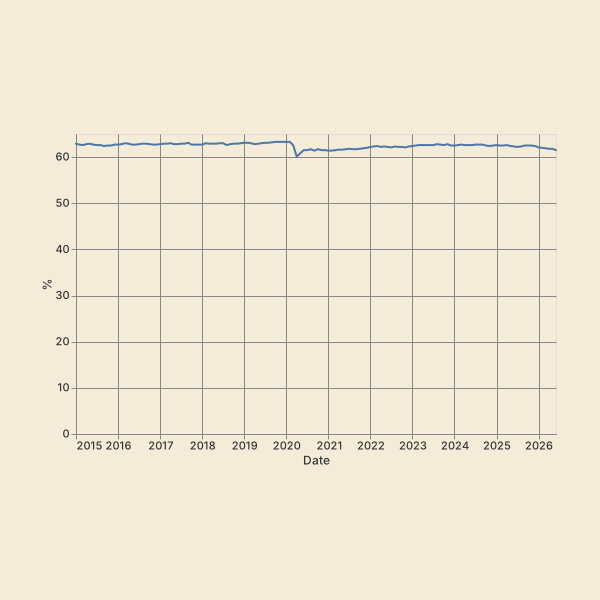
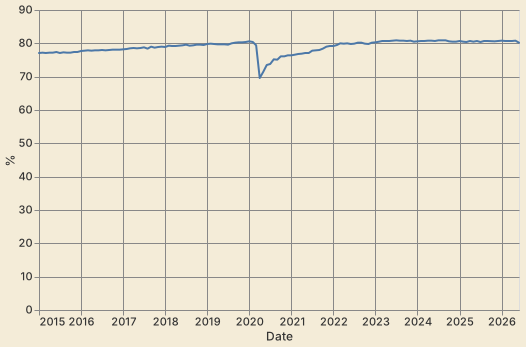
Economists remain divided on whether AI will ultimately eliminate more jobs than it creates, but there is broad agreement that the technology will boost productivity, as MSI reported in June. The U.S. labor-force participation rate stood at 61.5% as of July, with the prime-age employment-to-population ratio at 80.2%.
There are caveats to the demographic forecast. A sharp rebound in immigration could increase the supply of workers, potentially offsetting the projected decline, Ruggles acknowledged.