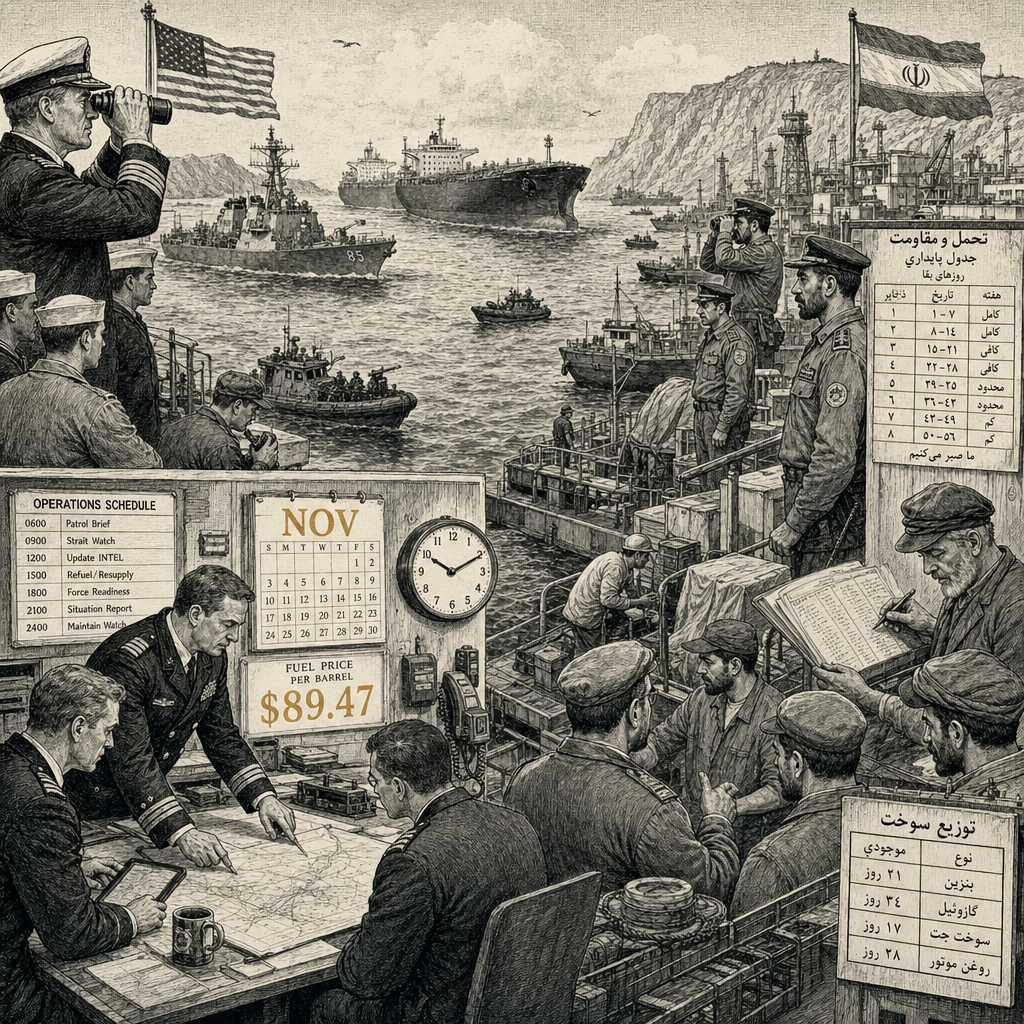
Both sides bet on endurance in low-level strait standoff
WASHINGTON — With the U.S.-Iran ceasefire in the Strait of Hormuz having crumbled, each government is calculating whose political and military clock will run out first, according to analysts and U.S. officials cited by the Wall Street Journal.
President Trump would prefer a resolution before the November midterm elections and before oil prices surge back to painful levels for Americans, the Journal reported. Tehran is hoping it can outlast Trump before a reimposed U.S. naval blockade cripples its already reeling economy — and without provoking another large-scale American and Israeli attack aimed at toppling the Islamic government.
“It’s really about endurance now,” said Hamidreza Azizi, a visiting fellow specializing in Iran at the German Institute for International and Security Affairs, as quoted by the Journal.
Each side has concluded its best course is to resume the conflict at a low level while waiting for the other to buckle, analysts said.
For Tehran, the immediate task is to maintain its chokehold on the Strait of Hormuz, using its battered but still formidable array of small boats and antiship missiles to block oil tankers and other ships from exiting the Persian Gulf. Achieving that aim would raise the pressure on Trump again, as it did after the war began in March, the Journal reported.
For Washington, the challenge is to find a way to slip out of that knot by degrading Iranian military sites that threaten shipping and by curtailing Iran’s oil exports from the Gulf with a reimposed naval blockade. The strategy had limited success early in the conflict but might show better results as the toll on Iran mounts, the newspaper reported.
“Iran basically thinks that it can attack enough vessels that they’ll effectively suppress shipping in the strait,” said Rosemary Kelenic, director of the Middle East program at Defense Priorities, a Washington think tank, as quoted by the Journal. “Trump seems to think the U.S. has found a way to get significant quantities of oil out of Hormuz, even if the Iranians don’t cooperate.”
The U.S. has cleared shipping lanes off the southern Hormuz coast of Oman to help commercial vessels move in and out of the Gulf. Over the past two months, U.S. forces have helped more than 800 ships sail through the narrow waterway, the American military has said.
As the ceasefire has crumbled in recent days, Iran’s Islamic Revolutionary Guard Corps managed to hit and disable ships using the southern route with its missiles and drones, killing and injuring crew members and alarming shipping companies. Tehran wants ships to go through the strait’s northern passage, which hugs Iran’s coast, the Journal reported.
The attacks are threatening to choke off traffic and once again raise oil prices, after they returned briefly to prewar levels last month. Prices for Brent crude, the international benchmark, rose 1.7% to $84.73 a barrel on Tuesday and are up more than 11% over the past two days. It is still far below the highest levels reached at the beginning of the war, when prices breached $100 a barrel.
U.S. strikes that restarted last week continued Tuesday, said the U.S. military, which added that its “forces began launching an additional round of strikes against Iran to continue degrading Iranian capabilities used to attack commercial shipping in the Strait of Hormuz.” The U.S. blockade of Iranian ports and shipping resumed Tuesday afternoon.
The Pentagon has used jet fighters, drones, and attack helicopters flying over the strait to intercept Iranian weapons and boats before they can hit ships sailing along the Omani shore. But with Iran firing coastal-defense cruise missiles from close range, some recent Iranian attacks came too fast to stop, a senior U.S. official told the Journal.
The Pentagon could potentially dedicate guided-missile destroyers to the navigation effort, positioning them alongside tankers to shoot down Iranian missiles. But a convoy operation is impractical with the blockade in full force, U.S. officials said. The destroyers are needed in the Gulf of Oman to help prevent ships from traveling to and from Iranian ports, the officials added.
The ticking clock that both sides face in some ways favors Tehran, as long as it can keep the conflict contained, analysts said.
“They don’t want to escalate to the point where escalation would get out of control, where Trump is out of options other than more extreme military options,” Azizi said.
Although the blockade is likely to further harm Iran’s economy, the Journal reported, Tehran has shown it can absorb such costs and is now seeking to reconstitute missile arsenals and air defenses that have been badly degraded during the conflict.
The U.S. is unlikely to be able to stop Iran from threatening shipping in the strait without a sharp increase in its military effort, which it won’t risk for reasons rooted in domestic politics, said Alan Eyre, a former senior State Department negotiator with Iran now at the Middle East Institute, in a social-media post Tuesday.
With U.S. elections looming, Iran still has to worry that Trump might escalate attacks, seeking a clear-cut victory instead of allowing the conflict to continue through the midterms. But such a strategy would carry heavy risks for Trump, analysts said. Iran would likely retaliate against U.S. allies in the Persian Gulf and even against Israel. The U.S. is also facing shortages of interceptors that are critical for knocking out incoming Iranian missiles, making it dicier for Trump to stretch the clock, the Journal reported.