Black Belt towns fear loss of federal aid as map changes
In Tuskegee, a rural Alabama city of less than 9,000 people where over 80% of residents are African American and nearly one in three live in poverty, basic medical services remain out of reach for many residents. When 19-year-old Tuskegee University student De’Mari Benham cut his arm on a shattered glass door, firefighters bandaged him at the station and advised him to go to a hospital in the next town for stitches. He told the BBC he chose not to go “both because it’s far and because I just simply don’t have the funds.”
The fire department, whose building is not fit for purpose, is where many residents seek help. Captain Dondrell Hopson told the BBC, “We get calls, crazy calls, for all kinds of things. Treating bullet wounds. Guys bleeding out.” Fire Chief Willie Smith added, “we need a building.”
Barely a year after his election, Figures helped secure $1 million from the federal government to build a civic center in Tuskegee. It will serve as a fallout shelter against deadly storms and house the police department and the fire department.
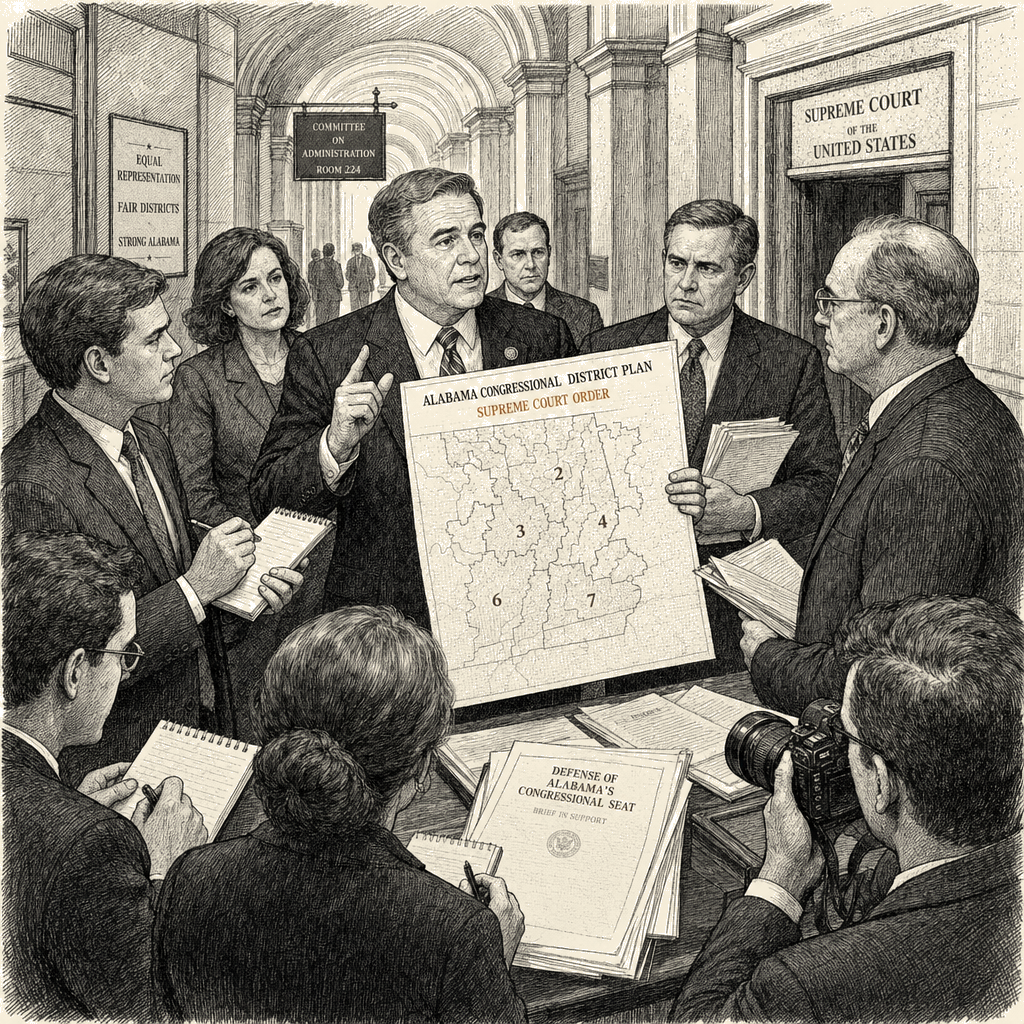
But the Supreme Court’s April ruling on the Voting Rights Act shifted the political landscape. The decision allowed Republican-led states to redraw congressional maps, and Alabama dissolved Figures’ majority-Black district. Figures, a Democrat, now goes into November’s midterm elections defending a redrawn, white-majority seat.
Tuskegee Mayor Chris Lee told the BBC that the city depends on federal funding. “All of our issues, we do depend on federal funding,” Lee said. “It’s very important that we have someone who has our back.” In the years before Figures, the area was represented by Republican Mike Rogers, who did not respond to the BBC’s request for comment. “I cannot even remember seeing our congressman before,” Lee said.
Figures told the BBC he believes the motivation for the new map is racial. He pointed to what he described as evidence in the record of state legislators referring to Montgomery during the redistricting process as “monkey town.” Montgomery, the state capital, is over 60% African American. That text message was cited by the three-judge panel that first blocked Alabama’s map.
Alabama Attorney General Steve Marshall disputed that characterization, telling the BBC the efforts are partisan battles, not motivated by race. “I don’t believe that there’s been a direct targeted history… in a way that suppresses minority voter participation,” he said. He pointed out that Democrats have redrawn maps in states such as California to boost their chances of winning more seats, and said Republicans are following the same “race-neutral” principles.
Cedric Coley, chair of the Alabama Young Republicans, told the BBC he opposes federal judges intervening in redistricting. “I would rather have family disputes, with the people of Alabama, instead of federal judges stepping in and saying because your past is racist, we must be racist in the future and create racial maps, and box people in racial quotas. I just don’t believe that.”
Joe Reed, a Montgomery-based civil rights activist and lawyer, told the BBC, “It’s a big setback for black people. You can discriminate based on politics, but you can’t discriminate based on race. Well, hell, in Alabama, with the polarised voting we have, everything is race. Everything.”
The district Figures represents touches Alabama’s eastern and western boundaries, stretching through Montgomery and across a region known as the Black Belt, named after its fertile black soil and the large Black population that remained in the area after slavery. The landscape is drenched in civil rights history. In Tuskegee, monuments to the Confederacy stand on the same grounds where America’s first Black U.S. Air Force pilots trained for World War Two.
Sixty-two miles east of Tuskegee is the rural outpost of Eufaula, where, in 1874, a white mob fired hundreds of rounds into a group of Black men headed to vote, killing six. The population of Eufaula is now roughly 45% white and 45% Black, but inequality remains high. Black residents experience poverty at nearly 57%, more than four times the rate of the white population.
Mary Porter, 71, lives on a fixed income with no means of transportation. She recalled marching as a child to pass the 1965 Voting Rights Act. “We should have a voice here, and it should be equality and justice for all,” she told the BBC. Porter said she relies on God and friends to get to her doctor over 50 miles away, in Columbus, Georgia. After suffering two strokes, she worries about the fate of Eufaula’s hospital, Medical Center Barbour, which has struggled financially and does not have an MRI machine.
Since Figures was elected, he helped the medical center receive $500,000 in federal funding for a new MRI, in addition to more than $1 million in federal tax credits. CEO Jannet Kinney said the machine will improve patient care and raise revenue. “I think he cares,” Kinney told the BBC. “And I’d hate to lose anybody that cares.”
Eufaula’s four-term mayor, Jack Tibbs, who votes Republican but is nonpartisan in his role, praised Figures’ engagement. “I’ve seen him four times since he went into office,” Tibbs told the BBC. “I can’t say that about the previous guy. The guy before him, and the guy before him, weren’t doing that.” Eufaula’s previous representative, Barry Moore, a conservative and Trump loyalist now running for Senate, did not respond to the BBC’s request for comment. After the ruling, Moore told local media that “elections should be determined by Alabama’s values and candidates’ ideas, not the color of anyone’s skin.”
Figures faces the winner of the August 11 Republican primary in November. State Representative Rhett Marques appears to be the favorite, after receiving endorsements from House Speaker Mike Johnson and President Trump. Marques has spent much of his time campaigning in Alabama’s wiregrass region, a mostly-white, rural farming community that was folded into Figures’ district after the Supreme Court ruling.
On a recent Sunday in Tuskegee, parishioners gathered outside Butler Chapel African Methodist Episcopal Zion Church, grappling with the ruling and their future in the district. “They’re trying to remove our voices and our votes, trying to make our votes less powerful,” 18-year-old Tuskegee University student Deirdre Newcomb told the BBC. Gale Brown, 73, said, “It hurts me. I never thought this would happen in my lifetime.”