Hezbollah rejects disarmament as condition for Israeli withdrawal
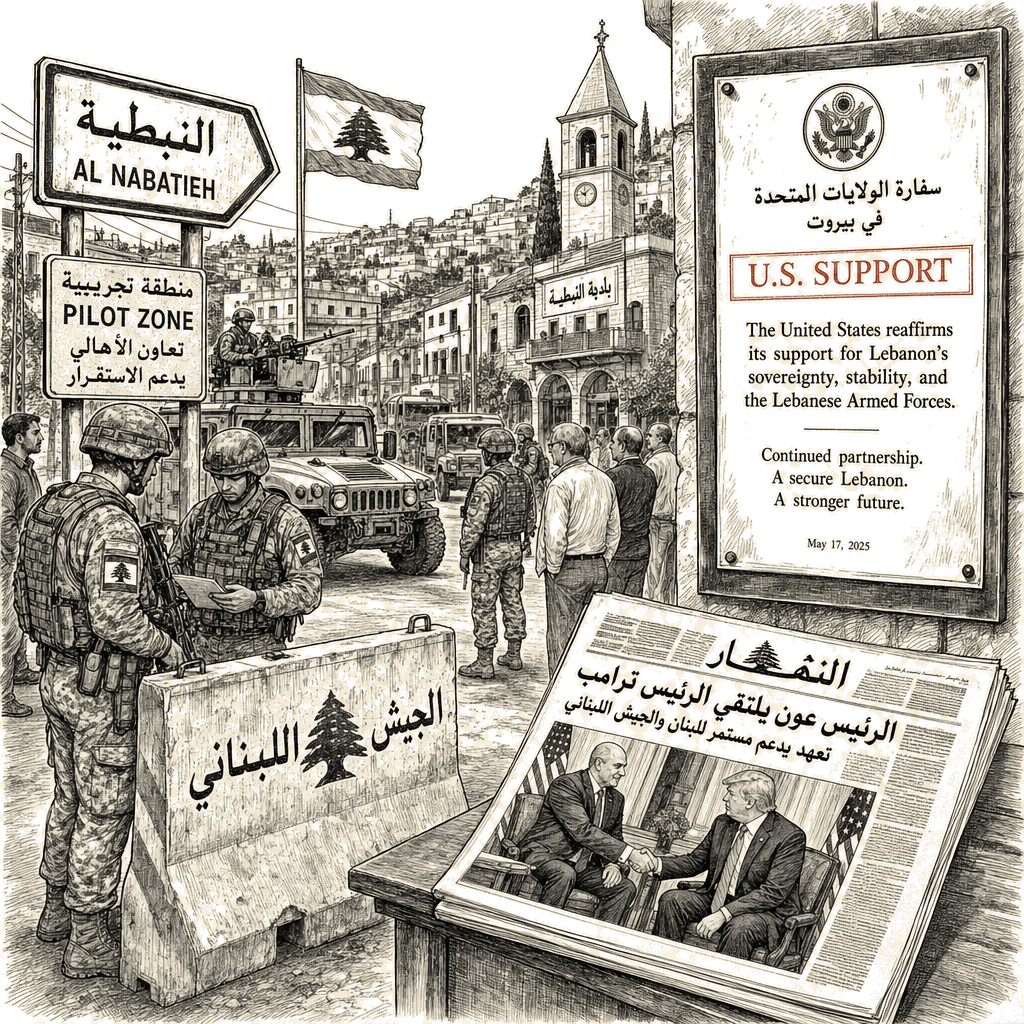
Lebanese President Joseph Aoun met with President Donald Trump in Washington this week, becoming the first Lebanese head of state invited to the White House since 2009, according to United Press International. Trump agreed to provide political backing for Aoun, continued military assistance to the Lebanese Army, the resumption of direct commercial flights by U.S. airlines to Lebanon, and increased U.S. investment and support for economic recovery, UPI reported.
The meeting occurred hours after the Lebanese Army began deploying forces in two pilot zones in southern Lebanon under a U.S.-brokered framework agreement signed June 26. The agreement sets a phased sequence of Israeli withdrawals conditioned on the disarmament of Hezbollah, which has maintained a military presence in southern Lebanon.
Aoun, who served as Lebanon’s army commander before being elected president last year, emphasized the need for Israel’s complete withdrawal from occupied parts of southern Lebanon, describing it as an “essential step” toward consolidating Lebanon’s sovereignty and stability, according to the report.
Retired Brig. Gen. Ziad al-Hashem, a former Lebanese Army deputy chief of staff for planning, told UPI that the deployment in the village of Zawtar al-Gharbieh — the first pilot zone — represented a “historic achievement” for Lebanon because it marked the first time territory had been recovered through diplomatic means rather than force.
“Any inch of land liberated to restore state sovereignty is an achievement,” al-Hashem said.
Al-Hashem acknowledged criticism from Hezbollah officials who argued that Zawtar al-Gharbieh had not been occupied by Israeli forces. He responded that the village had remained within Israeli firing range and that Israeli troops had entered and withdrawn from it repeatedly for tactical reasons. The initial deployment, whose implementation will be supervised by specialized U.S. military teams, is expected to be followed by the creation of additional secure zones, permitting the return of displaced residents and reconstruction.
If successful, the process would represent a significant political victory for Aoun and validate his strategy of pursuing diplomacy despite Hezbollah’s opposition.
The framework agreement ties Israel’s complete withdrawal to Hezbollah’s disarmament — a condition Israel has set and Hezbollah has rejected. The group, along with Iran, continues to insist on linking Lebanon’s negotiations to the suspended U.S.-Iran talks, according to UPI.
Eric Lob, an associate professor of Middle East comparative studies at Florida International University in Miami, told UPI there is considerable reason for skepticism about whether diplomacy can succeed. He pointed to the situation in Gaza as a cautionary example, citing a 20-point plan that he said has failed to halt the conflict.
“Even if Hezbollah has been degraded, it must be looking at what is going on in Gaza and saying to itself, ‘There’s just no way we can disarm,’” Lob said.
Lob said the ongoing U.S.-Iran conflict is “another factor that disincentivizes Hezbollah from disarming,” citing reports that the group has transformed itself since 2023 and reverted to operating more as a guerrilla force. He said Washington is playing a “big role” in restraining Israel, but added that whether that restraint will continue is uncertain.
Al-Hashem said Aoun’s plan could contain Hezbollah’s weapons without triggering a confrontation “by simply keeping them in depots and preventing them from being moved from one area to another or used.”
He warned that failure by the Lebanese government to fulfill its commitments would give Israel a pretext to resume attacks, destroy more villages, and abandon the accord.
A Lebanese official, recently interviewed by UPI, warned that if Iran’s Islamic Revolutionary Guard Corps — which may have taken control of Hezbollah’s decision-making — orders the group to fire on Israel, the resulting Israeli retaliation would be “catastrophic” for Lebanon, causing more destruction, casualties, and the occupation of additional territory.
Al-Hashem said that Aoun met with Trump while Israeli Prime Minister Benjamin Netanyahu was still awaiting a date for his own Washington visit, arguing that the timing reflected continued U.S. commitment to the framework agreement and Washington’s willingness to pressure Israel.
“Bringing more territory under Lebanese sovereignty is very important, while keeping Lebanon linked to the U.S.-Iran track is very dangerous for the country,” al-Hashem said.