A lobbyist who previously worked for the White House facilitated the call
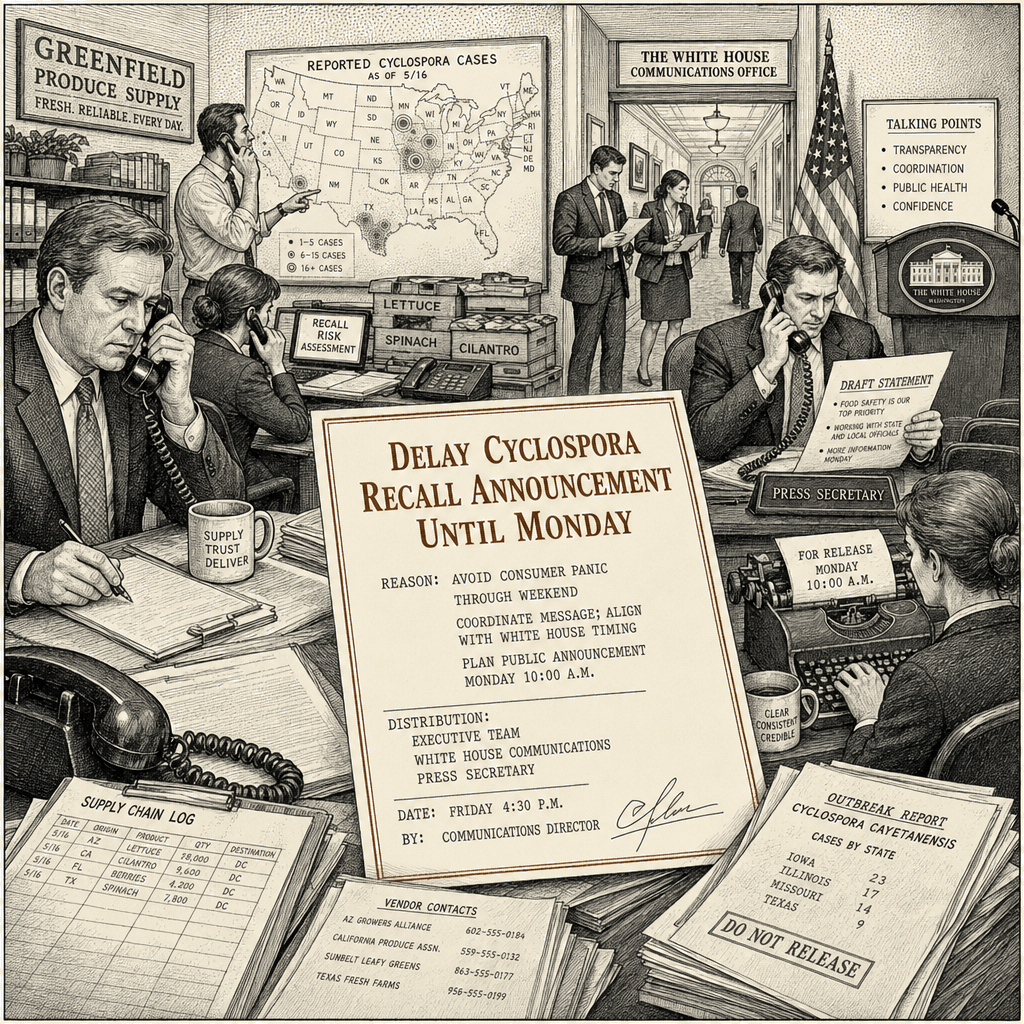
Produce supplier Taylor Farms contacted the White House in an attempt to delay the announcement of a recall tied to a multistate cyclospora outbreak, according to people familiar with the matter. The call, facilitated by a former senior White House personnel official now working as a lobbyist, took place as federal health authorities prepared to publicly link the company to illnesses that have sickened thousands.
The call, during which Taylor Farms requested more evidence and more time before being publicly linked to the outbreak, was part of the company’s effort to request more proof, according to people familiar with the matter.
Taylor Farms sought out the White House after company executives felt they had not received enough clarity from the Food and Drug Administration on the evidence behind a potential recall and its scope, according to a person familiar with the situation. The White House asked FDA officials to join the call, and later held a separate conversation with the agency to understand how it had traced the outbreak to shredded iceberg lettuce supplied by Taylor Farms to Taco Bell, some of the people said. The White House was eventually convinced by the FDA’s findings and gave the agency approval to make them public.
In a July 16 announcement, the FDA refrained from naming Taylor Farms because of legal restrictions around trade secrets, according to people familiar with the decision. The agency said only that illnesses in five states were tied to Taco Bell and a single supplier in Mexico. A day later, Taylor Farms voluntarily recalled all of its iceberg lettuce from central Mexico.
A Taylor Farms spokeswoman said the company immediately removed all potentially implicated products from the market when questions were raised about the outbreak’s source, and issued an even broader recall out of an abundance of caution.
On Saturday, the FDA said a sample of Taylor Farms lettuce had tested positive for cyclospora, appearing to provide the first laboratory link to the company. The agency added that the positive sample was found in lettuce not covered by the recall, suggesting additional product might be unsafe. But the agency reversed itself Sunday, saying the result was a false positive, which sparked widespread confusion. The FDA said it had not issued an official apology, and Taylor Farms later deleted a social-media post highlighting one, though its original weekend statement remains on its website.
Health and Human Services Department spokeswoman Emily Hilliard said the FDA presented Taylor Farms with substantial evidence connecting its products to the outbreak and engaged in extensive discussions with the company. Health officials raced to clarify Monday that strong epidemiological evidence continued to point to Taylor Farms as the source, and that the company’s recall remained in effect.
Taylor Farms’ response frustrated administration officials, who viewed it as an effort to cast doubt on the broader investigation and obfuscate the company’s role, according to people familiar with the matter.
Former FDA deputy commissioner Frank Yiannas said the agency appears to have moved slowly in its response, noting that cyclospora-related illnesses began on May 13, two months before federal officials issued their first advisory. He called the release of the unconfirmed positive test result “an unacceptable, unfortunate and consequential error.”
Susan Mayne, who directed the FDA’s Center for Food Safety and Applied Nutrition from 2015 to 2023, said Taylor Farms’ efforts to limit its exposure amplified confusion around the outbreak, including a recall notice she described as “striking in terms of the lack of information being made available.”
Taylor Farms has commissioned independent experts to conduct a thorough review of the company’s food safety processes and protocols at its farms and facilities in central Mexico, the spokeswoman said, adding that the company invests more than $200 million annually in food safety measures. The company has temporarily suspended production at its processing facility there to conduct the review.