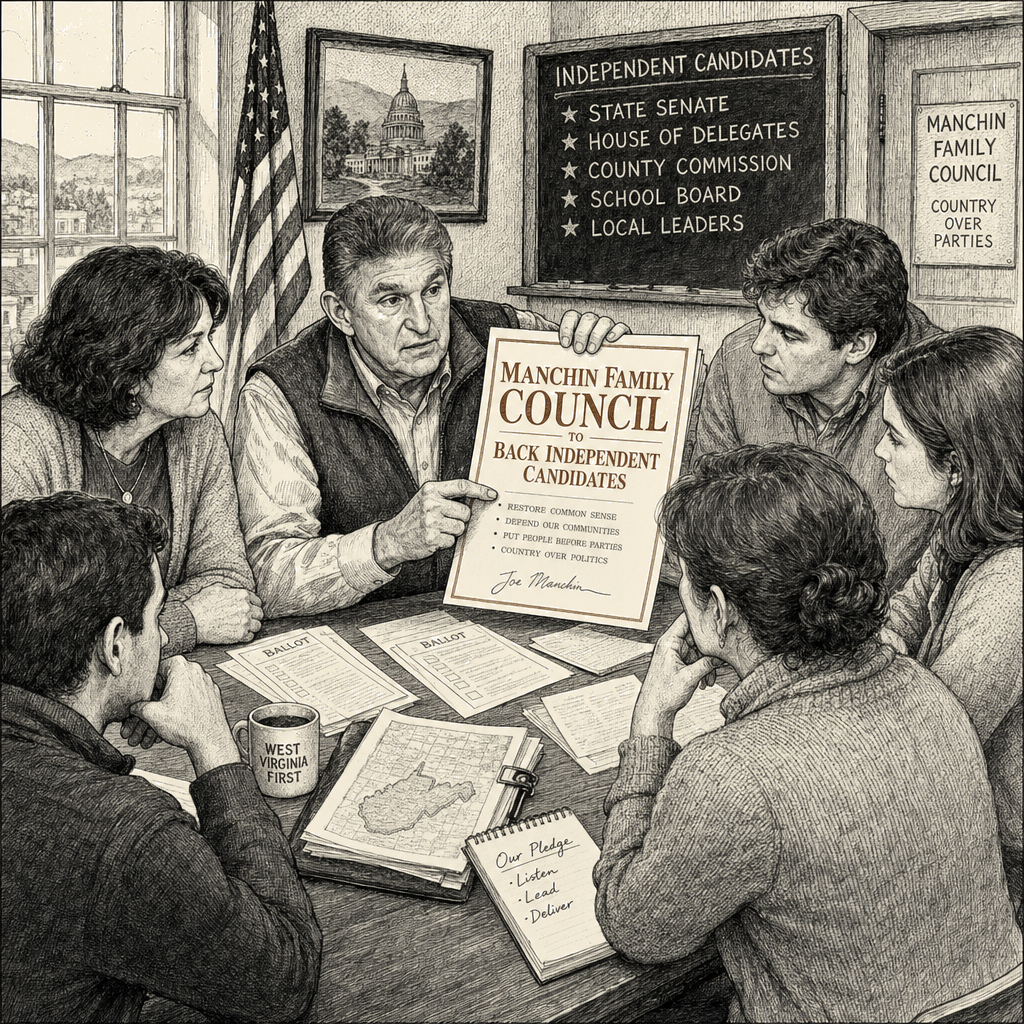
Greenbrier summit draws ‘over eight figures’ in commitments
The Independent Leadership Council combines a family-run political organization with a data-driven nonprofit that studies the growing independent electorate. “This is not about a third party. This is about people running outside the two party system,” Heather Manchin told NPR. “We’re willing to go out there and campaign, we’re going to be fundraising, we’re going to put our arms around this effort to do all we can, because the infrastructure for independents lacks significantly.”
The effort launched Friday at the Greenbrier Resort in White Sulphur Springs, West Virginia — a property that includes a Cold War-era bunker designed to house every member of Congress in the event of a nuclear attack. The gathering brought together eight independent candidates with donors in an attempt to close the fundraising gap that has long put independents at a disadvantage against the two major parties.
“The candidates needed to know that they could trust people to believe in their vision as an independent candidate, and funders and donors needed to trust that there was going to be an actionable plan that would really turn out results in November,” said Seth Cohen, a senior adviser at the Independent Center and one of the co-founders of the council.
The council’s strategy relies on data collected by the Independent Center, which has used artificial intelligence to identify districts where independents have the best chance of winning. “We have to show that it’s not just that we have a good strategy, but that the strategy can win,” said Adam Brandon, a senior adviser at the Independent Center. “This isn’t about a moral victory — this is about winning. And so we had to show that every candidate we had here has a path to victory.”
Brandon, who previously led the conservative grassroots group FreedomWorks and helped turn Tea Party activists into a major political force, said the retreat’s fundraising results produced over eight figures in commitments. “We have over eight figures in commitments,” he said. “We’re going to be able to go and actually start supporting some of these candidates. You’re going to see viable independent candidates in the field in America really for the first time in my lifetime.”
Rep. Kevin Kiley, a California congressman who left the Republican Party in March to become an independent, attended the summit and described a “dawning realization” among voters. “The division is getting worse, the polarization is getting worse, the gridlock in Congress is getting worse,” Kiley said. “There is a dawning realization among more and more people that we need to chart a different course.”
A central question for the council is whether successful candidates will decline to caucus with either party once they reach Capitol Hill. Current independent Sens. Bernie Sanders of Vermont and Angus King of Maine both caucus with Democrats. Kiley, who continues to caucus with Republicans for the remainder of his term, said he would push to change House rules so that independents could serve on committees without having to align with a party. “It makes absolutely no sense that in order to serve on a committee, which is a huge, huge part of being in the House, that you’re forced to caucus with one or the other,” he said.
Michael Bridgford, who is running in a tossup district in Iowa, said the committee-access question is not something voters raise on the campaign trail. “This is literally the least productive Congress in history,” he said. “Being on those committees, if they’re not accomplishing anything, I’m not sure what that yields.”
Former Arizona Rep. Matt Salmon, who spoke at the gathering, said independents could wield disproportionate influence in a closely divided chamber. “For this to work, whoever wins the majority, it’s going to have to be very, very thin like it is today,” he said. “As an independent, your strength is in a slim majority because when the key votes come, they’re going to need your vote.”
Joe Manchin, a Democrat turned independent who left the Senate in early 2025, said the candidates signed a “Declaration of Independents” — a nod to the country’s 250th anniversary — pledging to remain outside the Democratic and Republican structures. “The pledge is simply this: that you remain independent and not be part of the Democrat or Republican system,” he said. “We’re going to challenge the system.”
Heather Manchin described the council’s immediate ambition as focused on a small number of races. “We’re not out here saying, we’re going to run 50 people,” she said. “We’re talking about a handful. If we can show one or two getting in, it just unlocks the untapped potential of giving independents a voice in this country.”
The Manchins have not yet endorsed any candidates and emphasized they are being strategic about their targets.