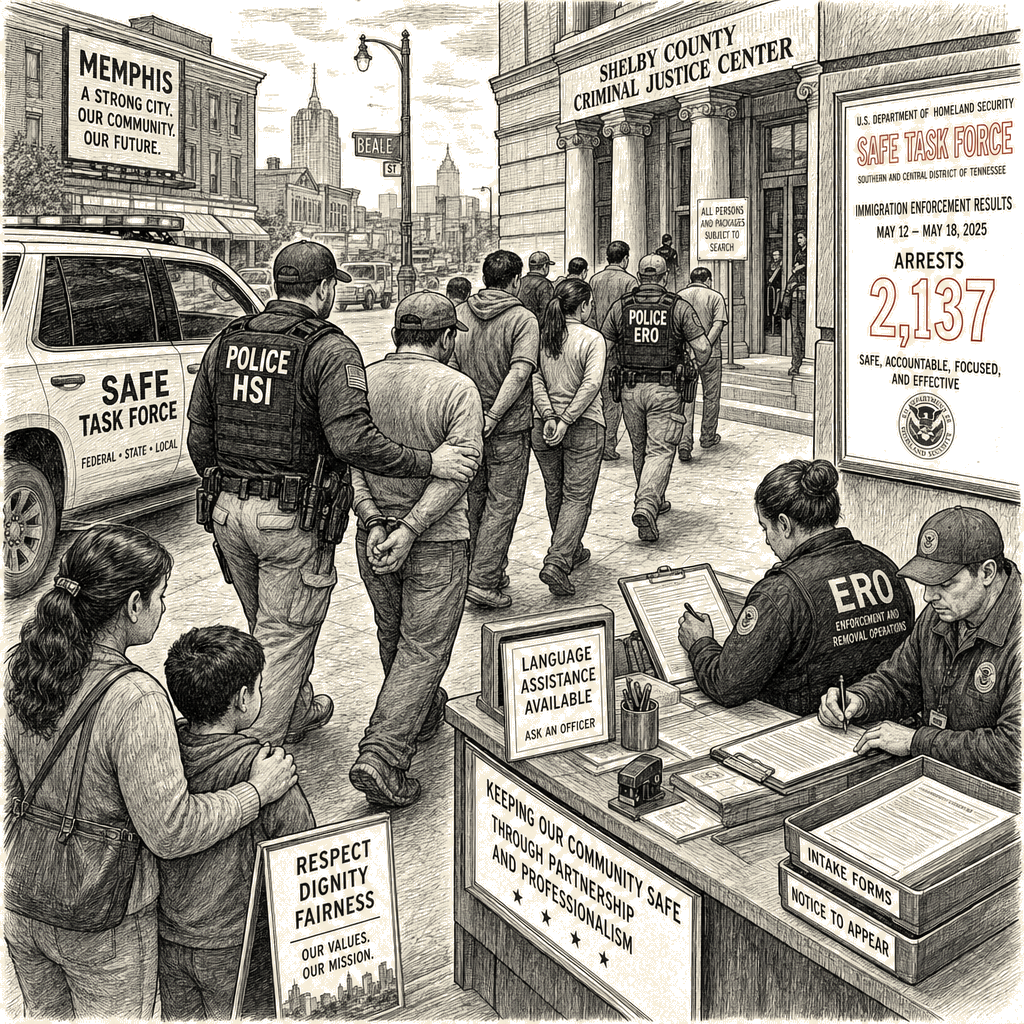
Most detained lacked criminal convictions, data analysis finds
President Trump launched the Memphis Safe Task Force last October alongside Tennessee Republican Gov. Bill Lee, despite crime in the city being at a 25-year low at the time. Trump described the operation as a “replica” of the ongoing anti-crime task force in Washington, D.C., and said it would target “dangerous career criminals.” More than a dozen federal agencies and hundreds of Tennessee National Guard members were deployed to work with local and state law enforcement.
An analysis of arrest data by the Institute for Public Service Reporting found that the first months of the task force brought hundreds of immigration arrests — a sixfold increase from previous months — and that the vast majority of those arrested had no criminal convictions. The city of Memphis initially listed immigration arrests on a public dashboard, but those numbers were later removed.
“This administration has used crime as a pretext for furthering and advancing its immigration enforcement agenda because they understand that immigration may not be top of mind in maybe non-border states in the way that it is in border states,” said Chioma Chukwu, executive director of American Oversight, a nonpartisan watchdog that has investigated the administration’s use of multi-agency task forces.
Emily Williams, a spokesperson for the U.S. Marshals Service, which leads the Memphis task force, said immigration enforcement is “only one aspect” of the mission. “Our primary focus is violent offenders. We arrest anyone who is breaking the law — if you are in the country illegally, you are committing a crime,” Williams wrote in a statement. White House spokesperson Abigail Jackson said the task forces have “yielded tremendous results for local communities” but did not provide evidence.
Immigrant-rights advocates in Memphis said they anticipated the immigration focus before the task force arrived. “As soon as the announcement came out, I was really clear-eyed about what was going to be happening,” said Casey Bryant, executive director of Advocates for Immigrant Rights in Memphis. He said media coverage focused on the deployment of the National Guard, but “it was really going to be about the federal agencies that were riding the coattails of the National Guard.”
Maria Oceja, co-founder of the local rapid-response network Vecindarios 901, said she began warning local officials that the task force would become an ICE operation. She recalled Stephen Miller, the White House chief architect of immigration policy, telling law enforcement officers during the rollout: “You are unleashed.” That first night, Vecindarios 901’s hotline received so many calls that four people had to answer simultaneously, a pace that continued for months.
Most immigration arrests appeared to occur during traffic stops concentrated in the city’s two main Hispanic neighborhoods, according to community organizers. Hunter Demster, a Memphis resident who films task force activity, said the stops were “very evident” as an immigration operation. “This isn’t necessarily about finding the worst of the worst or fixing crime,” Demster said. “It’s about targeting Black and brown folk.”
The fear rippled quickly through Memphis’s immigrant community, which is roughly 10% of the city’s population — mostly Hispanic and Haitian — and is the fastest-growing demographic segment, according to U.S. Census data. Mauricio Calvo, president and CEO of Latino Memphis, said children stopped attending school, people stopped going to work, and medical providers reported patients missing appointments. “There was a spike of fear and panic,” Calvo said.
Amber Hampton, who runs a makeshift food pantry from her garage in a Memphis suburb, works with a network of volunteers delivering groceries to families still limiting their time outside. She said the scenes in Memphis mirrored federal immigration raids in Minneapolis earlier this year, but with far less national attention because local officials were welcoming.
One high-profile case involved Yasser Jose Lopez Soza, an 18-year-old junior at Memphis Business Academy. Lopez was arrested in February while riding as a passenger in a car on his way to a soccer game, according to the Department of Homeland Security. He was held for 63 days at the West Tennessee Detention Facility after immigration agents followed the Memphis police traffic stop. Classmates staged a walkout to protest his detention, and a U.S. district court judge later found that his arrest and detention violated his due process, ordering his release.
Ronnie Davis, a barber in the Frayser neighborhood, said he initially felt safer with the added law enforcement presence but has since learned about cases like Lopez’s. He said some of his friends have been deported. “They are only touting the good things,” Davis said of officials’ praise for the task force, adding, “But had I been Hispanic, I’d be terrified. If I was Haitian, I’d be terrified.”
One key difference between Memphis and other cities that have experienced similar federal interventions is the cooperation at the state level. In a March visit to Memphis, Trump declared the task force a success, saying crime had been “fixed.” Gov. Lee sat alongside Trump, Defense Secretary Pete Hegseth, and Stephen Miller, thanking Miller directly for his focus on the task force. Lee focused entirely on crime reduction without mentioning immigration enforcement.
Memphis Mayor Paul Young, a Democrat, was not at that roundtable. At a separate press conference, Young said he was not “supportive” of the high number of immigration arrests but could not control it because federal and state officials were in agreement. “My goal is to make sure that I can control what I can control. And there’s no mayor in America that can control the immigration aspects of this,” Young said.
Crime has fallen in Memphis since the task force launched, according to local police data, though the decline continued a trend that began in 2023 after a near-record high. The task force does not have a set end date. Tennessee National Guard troops remain stationed in grocery store parking lots and along tourist areas. Unmarked SUVs with tinted windows continue to patrol thoroughfares, and mutual aid groups report sustained demand for food and other assistance.