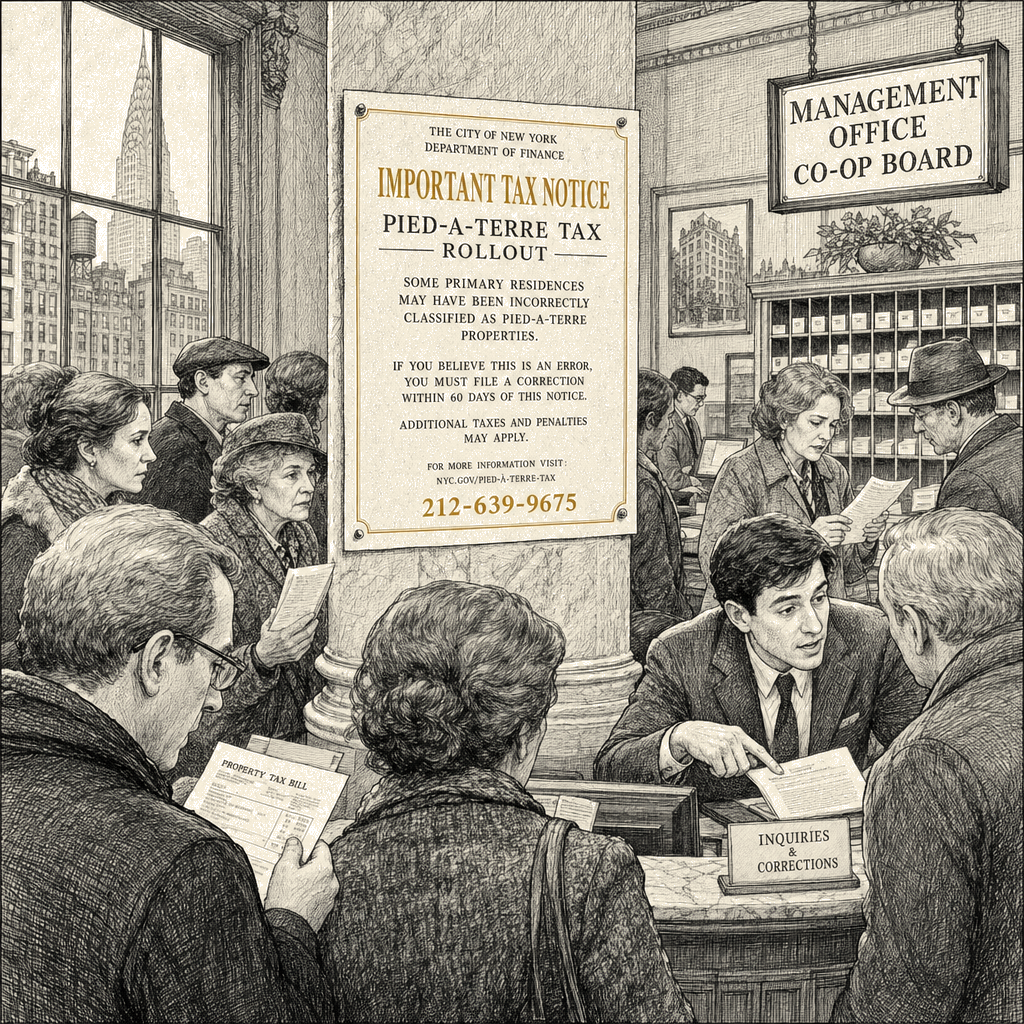
17,000 property owners received notices, but exemption applications prove difficult for some
New York City’s rollout of a new pied-à-terre tax has drawn backlash from residents who say their primary homes were incorrectly targeted, raising questions about the city’s ability to administer a major new levy fairly.
The tax, approved by state lawmakers in May, is designed to apply to people who maintain second homes in New York City valued at $5 million or more. Mayor Zohran Mamdani has celebrated the measure as a way to tax the city’s wealthiest residents in order to fund initiatives such as city-owned grocery stores and free buses. But the implementation has been messy: the city recently released a list of property owners who may be subject to the surcharge, and that list covered about 960,000 properties—roughly one-quarter of all units in the city—even though Gov. Kathy Hochul’s office had previously estimated the tax would apply to only about 10,000 second homes. A spokesperson for the mayor’s office said 17,000 property owners were sent letters telling them they might be charged.
Bob Ohlerking, 82, was among those who received a notice. He has lived in his Park Slope brownstone for 55 years, yet the letter said he owed a $44,048 surcharge based on the townhouse’s $5.56 million valuation and that the property was not his primary residence. “I’ve paid taxes for 55 years. All of that stuff is on record. So the fact that they think that I have a second home and that I live in this house for part of the year and somewhere else seems a little bizarre,” Ohlerking said. “It’s annoying. It’s not gonna upset my life forever. It’s just annoying.”
Ohlerking, who is blind, tried to apply for an exemption online with the help of his friend Jennifer Stadnik, but the website displayed a nonfunctioning blank white screen. The pair then printed out documents and went to the Department of Finance’s Brooklyn office, only to be told by employees that the office couldn’t accept the proof of residency at that time because the staff were busy setting up a designated intake center for people contesting their notices. On Friday, Stadnik said the office called Ohlerking to say it would help him on Monday morning. Department of Finance offices in Manhattan, Queens, and Brooklyn are now accepting walk-ins from homeowners applying for surcharge exemptions, according to the mayor’s office, and about 3,800 people have started exemption applications.
The discrepancy between the broad release list and the narrower set of those likely to owe the tax has fueled frustration. Republican City Council member Frank Morano, whose own house appears on the list, said his office received roughly 100 calls and emails in a single week from people asking whether they owed the tax or how to get exempt. “It’s now a question of whether city government can administer a major new tax competently and fairly, and it’s looking like the answer is no,” Morano said.
Claire Groome, a Sotheby’s real-estate agent, said she had heard from clients concerned about notices arriving at their primary residences. Submitting the required documents isn’t especially difficult, she said, but the fast-approaching deadlines add pressure. Letters told homeowners they have until Aug. 21 to submit an exemption application if they live in a townhouse or condominium, and until Aug. 24 if they live in a co-op. Officials have also said the city’s tax commission will accept appeals until March, which they described as the final deadline to be removed from the tax roll. Still, the requirement that owners prove their residency to avoid a tax is an unprecedented burden for many, Groome said.
Department of Finance Commissioner Richard Lee addressed the complaints at a Wednesday news conference. “We use existing information that we have, and it could have been that we don’t have updated information on their applications,” Lee said, explaining why the department hadn’t filtered out more owners before sending notices. At the same event, Mamdani said the notices were also sent to determine whether homes registered as trusts or LLCs were primary residences.
Pasquale Giordano, 76, who now lives in Miami, received a notice for a Brooklyn brownstone that he manages as a trustee and that his sister still lives in as her primary home—an exception written into the tax. The notice pegged the surcharge at $45,776 based on a market value of $5.7 million, a figure that jumped from $4.3 million in 2025. “In my mind, the house didn’t go up and down 30% in 12 months,” Giordano said, adding that the city is trying to “scam you out of money.” He applied for an exemption on July 27.
The pied-à-terre tax, championed by Mamdani, was authorized by state lawmakers in May. Hochul’s office had estimated it would affect roughly 10,000 second homes. The city has said only a “very small fraction” of the properties on the list will ultimately be charged, but the early confusion has left many homeowners anxious and skeptical about the administration’s handling of the tax.