Talks aim to set stage for December election, opposition representative says
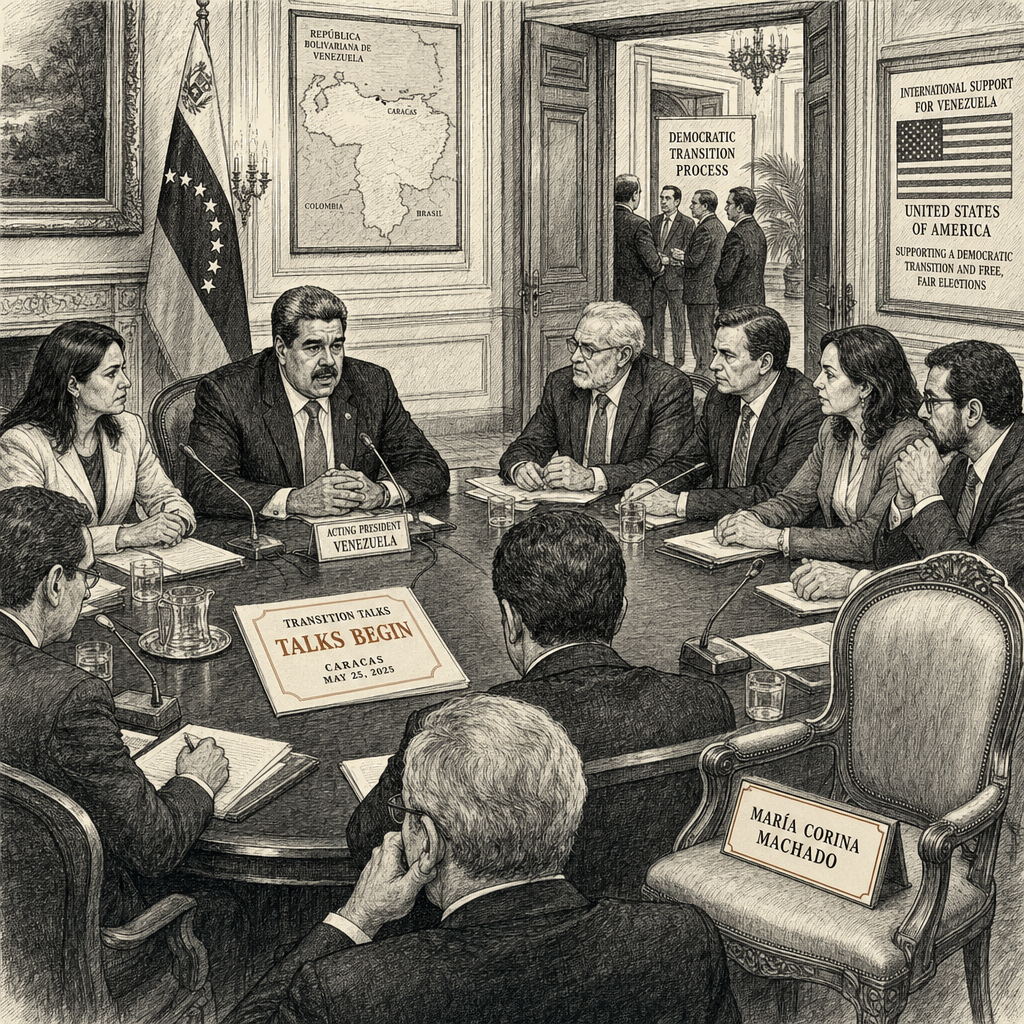
The first formal negotiations between Venezuela’s government and political opposition since the U.S. toppled Nicolás Maduro began Saturday, backed by the Trump administration but excluding the opposition’s most influential leader, María Corina Machado.
Nearly seven months after Maduro’s ouster, the talks aim to put Venezuela on a path toward a democratic transition, U.S. officials said. The process involves the government of acting President Delcy Rodríguez and some of the political opposition, part of Washington’s stabilization-and-recovery plan for the troubled South American country.
The exclusion of Machado, who has expressed skepticism about the process, has drawn criticism. Machado and Edmundo Gonzalez, the retired diplomat who independent observers say won the 2024 presidential election, said in a statement that they played no role in the talks’ “design, construction or operation” and that the mandate delivered by voters “remains in force.”
The opposition is represented by a group of lawmakers elected to the National Assembly in 2015, the last institution the U.S. recognized as democratically elected. Dinorah Figuera, who had been the last leader of that assembly and had lived in exile in Spain working at a nursing home before returning for the discussions, said the process “will open a step toward a democratic future for Venezuela” and aims to deliver the institutional foundations to call for an election by December.
Rodríguez’s party is represented in the talks by her brother, Jorge Rodríguez, who heads the National Assembly and had served as Maduro’s top negotiator during numerous past failed negotiations. Interior Minister Diosdado Cabello said, “Dialogue does not mean capitulation.”
President Trump said last week of elections in Venezuela, “They’re not really ready for them yet. But, boy, a lot of progress has been made. Delcy has been doing a fantastic job.” Secretary of State Marco Rubio said the U.S. is “there to facilitate it, not to dictate it,” and that Machado’s participation is “up to the Venezuelans to decide.”
Critics warn the talks could buy time and legitimacy for Rodríguez’s unelected leadership. Carrie Filipetti, who served as a senior State Department official overseeing Venezuela policy during Trump’s first term, said the U.S. isn’t using its significant leverage — including control over Venezuelan oil revenues — toward a real democratic end. “The talks cannot realistically represent the democratic voices in Venezuela if the person who represents the significant majority of those voices, María Corina Machado, is not only not leading negotiations for the opposition, but isn’t even safe to return to Venezuela in the first place,” she said.
Some U.S. lawmakers have expressed discomfort with the lack of clear progress toward democratic elections. Sen. Tim Kaine of Virginia, the top Democrat on the Senate Foreign Relations Western Hemisphere subcommittee, introduced legislation in June requiring a U.S. strategy for elections this year. “Delcy Rodríguez and others are now rapidly consolidating power, with no sign of plans to leave,” he said.
Privately, even some of Machado’s staunchest supporters on Capitol Hill say that after nearly seven months with no clear movement toward a transition, a flawed process is better than none, according to the Wall Street Journal.
Polls show Rodríguez’s popularity is sliding as Venezuelans lose patience with the pace of economic and political reforms. The government’s handling of a devastating earthquake in June has added to the discontent.
David Smilde, a Tulane University professor who closely tracks Venezuelan politics, said the government led by Maduro and now Rodríguez has long been accused of dragging out negotiations to delay reforms and harden its authoritarian grip. He said the U.S. wants to show a foreign policy win. “It’s kind of the United States that calls the shots on this,” he said.
Carlos Romero, a retired political science professor in Caracas, said negotiators ought to focus on reaching agreements on how to revamp Venezuela’s Supreme Court and the National Electoral Council. But Romero expressed skepticism, noting that 16 previous rounds of negotiations over the course of Maduro’s government produced little. “Very little of what was promised was ever fulfilled,” he said.