NAACP alleges 27 Mississippi gas turbines ran without Clean Air Act permits
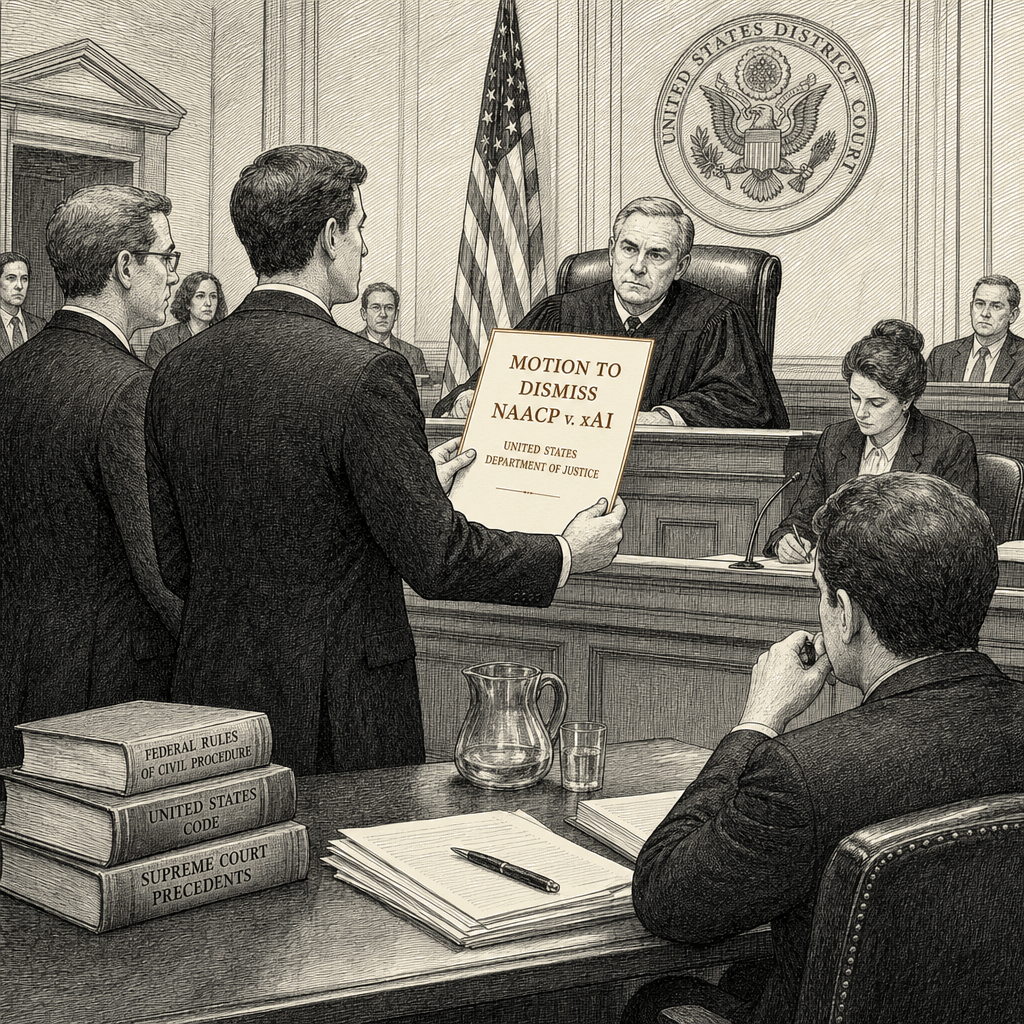
The U.S. Department of Justice asked a federal judge in June 2026 to dismiss the NAACP’s Clean Air Act lawsuit against Elon Musk’s artificial intelligence company xAI, arguing that private citizens cannot enforce environmental laws when the executive branch decides not to act, according to a legal filing in the case and an account by Sarah J. Morath, a professor of law and associate dean for international affairs at Wake Forest University.
The NAACP sued xAI in April 2026, alleging that the company and a subsidiary built and operated 27 natural gas-fired turbines in Southaven, Miss., to power the nearby Colossus 2 data center without obtaining the required Clean Air Act permits. The suit alleged that the turbines emitted nitrogen oxides, formaldehyde and other pollutants that can increase rates of asthma, respiratory diseases, heart problems and certain cancers. Had xAI applied for a permit, the Environmental Protection Agency would have required the company to use the best available technology to reduce those emissions, Morath wrote.
Congress included citizen suit provisions in the Clean Air Act, the Clean Water Act and the Safe Drinking Water Act so that enforcement would not rest with the executive branch alone, Morath wrote. Since the 1970s, the provisions have allowed ordinary people and advocacy groups to sue companies they believe are violating the law, and to sue federal agencies that fail to enforce it. According to Morath, the provisions have been used in more than 2,000 lawsuits, and citizen suits now account for a majority of environmental litigation.
The process typically begins with a formal notification to the person, company or agency suspected of violating the law, with a copy to the Environmental Protection Agency; if the problem is not resolved within 60 days, the lawsuit may proceed. Courts can order the polluting activity stopped, payments for reducing or cleaning up the harm, and civil penalties paid to the government, but a citizen suit cannot move forward if the government has already begun an enforcement action or is actively prosecuting the violator. The provisions have produced settlements in other cases, including a $50 million 2019 agreement by Formosa Plastics over plastic pellet pollution in Lavaca Bay and a $2.5 million 2025 agreement by Styropek USA over pellet pollution in a western Pennsylvania creek.
Morath wrote that defendants and judges have questioned the constitutionality of citizen suits in the past, but this is the first time the Justice Department has formally taken this position in court. “Some critics, including the Trump administration, view citizen suits as a way for citizens to usurp the executive branch’s prosecutorial authority,” she wrote. Supporters of the provisions say they let ordinary people exercise their statutory rights to advocate for a clean and healthy environment and to enforce environmental laws when the government’s efforts fall short.
In its June 2026 filing, the department argued that citizen suits cannot proceed when the federal government does not oppose the polluting behavior. The department cited two executive orders President Donald Trump signed within days of the start of his second term — one declaring a “national energy emergency” and the other seeking to support “American leadership in artificial intelligence.” The lawsuit, the department said, threatens “artificial intelligence innovation” and national security. The department further argued that citizen suits should be allowed only when the government fails to enforce a statute, not when the executive branch has decided that enforcement action is contrary to the public interest.