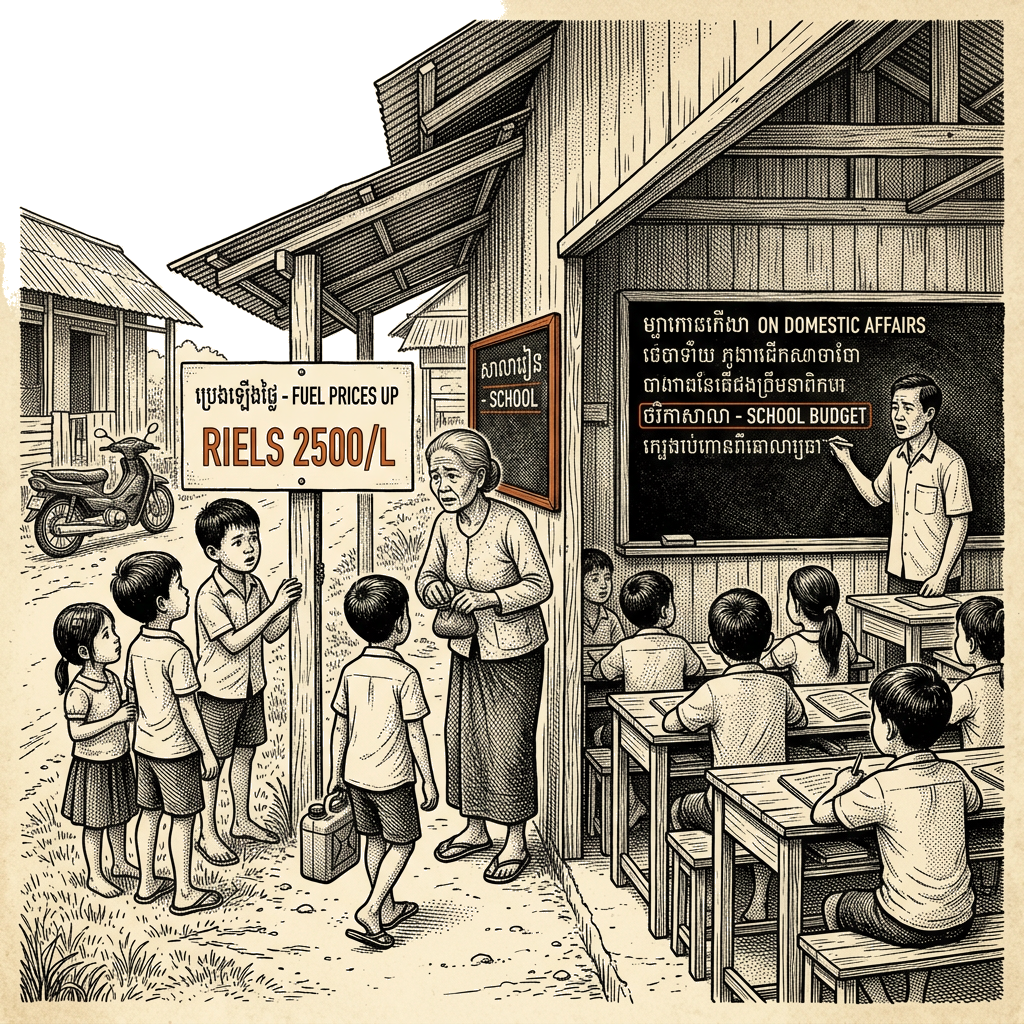
Fuel costs squeeze both family commutes and government education budgets
Rising fuel prices driven by the Iran war are tightening access to education in Cambodia through two channels documented by an Associated Press report from Kampong Prahok — making it more expensive for children and teachers to reach classrooms, and squeezing the national budgets that fund schools.
For households, the mechanism is direct. Soaring fuel prices push up the cost of the commute itself — the gasoline, the boat fuel, and the transport that connects remote communities to school buildings. Teachers who travel to their posts face the same rising prices. The AP report says the burden falls first and hardest on the poorest families, and unlike the outright school closures that marked COVID-19, the current impact registers as costs that compound existing barriers rather than as visible shutdowns.
For governments, the same fuel-price pressure that lifts household transport costs also constrains the fiscal space available for education funding, according to the AP report. The squeeze arrives at the same moment that rising transportation costs are making it more expensive for the system to function.
The combined pressure is concrete on Cambodia’s Tonle Sap, the largest freshwater lake in Southeast Asia. There, 13-year-old Sou Sreynich first entered a classroom at age 10 — several years after most Cambodian children begin school, according to the AP report. Her mother waited until she was old enough to swim, fearing the boat to school could capsize. Sreynich, the AP report says, dreams of becoming a teacher.
The AP report, by Aniruddha Ghosal, was published August 17, 2026.