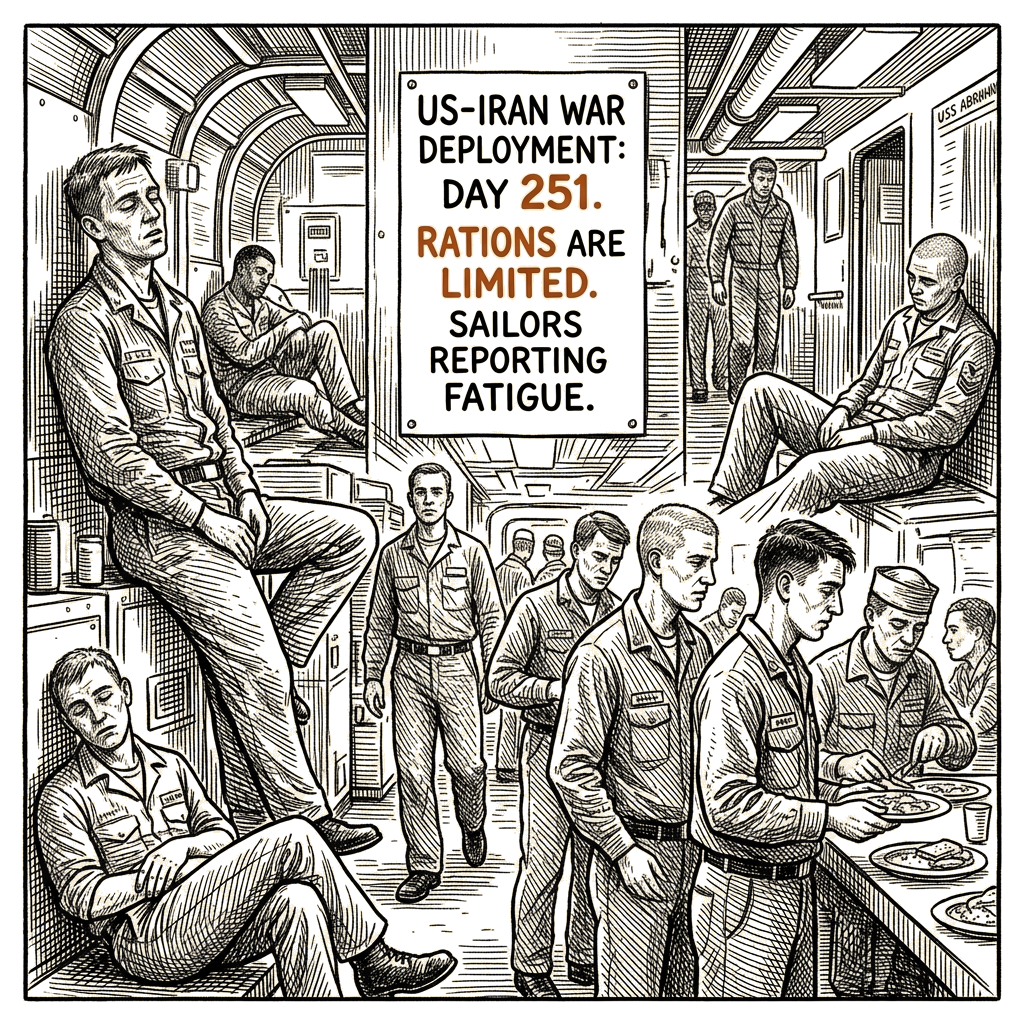
Admiral says Lincoln has among the lowest mental-health case counts
The BBC’s Monday report adds detail to accounts published by the Military Times and Stars & Stripes describing deteriorating conditions aboard the Lincoln, including food shortages, broken plumbing, and exhaustion. Family members interviewed by the BBC and other outlets said some sailors had lost substantial weight; one relative told the BBC their family member had lost 65 pounds (29 kilograms) and was suffering from exhaustion caused by the constant noise and vibrations aboard the ship.
Concerns about mental health have also surfaced. Family members told the BBC they fear conditions on the carrier are degrading sailors’ psychological state, with some sailors reportedly attempting to jump overboard. The reports have circulated as the Lincoln’s deployment, which began 11 December, passed the eight-month mark — more than double the 111 days served aboard the USS Vinson by Jonny Burnell, a Navy photographer who spoke to the BBC.
Military officials have disputed the severity of the accounts. Admiral Brad Cooper, the head of US Central Command, which oversees operations in the Middle East, said in a statement Sunday that of the Navy’s 11 active aircraft carriers, “the Lincoln currently has among the lowest number of cases related to mental health.” Cooper noted that “service at sea for long periods isn’t for everyone,” is “uniquely challenging and tough,” and that “mental health is another aspect of individual health and requires our attention just like physical health and spiritual health.”
President Trump dismissed the conditions reports on Friday, saying the deployment is “not nearly long enough.” Retired Navy Lt. Commander Steve Rogers, director of the Association of the United States Navy (AUSN), a non-profit that works with Navy servicemembers, called the media reports “99% hype” and “absolutely outrageous,” blaming the press for harm to morale.
Rogers argued that talk of sailors debating whether to jump overboard is overblown, recalling his own shipboard experience. “I remember one guy said, ‘I wish I could parachute outta here,’” Rogers said, dismissing it as “locker room talk.” The AUSN says families routinely worry about deployed relatives and that the troops are well-prepared for the situation, with access to chaplains and mental-health counselors.
CNN visited the carrier on 7 July and did not find widespread issues during three days aboard, the outlet reported. Several sailors told CNN they had been forced to ration food and had lost weight over “many months,” but when CNN boarded, “food was plentiful.” Showers were hot, though there were indications of mould.
The USS George Washington, which is being deployed to relieve the Lincoln and is expected to arrive in the Middle East within a week, has its own documented history of mental-health crises. A spate of suicides aboard the George Washington in 2022, while it was docked in Virginia, prompted a military inspector’s investigation. The May 2023 report found the deaths were not attributable to any single cause but stemmed from “poor living conditions,” and concluded that Navy leadership had “let our standards slip — and in doing so we let our people down.”
Dr. Harold Kudler, a former head of mental health policy for the US Department of Veterans Affairs (VA), said the isolation of long deployments amplifies mental-health strain. Sailors below deck may go long stretches unable to see the sky, and the rhythm of prolonged boredom punctuated by “extreme alertness” can be destabilizing, he said. “You don’t know where the front is,” Kudler said, describing the Lincoln’s situation. “Especially in this kind of asynchronistic war that we’re seeing.”
Years of research by the VA has determined that troops and veterans are at a 50% higher risk of suicide than the general American population, according to Kudler. He supports a call by Democrats in Congress to investigate conditions on the Lincoln. “The ship can only perform as well as its crew,” he said. “Those 5,000 people comprise a community. Not just men and women under stress. It’s a community under stress.”
Burnell, the former USS Vinson photographer, said watching the Lincoln coverage has left him “on the brink of tears.” He described his own ship as a “floating prison” in which he slept in “coffin racks” so narrow he could not turn over, with the cables that catch landing aircraft running through the wall behind his head. “It was just non-stop noise. The ship is just always loud,” he said.