Fifteen states still permit corporal punishment as federal release lags
About eight years ago, when Tessa Davis’ son was in kindergarten, his school outside Little Rock, Ark., told her he had grabbed a girl’s jacket in the cafeteria and twisted it. The school offered her two options, she said: a three-day suspension or a paddling by an administrator. Davis said she could not afford to miss work to stay home with him.
“I was kind of at, just like my breaking point,” she said. “Well, I was paddled, so give him the paddling,” she recalled her husband saying. “And I just remember feeling like instant regret.”
Afterward, Davis said, her son was scared to go back to school. “Especially in that building, he was always more tense, more aware and afraid,” she said. “One time he told me that he didn’t want to go to school there anymore because he was afraid that he was gonna get hurt.”
The family’s experience reflects a practice that remains legal across much of the country. The United States has no federal law banning corporal punishment in public schools. The American Academy of Child and Adolescent Psychiatry defines it as “anything done to cause pain or discomfort,” and in schools it usually means a paddling. States and local districts decide whether it can be used, and many require parental consent.
Federal data and state-level landscape
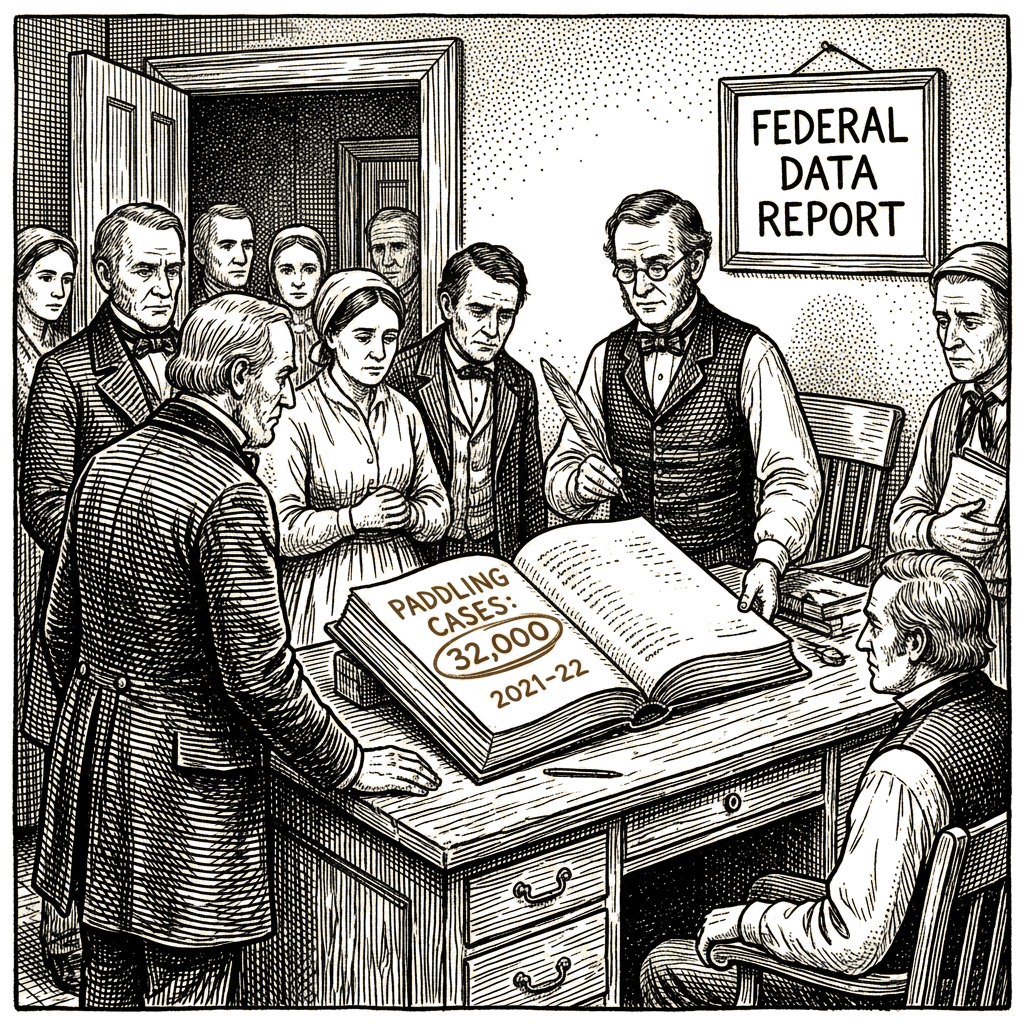
The most recent data from the U.S. Department of Education’s Civil Rights Data Collection, covering the 2021-22 school year, recorded almost 32,000 instances of corporal punishment on K-12 students, or about one reported incident per 2,000 students. An NPR analysis found 15 states allow schools to employ the practice, though it may be banned locally. Thirty states plus Washington, D.C., have passed laws explicitly banning it, and the remaining states have no explicit ban, with some having other laws interpreted as bans. Almost all reported instances happened in eight states, primarily in the South. Arkansas, where Davis lives, has some of the highest rates in the country, second only to Mississippi.
In some Southern communities, the practice is rooted in faith-based beliefs and community norms, said Morgan Craven, a policy expert with the Intercultural Development Research Association, which promotes equal educational opportunities. “There is this belief that corporal punishment … is not harmful at all, but is actually part of the expectation that some communities have for raising children,” she said. “There are also many communities in the South,” she added, “who are pushing back against physical violence as a way to discipline children and really want to challenge those understandings.”
Davis, who said she and her husband both grew up in households that used corporal punishment, now advocates publicly against its use in schools. She said the family no longer uses it at home or permits it at school. “I still want him to be held accountable, but also in a way that’s safe for him and for everybody else,” she said. Her son, now 13, loves to dance — “everything from musical theater and jazz to hip hop,” she said — and still sometimes struggles with his emotions, though he now accepts consequences that no longer include paddling.
Joan Durrant, a child developmental psychologist in Manitoba, Canada, who has spent her career studying the practice, said it teaches children to lie and avoid punishment rather than change their behavior. “It really fuels dishonesty,” she said. “You learn how to lie. You learn to avoid punishment.” She and other researchers have connected the practice to increased aggression, anxiety, depression and addiction. The American Psychological Association has warned that corporal punishment “may create in the child the impression that he or she is an ‘undesirable person,’” an impression that lowers self-esteem and may have chronic consequences.
Federal data shows the practice falls unevenly across student groups. An Education Department analysis of 2017-18 data found boys were more likely than girls to receive corporal punishment, and a federal analysis of 2020-21 data found white, Black and Native American or Alaska Native boys all experienced it at disproportionately high rates relative to enrollment. A 2021 study in the journal Social Problems found that in counties with more lynchings, students were more likely to experience corporal punishment, with lynching history “particularly predictive” of the practice for Black students.
Practitioners’ views
Oklahoma psychologist Randy Randleman, a former state representative who said he has worked in more than 150 small schools, argues the practice has value as a deterrent. “I go out here every day and I see there’s a small group of kids that, if they knew they would get a paddling – oh, [the misbehavior is] done,” he said. “So why would you give that up?” He said he considers corporal punishment a last resort and does not want the option legislated away.
District leaders in states that allow the practice describe it as a deterrent and favor leaving the decision to local districts. David Vinson, superintendent of Oklahoma’s Warner Public Schools, which serves about 860 students, said the district has allowed corporal punishment for the 14 years he has led it and called it “a great deterrent to a lot of kids.” Elementary Principal Alan Gordon keeps two paddles in his office, named Peace and Harmony, and said students receive a paddling only after repeated office visits and lunch detention for the same infraction. “I think that the responsible use of discipline can change kids’ lives,” Gordon said.
The federal data itself lags: the Civil Rights Data Collection traditionally publishes every two years, but the release for 2023-24 is more than six months late, and not all districts report incidents, so the count likely understates how often the practice occurs. “The spankings never made the behavior stop, ever,” Davis said. “In fact, it made it worse.”