Hürtgen Forest fire forced evacuation of nearly 2,000 people
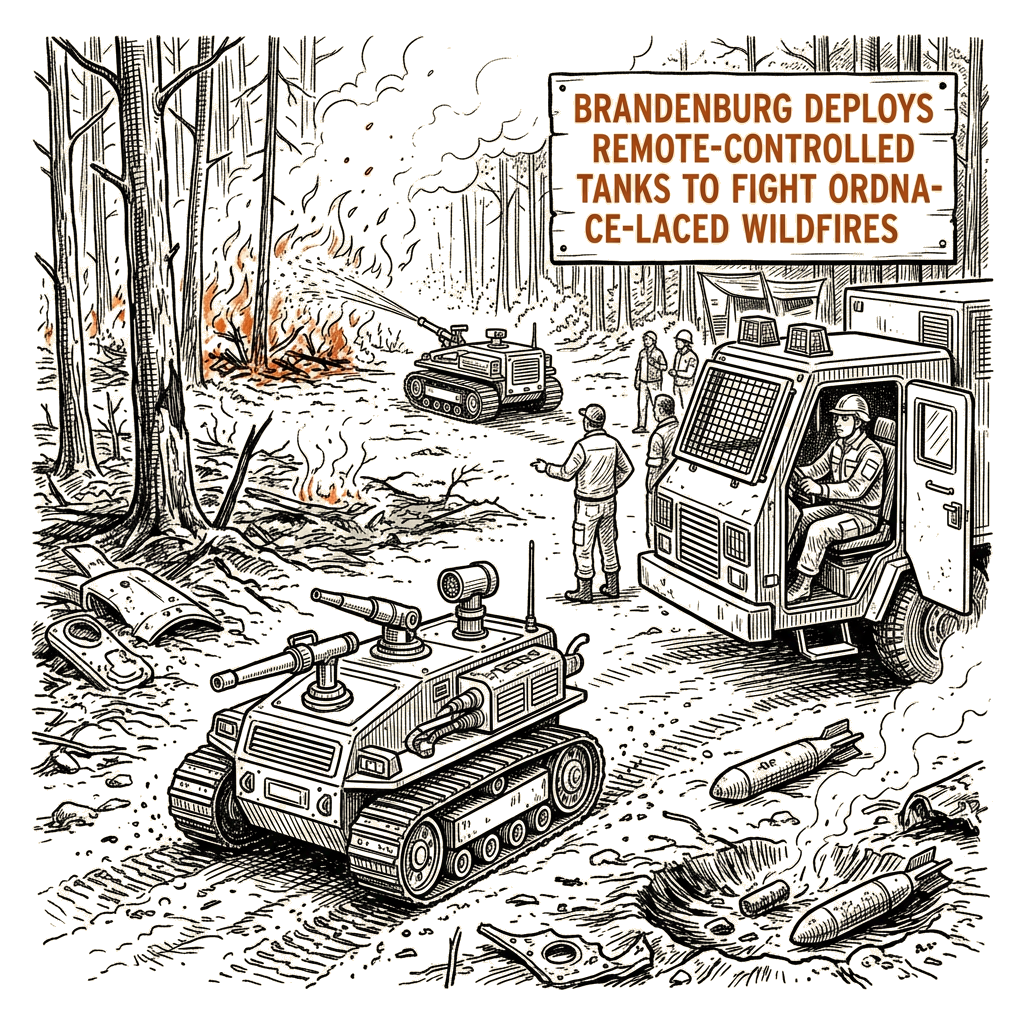
The state of Brandenburg last year purchased two unmanned tracked vehicles, one with a grabbing arm and a fire hose that can shoot water or foam 180 feet and another that scrapes vegetation from the ground, along with an armored vehicle in which operators sit at a distance. The roughly $3.5 million system was put to work in late July and early August at a forest fire near a former military training area outside the town of Jüterbog, said Norman Barth, a wildfire expert working for Brandenburg’s government.
The deployment comes as Europe endures a scorching summer that has shrunk rivers, parched crops and tested the continent’s infrastructure, with explosive wildfires now another entry in the region’s fast-lengthening catalog of weather-related disruption. A fire in the Hürtgen Forest in western Germany consumed only a few hundred acres but forced the evacuation of nearly 2,000 people from a nearby village. Extinguishing it required almost as many firefighters and other emergency personnel, as well as 10 helicopters. Unexploded ordnance, some of which detonated during the days-long effort, made it harder for firefighters to get close to the blaze.
The Hürtgen Forest is littered with ammunition from a World War II battle in which the invading U.S. First Army suffered more than 30,000 casualties. In Brandenburg, a heavily forested state where large areas served as military training grounds in the former East Germany, nearly 20 percent of the land is suspected to harbor old munitions.
The remote-controlled system is designed to let firefighters reach areas that haven’t been checked by bomb-disposal teams so they can cut firebreaks and douse strategic patches of land to protect key areas.
Lindon Pronto, a Californian firefighter turned wildfire adviser who helped conceive Brandenburg’s setup, said the growing risk from unexploded ordnance is one example of how fiercer blazes are straining firefighting practices in many parts of the world. “It’s changing everywhere,” he said. “The intensity is catching people off guard.” Pronto said he envisions unmanned tanks aiding firefighters in other former battlegrounds such as Syria and, eventually, Ukraine.
Other companies are pursuing technology along similar lines. Drone Amplified, a startup, has developed unmanned aerial vehicles that drop balls containing fire-starting chemicals to ignite controlled burns. South San Francisco-based Burnbot has built tracked machines with arrays of torches for the same purpose.
Rheinmetall, which has been making ammunition since before World War I, recently acquired a majority stake in DOK-ING, the company behind Brandenburg’s remote-controlled vehicles, whose slogan is “Don’t send a man to do a machine’s job.”
Johann Goldammer, head of the Global Fire Monitoring Center, a research and advisory group in Germany, said extended hot, dry spells and the deterioration of old ammunition are making explosions more likely. He said the cyclical freezing and thawing of soil also brings old shells to the surface, much as flower beds can seem to produce fresh stones every winter.
Barth said two longer-term measures would help: replacing flammable pine forests with mixed woodlands, and accelerating the process of detecting and removing old munitions. “Maybe we will be ready in 100 years,” Barth said.