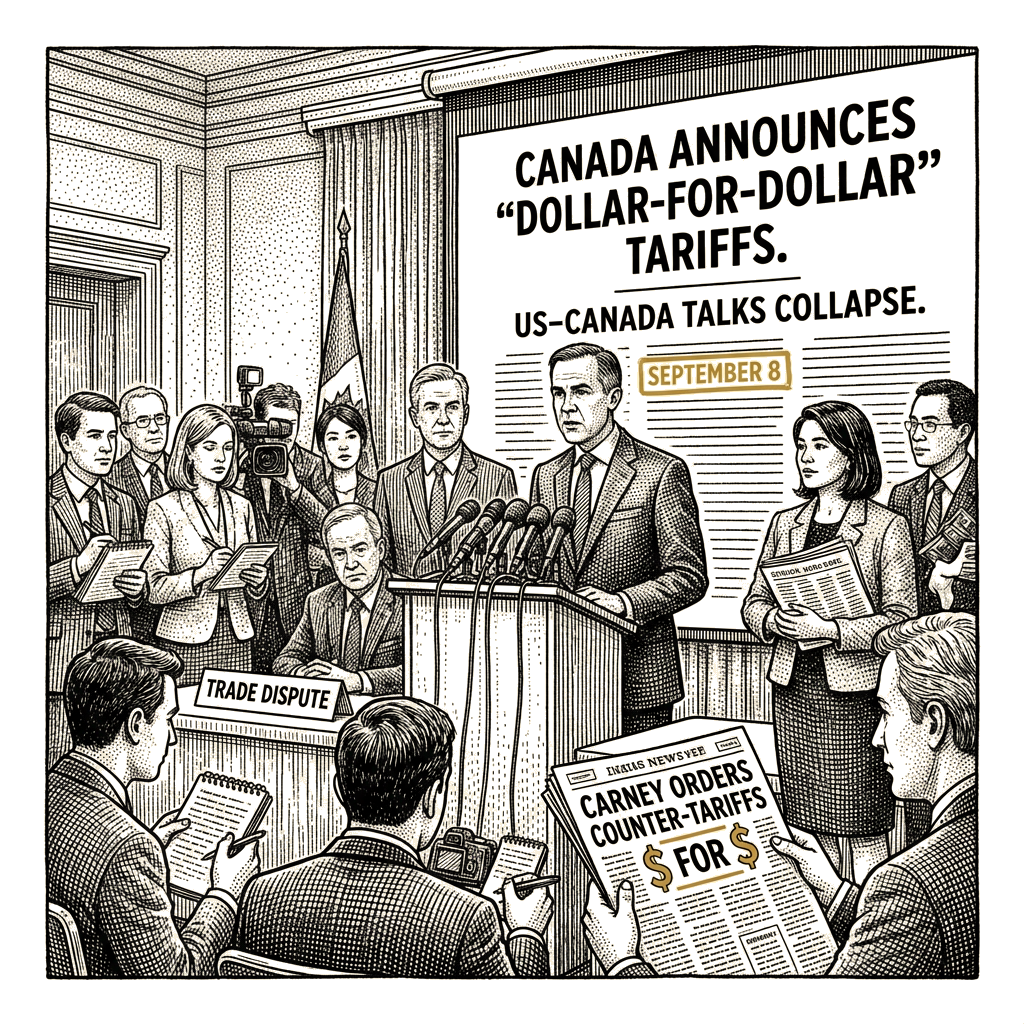
Each government blamed new terms and reversals for the breakdown
Carney’s announcement came in a Saturday morning address to Canadians — his first since announcing late Friday night that no deal would be reached. He said Canada was retaliating “reluctantly” to protect its interests and that details of the countermeasures would be released in the coming days. President Donald Trump had not commented publicly as of the time of Carney’s address.
The breakdown followed a week in which both governments had expressed optimism about reaching an agreement. Carney said the late US-proposed terms “were unfair, uneconomic, and called into question the reliability of any deal.” Greer pointed to “new demands and walk backs of other commitments by Canada.”
In a Friday statement, the Distilled Spirits Council of the United States suggested that “Canadian provinces’ continued refusal to return US spirits products to store shelves has led to this outcome.” Both Ontario and Quebec had yet to say whether they supported reversing the US alcohol boycott. Canadian media reported that US Commerce Secretary Howard Lutnick was unhappy with the prospective deal.
Canadian political reaction was largely supportive of Carney’s decision. Conservative opposition leader Pierre Poilievre, who had previously warned that any agreement containing “one-sided” tariffs on Canadian industry would be “a bad deal,” said Saturday: “Canada cannot accept one-sided tariffs that will deindustrialise our country.” Ontario Premier Doug Ford, who had been silent on the tentative deal during the week, sent Carney a letter raising concerns that an agreement under US pressure would “embolden the United States to seek concession after concession.” After the breakdown, Ford said “the prime minister has my full support for a strong response - tariff for tariff, dollar for dollar.”
The new US tariffs include a 50 percent levy on a range of Canadian goods, in addition to existing US tariffs on Canadian steel, aluminum, automobiles, and lumber. Canada sends about 70 percent of its exports to the United States, and several US states — including Michigan, Kentucky, Indiana, and Ohio — count Canada as their top trading partner.
Carney came to power with a call for “elbows up” — an ice-hockey term for an aggressive approach — vowing to fight for Canada in the face of US tariff measures. Recent polling suggests Canadians back that posture: an Abacus Data survey found about 36 percent of Canadians would support retaliating against US tariffs, while a Leger poll indicated 56 percent want the federal government to take a hard line and make no more concessions.
Canadian consumers have already been applying economic pressure of their own. A travel boycott has cost the United States about C$3.3bn ($2.35bn; £1.75bn) in travel revenue over the past year, and most provinces’ removal of US alcohol from store shelves has hit that sector hard. US wine exports to Canada fell 78 percent year over year — a $357m loss — according to US government trade data. The US distillers association reported American spirits exports dropped by more than 70 percent because of provincial bans.
Carney was scheduled to meet with provincial premiers on Saturday to brief them on the state of affairs.