Lawmakers could revisit testimony if Democrats win November elections
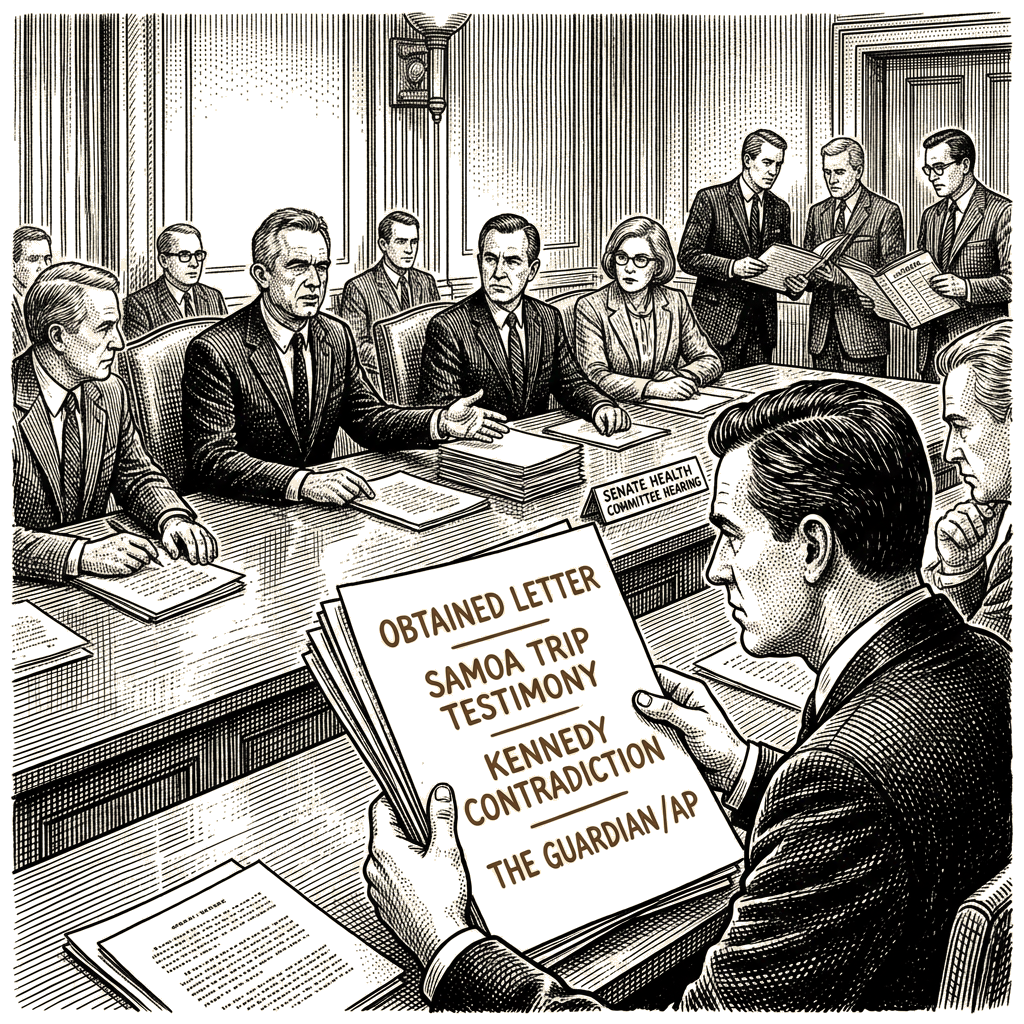
The January 20, 2019 letter, obtained jointly by The Guardian and the Associated Press, was written on Children’s Health Defense letterhead and addressed to Malielegaoi, then Samoa’s prime minister. In it, Kennedy said he was writing “in the hope that we might be helpful to the people of your great nation” and proposed that his team “conduct detailed health informatics assessment in Samoa of what happened with your MMR vaccines.” Kennedy speculated that the deaths of two children in Samoa after MMR vaccination may have resulted from manufacturing issues with different vaccine lots.
The prime minister responded a month later, writing: “It is certainly beneficial for Samoa to have the benefit of your Team’s independent health assessment of our MMR Vaccines and I would welcome with much anticipation your Team’s proposed visit to our islands.” A separate email from Kennedy’s CHD colleague, Dr. Michael Graven, to Samoan officials in May 2019 described the team’s trip as a “vaccine-related mission.”
Kennedy traveled to Samoa with his wife, actor Cheryl Hines, and Graven in May and June 2019, meeting with anti-vaccine activists while there, the Guardian and AP previously reported.
The new documents complicate Kennedy’s account of the trip during his Senate confirmation hearings. Under repeated questioning, Kennedy told lawmakers that vaccines were not the purpose of his visit. Asked by Democratic Sen. Ron Wyden of Oregon, Kennedy said: “I went there, nothing to do with vaccines. I went there to introduce a medical informatics system that would digitalize records in Samoa and make health delivery much more efficient.” The following day, when Democratic Sen. Edward Markey of Massachusetts asked about it, Kennedy said: “My purpose in going down there had nothing to do with vaccines.” Upon further questioning, Kennedy again denied the trip had anything to do with vaccines before adding: “My purpose in the trip was not to – I ended up having conversations with people, some of whom I never intended to meet.”
Kennedy also said during hearings that he had never given “any public statement about vaccines” in Samoa and that “you cannot find a single Samoan who will say I didn’t get a vaccine because of Bobby Kennedy.”
The Senate confirmed Kennedy on a 52-48 vote.
The Samoa trip has long drawn scrutiny. At the time, Kennedy was chair and chief legal counsel of Children’s Health Defense, a nonprofit known for its anti-vaccine activism. The group turned its attention to Samoa in July 2018, after two young children died following administration of an improperly mixed MMR vaccine; the two nurses involved were criminally charged the following month and ultimately pleaded guilty to manslaughter. The Samoan government halted all vaccinations for 10 months, until April 2019, and vaccination rates plummeted during that period.
By the time Kennedy arrived in Samoa, vaccinations had resumed and the country’s top health official had publicly announced that human error, not a vaccine issue, was responsible for the children’s deaths. Months later, with vaccination rates still dangerously low, measles broke out, sickening thousands; 83 people died, mostly children under five. Public health experts have said efforts to contain the outbreak were hampered by anti-vaccine activists, some of whom they said were emboldened by Kennedy’s visit.
In a 2021 blog post on the CHD website, Kennedy said he went to Samoa to attend an Independence Day celebration and to discuss “the introduction of a medical informatics system” to track drug safety, and that Samoan officials “were curious to measure health outcomes following the ‘natural experiment’ created by the national respite from vaccines.”
The newly obtained letter raises questions about how truthful Kennedy was in testimony before Congress. During his confirmation process, Kennedy also pledged to maintain vaccine policies that, once in office, he moved to change. The Guardian and AP previously reported that State Department and Unicef officials privately discussed that Kennedy’s trip was about vaccines; Democratic lawmakers including Wyden and Markey have said Kennedy lied or misled the Senate.
A spokesperson for the Department of Health and Human Services said in a statement: “Secretary Kennedy’s visit to Samoa in 2019 was unrelated to vaccines. Any claim or insinuation based on these letters that Secretary Kennedy lied under oath or to Congress is not only false but outright defamatory.” Kennedy was not under oath during his two confirmation hearings. The Guardian said it asked HHS to explain the contradiction between Kennedy’s claim that the trip had nothing to do with vaccines and his letter to the Samoan prime minister; HHS did not provide a response to that question. The White House did not respond to a request for comment.
Knowingly giving material false testimony to Congress is a federal crime that carries a possible prison sentence, though it is rarely prosecuted. Attorneys with expertise in Senate procedure told the Guardian that if Democrats win control of the House or Senate in November’s elections, they could use Kennedy’s statements as grounds for hearings, an impeachment inquiry or other obstacles for the Trump administration. The federal statute of limitations for lying to Congress is five years, meaning a Justice Department under the next president in 2029 could theoretically investigate the case.
Kennedy, who has a law license, has indicated he is open to pursuing criminal charges against congressional witnesses himself: He suggested last month that former health official Dr. Anthony Fauci could face perjury charges when called before a Senate committee to testify about Covid-19.